20 September، 2026
Scientific Research Published in a Q1 Scopus-Indexed Journal
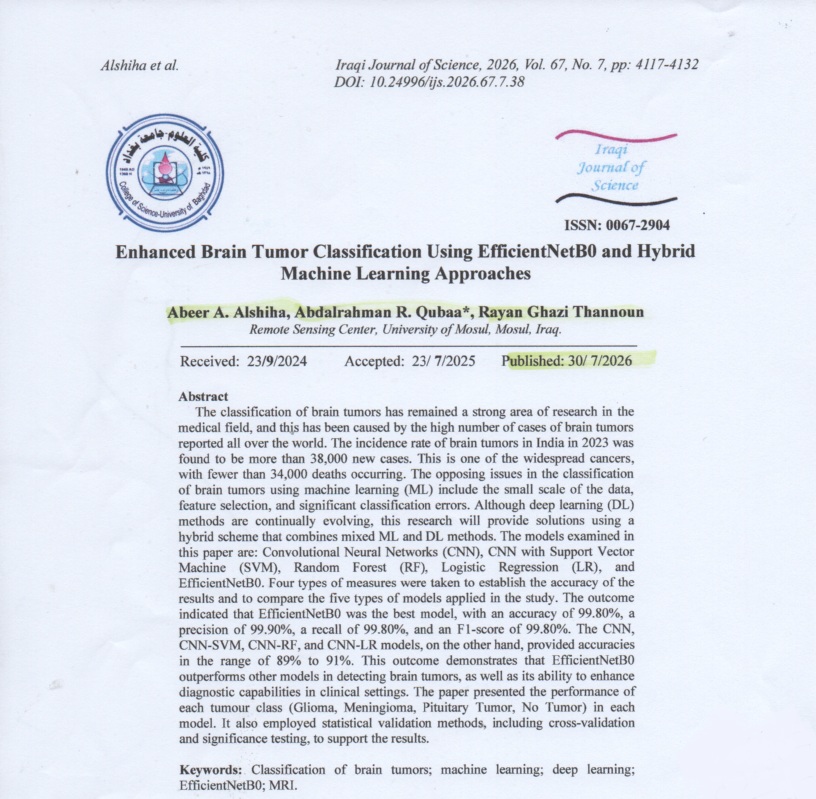
As part of the ongoing scientific and research activities of the Remote Sensing Center at the University of Mosul, a research paper entitled “Enhanced Brain Tumor Classification Using EfficientNetB0 and Hybrid Machine Learning Approaches” has been published by Assistant Professor Dr. Abeer Adel Mohammed, Assistant Professor Dr. Abdul-Rahman Ramzi Qabaa, and Professor Dr. Rayan Ghazi Thanoon in the Iraqi Journal of Science, which is classified in the first quartile (Q1) in the Scopus database.
The research addressed the detection and classification of brain tumors, which represent a significant health challenge. The study examined key challenges associated with brain tumor classification using Machine Learning (ML), including limited dataset size, feature selection, and relatively high classification errors.
The research proposed a hybrid framework combining machine learning and deep learning techniques for tumor detection. The study employed several models, including Convolutional Neural Networks (CNNs), CNN combined with Support Vector Machine (SVM), Random Forest (RF), Logistic Regression (LR), and EfficientNetB0. Four evaluation metrics were used to assess the accuracy of the results, along with a comparative analysis of the five models implemented in the study.
The results indicated that the EfficientNetB0 model achieved the best performance among the evaluated models in brain tumor detection, demonstrating its potential to enhance diagnostic capabilities in clinical settings. The study also presented the performance of each model across the different tumor categories, namely glioma, meningioma, pituitary tumor, and no tumor.
The research aligns with the United Nations Sustainable Development Goals (SDGs), particularly SDG 3: Good Health and Well-Being, which seeks to ensure healthy lives and promote well-being for all through improved access to healthcare services, and SDG 4: Quality Education, by supporting equitable learning opportunities and developing skills aligned with future requirements.