3 June، 2025
Master’s Thesis at College of Engineering on Evaluating the Performance of Badoosh Dam Under Various Scenarios of Mosul Dam Reservoir Conditions
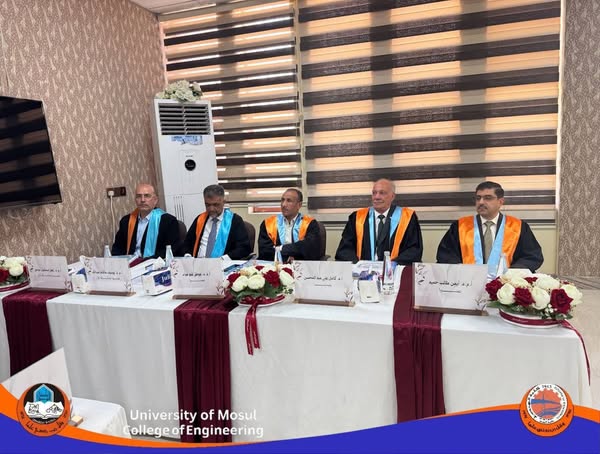
On Tuesday, June 3, 2025, Department of Dams and Water Resources Engineering at College of Engineering, University of Mosul, held a Master’s thesis defense titled “Evaluating the Performance of Badoosh Dam Under Various Scenarios of Mosul Dam Reservoir Conditions.” The thesis was presented by Sura Hussein Abdulmajid Al-Qahwaji.
The session was attended by Assistant Professor Dr. Omar Muqdad Abdulghani, Head of Department of Dams and Water Resources Engineering, along with several faculty members from the department.
The study examined the performance of Badush Dam when operated as both a storage and protective dam, addressing both hydrological and geotechnical aspects. A simulation model of the Mosul Dam reservoir was developed using the GoldSim platform, and the results showed excellent agreement with actual reservoir operations.
Based on the verification results, the simulation model was expanded to represent a multi-reservoir system involving both Mosul and Badoosh Dams in sequence. This allowed the assessment of Badoosh Dam’s effectiveness as a storage dam. The findings indicated that Badoosh Dam could store a substantial volume of water, which could be used during dry seasons to meet regional water demands, as well as to generate hydropower—maintaining full storage throughout the year and supporting downstream water projects still under study.
In the next phase, the multi-reservoir model was subjected to five scenarios simulating varying levels of inflow reduction. The results indicated a significant impact on both Mosul and Badoosh reservoirs.
Another model was developed to simulate the operation of Badoosh Dam as a flood protection dam in the event of a hypothetical failure of Mosul Dam. The dam was tested against eight hypothetical flood waves derived from a previous study. The results showed that Badoosh Dam could withstand six out of the eight waves, highlighting the urgent need for constructing an emergency spillway to prevent overtopping and potential failure of the dam.
The study also included a stability analysis of Badoosh Dam’s slopes under water loads derived from the hydrological model. The results indicated that the slopes remain stable at the maximum design elevation when the dam functions as a storage dam. However, they become critical at the maximum storage capacity of 10 billion cubic meters, particularly at the downstream slope. In scenarios of rapid drawdown over eight days, the safety factors in the initial hours were 1.07 for the abutment section and 1.17 for the river section—both falling below standard safety thresholds.