27 August، 2025
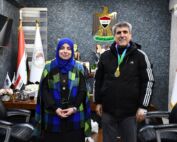
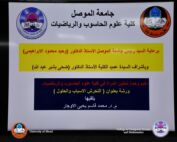
Ph.D. Dissertation by Student Firas Mahmood Saeed Thanoon
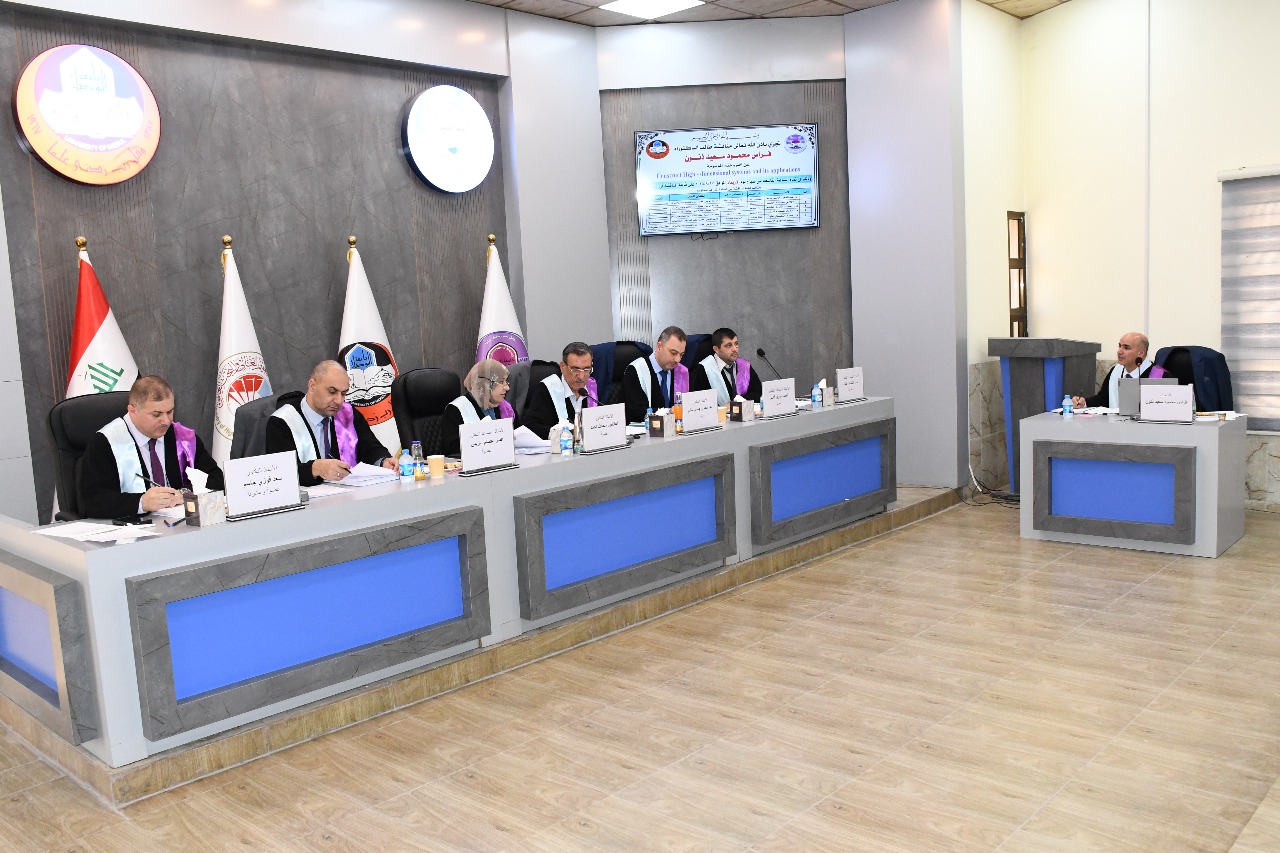
Discussion of Ph.D. Dissertation in the College of Computer Science and Mathematics – Department of Mathematics Sciences entitled:
“ Construct High-dimensional systems and its applications”
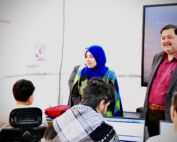
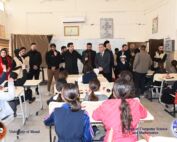
It was discussed in the discussion room at the Faculty of Computer Science and Mathematics at the University of Mosul on Thursday, 27 -8-2025.
Ph.D. Dissertation by Student Firas Mahmood Saeed Thanoon
under the supervision of Prof. Dr. Saad Fawzi Jasim
Obtaining high-dimensional dynamical systems with the fewest possible terms to generate chaos is a difficult challenge. This is due to several reasons, including the lack of unconstrained solutions, the failure to satisfy the (n-2) property of positive Lyapunov exponents, and the inability to utilize them in some applications such as electronic circuits and cryptography.
In this work, high-dimensional dynamical systems, including a 6D and a 7D system, are presented, with different case studies for each. The first 6D system was obtained using a coupling strategy, followed by a state feedback strategy. This system is characterized by having two states that guarantee the production of hyperchaotic behavior for the proposed system and obtaining positive Lyapunov exponents (n-2). In the first state, the system belongs to the class of self-excited attractors. The second state is classified as a type of hidden attractor; a high-dimensional 7D system was obtained using a state-feedback strategy only. This system is characterized by having two states that guarantee the production of hyperchaotic behavior for the proposed system and obtaining positive Lyapunov exponents (n-2). The two states are equilibrium points for unstable, non-hyperbolic saddle foci. It belongs to the class of self-excited attractors. The properties of these systems were analyzed in terms of the number of Lyapunov exponents, Lyapunov dimension, stability, equilibrium points, the Jacobian matrix and its effect, and the sensitivity of these systems to initial values.
The practical aspect of this study involved simulating systems in various states as electronic circuits using Multisim 14.2, followed by obtaining trajectories using a universal oscilloscope and a Tektronix oscilloscope. The experimental results demonstrated that the trajectories matched those obtained through simulations using MATLAB 2023b, confirming the efficiency and effectiveness of the proposed systems.
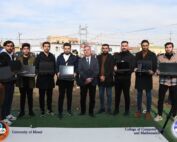
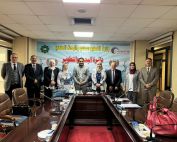
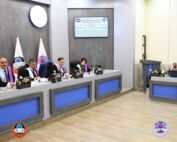
The scientific committee included the following members:
- Dr. Abdulghafoor Jasim Salim – Chairman.
- Dr. Ekhlass Saadallah Ahmed – Member.
- Prof. Dr. Ahmed Farooq Qasim- Member.
- Prof. Dr. Ammar Isam Edress – Member.
- Prof. Dr. Ahmed Entesar Ghitheeth- Member.
- Dr. Saad Fawzi Jasim- Member and supervisor.