23 August، 2026
Master’s Thesis at the College of Basic Education on Al-Bidaya wa al-Nihaya by Ibn Kathir as a Source for Studying Mongol History
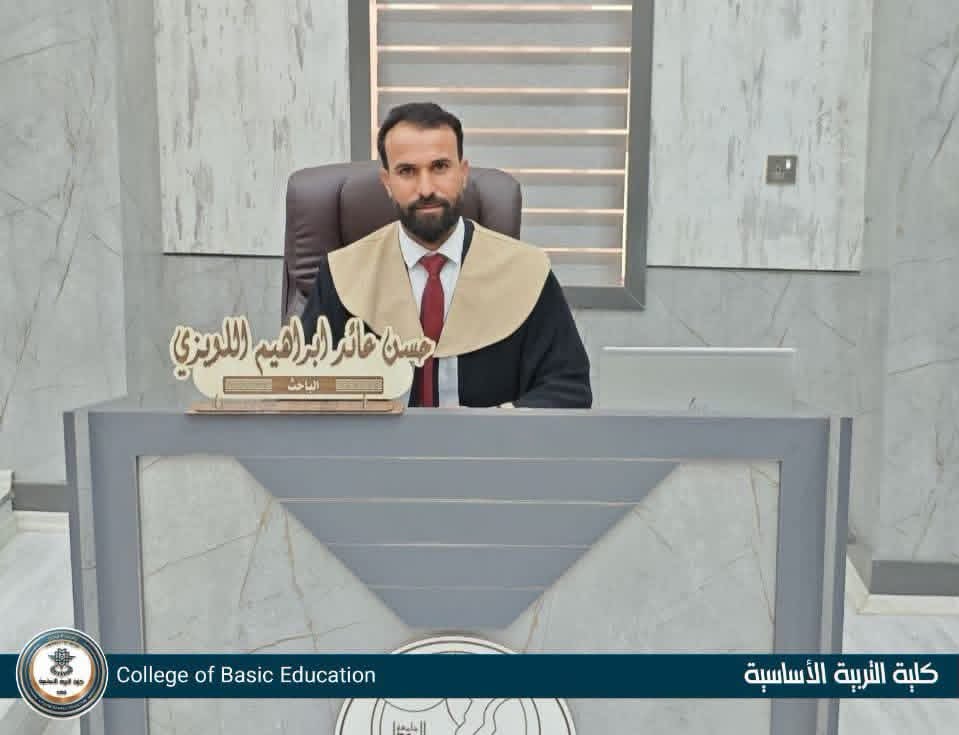
A Master’s thesis entitled “The Book Al-Bidaya wa al-Nihaya by Ibn Kathir (d. 774 AH/1373 CE) as a Source for Studying Mongol History” was discussed at the College of Basic Education, University of Mosul, on Thursday, August 13, 2026, in the Al-Hadbaa Hall at the College.
The thesis, submitted by Hassan Aaed Ibrahim Al-Luwaizi, aimed to examine the historical accounts of the historian and Qur’anic exegete Ibn Kathir concerning the Mongols in his book Al-Bidaya wa al-Nihaya. It explored his methodology in presenting and analyzing historical events, identified his historical sources, and assessed the scholarly value of his accounts for studying Mongol history and their relations with the Islamic world.
The study also addressed the major political and military events accompanying the emergence and expansion of the Mongols, as well as the political, civilizational, social, economic, and administrative consequences of their invasions in the Islamic regions.
The significance of the study lies in the fact that Al-Bidaya wa al-Nihaya represents an extensive historical encyclopedia containing rich material on Mongol history. Its value extends beyond documenting political and military events to revealing the civilizational, cultural, and social dimensions associated with the Mongol invasion, particularly the fall of Baghdad in 656 AH/1258 CE and the profound transformations that followed in the Islamic world.
The study concluded that Al-Bidaya wa al-Nihaya possesses significant scholarly value as a fundamental source for studying Mongol history, owing to its rich and diverse historical material on the period of Mongol rule and its comprehensive treatment of the political, military, and civilizational consequences of the Mongol invasion.
The study also demonstrated that Ibn Kathir was not merely a transmitter of historical events; rather, he possessed a clear critical perspective on the Mongol invasion and its practices and sought to explain the causes of political transformations and the factors contributing to the weakness of the Islamic world.
Furthermore, the study revealed the diversity of Ibn Kathir’s sources, including written and documented sources as well as oral accounts, and his reliance on comparing different narratives. It also noted that some accounts require further verification and critical assessment, underscoring the importance of approaching the book as a significant historical source that requires critical and analytical study.
The discussion committee consisted of:
- Prof. Dr. Raed Amir Abdullah Al-Rashed — Chair
- Prof. Dr. Fayez Ali Bakhit — Member
- Asst. Prof. Dr. Ahmed Khalaf Afandi — Member
- Asst. Prof. Dr. Mohammed Maysar Mohammed Baha Al-Din — Member and Supervisor
Media and Government Communication Division
 Master’s Thesis at the College of Basic Education on “The Rationale Behind Naming in Al-Maghrib fi Tartib al-Mu‘arrib by Al-Mutarrizi (d. 610 AH): A Study and Lexicon”
 Master’s Thesis at the College of Basic Education on “Transformations in Gulf Fiction in the Context of Sustainable Development”