12 August، 2026
A Legal Awareness Article: The Legal Protection of Workers from the Hazards of Working Under Direct Sunlight
Dr. Ahmed Fares Idris
University of Mosul – College of Law
Introduction:
The right to safe and healthy work is one of the fundamental rights guaranteed by national legislations and international conventions. The worker’s right is not limited to receiving wages, but extends to include the provision of a work environment that preserves their dignity and protects their health and safety. With the significant rise in temperatures during the summer season, employing workers under direct sunlight, especially during peak hours, has become one of the most prominent occupational hazards that may expose them to heat stress, sunstroke, and serious health injuries.
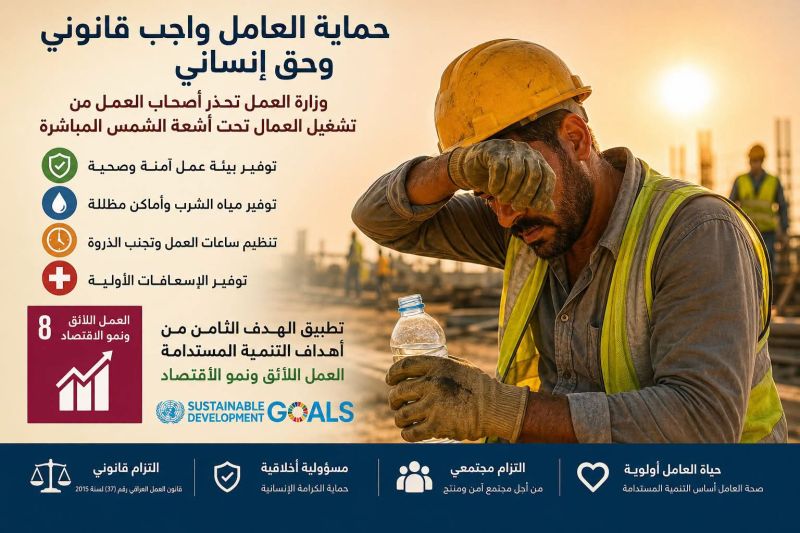
Hence, the warning issued by the Ministry of Labor and Social Affairs to employers against employing workers during peak hours constitutes an application of the principle of prevention and occupational safety protection, and is not merely an administrative directive.
First: The Position of the International Labour Organization (ILO):
The International Labour Organization (ILO) affirms that occupational safety and health constitute a fundamental human right at work, and that it is the duty of employers to take all necessary measures to protect workers from occupational hazards, including those arising from extreme weather conditions.
The Organization has also emphasized, within the framework of international conventions on occupational safety and health, the necessity of:
-
Continuously assessing workplace hazards.
-
Adjusting working hours to suit climatic conditions.
-
Providing shaded areas for rest breaks.
-
Providing drinking water and first aid facilities.
-
Training workers on the prevention of heat stress and sunstroke.
-
The International Labour Conference adopted in 2022 occupational safety and health as a fundamental right and principle of work, which reinforces the commitment of states and employers to provide a safe working environment for all workers.
Second: The Position of Human Rights Organizations:
Human rights organizations view safe working conditions as an integral part of the right to life, the right to health, and the right to human dignity. Article (7) of the International Covenant on Economic, Social and Cultural Rights stipulates the right of every person to enjoy just and favorable conditions of work that ensure occupational safety and health.
International human rights principles also affirm that exposing a worker to avoidable risks constitutes a violation of the obligations of states and employers to protect individuals while performing their work.
Third: The Position of the Iraqi Labor Law:
The Iraqi Labor Law No. (37) of 2015 is consistent with international standards, as it obligated employers to provide occupational safety and health conditions and to take all necessary precautions to protect workers from work-related hazards.
The employer is legally obliged to:
-
Provide a safe and healthy work environment.
-
Prevent workers from being exposed to hazards that threaten their lives or health.
-
Provide personal protective equipment.
-
Comply with occupational safety instructions issued by the competent authorities.
-
Take necessary measures when temperatures rise to prevent workers from being exposed to danger.
Fourth: Liabilities Arising for the Employer in Case of Violation of Legal Obligations:
In the event of a violation of legal obligations, the employer may incur multiple liabilities, including:
-
Administrative liability for violating the instructions of the Ministry of Labor.
-
Civil liability for compensating the worker for damages sustained.
-
Criminal liability if negligence results in serious injury or death of the worker, in accordance with the provisions of the law.
Fifth: Moral and Humanitarian Responsibility:
The protection of workers is not merely a legal obligation, but also a moral and humanitarian responsibility, because the worker represents the fundamental pillar of production and economic development. Work that threatens human life is inconsistent with the principles of social justice and with the concept of decent work advocated by the International Labour Organization. Respect for human beings begins with respect for their health and safety while performing their work.
Conclusion:
The warnings issued by the Ministry of Labor regarding the prohibition of employing workers under direct sunlight during peak hours represent a practical application of the principles of national law and international human rights and labor standards.
Therefore, protecting workers from the hazards of high temperatures is not an option for employers, but rather a legal and moral duty aimed at safeguarding the right to life, health, and human dignity. Adherence to these measures contributes to building a safe work environment, reinforces a culture of respect for law and human rights, and achieves sustainable development based on protecting human beings before achieving production.
Sources:
-
The Iraqi Constitution of 2005.
-
Iraqi Labor Law No. (37) of 2015.
-
Iraqi Workers’ Retirement and Social Security Law No. (18) of 2023.
-
The International Covenant on Economic, Social and Cultural Rights of 1966, particularly Article (7).
-
ILO Convention No. (155) of 1981 concerning Occupational Safety and Health and the Working Environment.
-
Convention No. (187) of 2006 concerning the Promotional Framework for Occupational Safety and Health.
-
The ILO Declaration of 2022 on Fundamental Principles and Rights at Work, which included occupational safety and health among the fundamental rights.
-
Declarations and instructions issued by the Iraqi Ministry of Labor and Social Affairs regarding the regulation of work in hot climatic conditions.