
14 August، 2026
An Awareness Legal Article
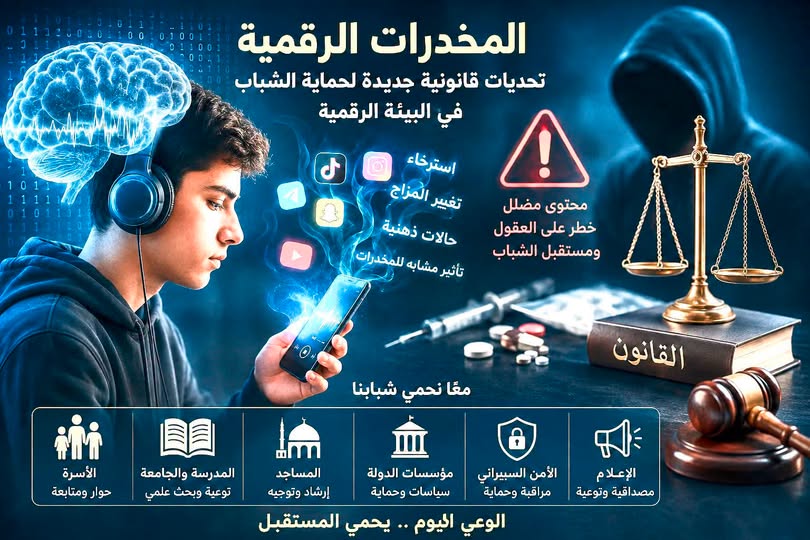
Digital Drugs: New Legal Challenges to Protect Youth in the Digital Environment
Dr. Ahmed Fares Idris
University of Mosul – College of Law
Introduction:
Drugs are no longer a danger that always comes in the form of a pill, powder, or substance hidden in pockets; technological development has given rise to new patterns of digital behaviors that have attracted researchers’ attention, among which is what is media-known as “Digital Drugs.”
This term is often used to refer to audio files, particularly binaural beats, which rely on delivering two slightly different sound frequencies to each ear via headphones, with claims that they can affect mood or consciousness. An international study examined this phenomenon and found that some users turn to them for relaxation or mood alteration, while others reported seeking an effect similar to that of certain drugs. (PubMed)
However, it is scientifically necessary not to fall into alarmism; studies regarding the ability of binaural beats to induce specific changes in brain activity remain inconclusive, and a systematic review found varying and inconsistent results across studies. (PLOS). Nevertheless, the real danger that deserves confrontation is the exploitation of the digital environment to market or normalize drug-related behaviors, especially among adolescents and youth.
First: What is Meant by Digital Drugs?
Digital drugs are not chemical drugs in the traditional sense, nor should they be scientifically equated with known drugs such as cannabis, cocaine, or opioids.
Rather, the term has become primarily associated with audio files that use techniques such as binaural beats, circulated online under various titles and claims, including relaxation, mood enhancement, increased concentration, or reaching certain mental states.
The problem arises when this content transforms from a mere auditory experience into a marketing tool that suggests to a young person that they can obtain the effect of drugs through a phone and earphones.
Second: How Do Users Engage with It?
This type of content can be accessed via the internet, applications, and digital platforms, and then listened to using headphones.
Published data on binaural beat users indicate that the motivations for use are multiple; they include relaxation, sleep, mood alteration, and the search for different mental states. (PubMed)
Here, a distinction must be made between ordinary listening to music or audio tones and content marketed as a means to achieve a drug-like effect.
Third: Why Should We Be Concerned?
The danger lies not only in the sound itself but in the digital environment surrounding it.
The internet allows content to reach large numbers of young people quickly, and harmful content can be presented in the guise of entertainment, an experiment, or a youth challenge.
Curiosity may turn into repetition, and repetition into behavioral dependence, especially when a young person uses digital means to escape anxiety, pressure, or social problems.
Moreover, the digital environment may expose young people to other more dangerous content related to drugs, which makes digital prevention part of the general prevention of substance abuse. The World Health Organization indicates that digital environments provide great opportunities but may also expose young people to harmful content and increase certain risks of excessive use and addictive behaviors, which calls for policies and interventions that promote a safe digital environment. (World Health Organization)
Fourth: How Do We Detect the Danger?
“Digital drugs” cannot be dealt with in the same way we detect chemical drugs; they are digital content, not a substance that can be identified through laboratory analysis.
Therefore, detection begins with behavior and content, through:
-
Monitoring content that promotes drug use or mimics its effects.
-
Raising family awareness of what children consume digitally.
-
Paying attention to excessive or compulsive use of digital content.
-
Encouraging young people to talk about any content that concerns them.
-
Conducting Iraqi scientific studies to determine the actual prevalence of this phenomenon.
-
Cooperation between specialists in law, medicine, psychology, and information technology.
Fifth: How Do We Limit Its Spread?
The best way to confront digital risks is prevention before harm occurs.
Families are called upon to engage in dialogue with their children, schools are called upon to provide awareness, universities are called upon to conduct scientific research, the media is called upon to correct misinformation, and the state is called upon to establish clear policies for dealing with harmful digital content.
Real alternatives should also be provided for young people: sports, culture, social activities, volunteer work, and a safe university environment.
Sixth: The Role of State Institutions:
No new danger can be confronted by a single institution alone.
-
Ministry of Interior and Security Agencies:
Monitoring electronic activities actually related to drug promotion or the exploitation of minors, and confronting digital criminal networks. -
Ministry of Health:
Conducting medical and psychological research and studies, and providing counseling and treatment services for those in need. -
Ministry of Education:
Integrating awareness of digital and drug-related risks into preventive programs for students. -
Ministry of Higher Education and Scientific Research:
Encouraging scientific studies on the phenomenon, especially Iraqi studies that reveal the reality of youth in universities. -
Telecommunications and Cybersecurity Authorities:
Contributing to the monitoring of harmful content and raising awareness about the safe use of digital platforms.
Seventh: The Role of Mosque Imams and Preachers
Mosque imams and preachers possess a great ability to reach the community, especially young people.
It is important that the religious sermon be part of the prevention system, by emphasizing that the preservation of the mind is one of the fundamental objectives of Islamic law, and that a person is responsible for their body, mind, and time.
Religious discourse should also address young people in a language close to them, and warn against misleading digital content, without alarmism or unverified information.
Conclusion:
“Digital drugs” are a phenomenon worthy of study and awareness, but confronting them must be scientific and balanced; it is impermissible to frighten society with unsubstantiated claims, just as it is impermissible to ignore digital content that may be exploited to normalize drugs or target young people.
The real battle is not against technology, but against its misuse. It is not the responsibility of the family alone, nor the school alone, nor the university alone, nor the state alone; it is a shared responsibility.
Prevention begins with an aware family, is reinforced by an aware school and university, strengthened by a responsible mosque, protected by professional media, supported by state institutions, and established by sound scientific research.
In an era where the phone has become a part of our children’s lives, protecting their minds must become an essential part of our national responsibility.
Sources:
-
World Health Organization (WHO), International Standards for Drug Use Prevention – Second Edition, 2018, in collaboration with the United Nations Office on Drugs and Crime (UNODC). (World Health Organization)
-
Ingendoh, R. M., Posny, E. S., & Heine, A., Binaural beats to entrain the brain? A systematic review of the effects of binaural beat stimulation on brain oscillatory activity, PLOS ONE, 2023. (PLOS)
-
Barratt, M. J. et al., Who uses digital drugs? An international survey of ‘binaural beat’ consumers, Drug and Alcohol Review, 2022, Vol. 41, pp. 1126–1130. (PubMed)
-
World Health Organization, Digital environments and mental health, regarding the opportunities and risks associated with digital environments and their impact on mental health, especially among young people. (World Health Organization)
-
United Nations Office on Drugs and Crime (UNODC) & World Health Organization (WHO), International Standards on Drug Use Prevention, Vienna, 2018. (UNODC)