7 October، 2026
The Yazidi Jamma Feast: A Religious and Heritage Occasion under the Constitutional and Legal Protection of Iraqi Diversity
Dr. Saeed Khadida Al-Sinjari
University of Mosul
Religious and cultural diversity represents one of the most prominent features of Iraqi society, as the religions and components that have succeeded one another on the land of Iraq have contributed over long centuries to shaping the country’s civilizational and cultural memory. Among these components is the Yazidi component, with its religious, cultural, and spiritual heritage deeply rooted in Mesopotamia.
Yazidi religious literature says: “If you wish to do good to someone, do not ask about his religion or sect.” In this saying, a sublime human philosophy is encapsulated, one that makes the act of goodness loftier than differences of religion and sect, and makes the human being the goal of goodness without asking about his affiliation.
As the Yazidi says in one of his prayers: “O God, preserve all creatures and persons, and we are among them.” Here, the supplication does not seek security, peace, and goodness for the Yazidi alone, but asks God, glorified and exalted, to preserve all creatures and persons, and to encompass them all with goodness, safety, and peace, with the Yazidi being one among them. This is a profound indication that goodness, in the Yazidi conscience, is not complete until it encompasses everyone.
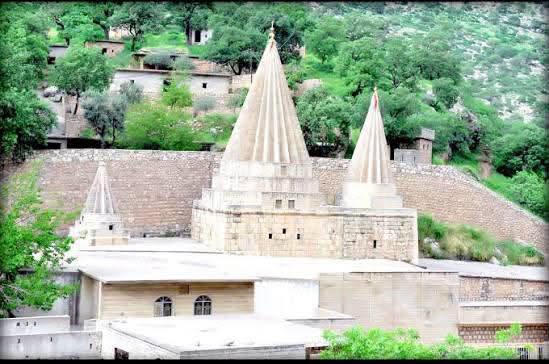
In this context, the Yazidi Jamma Feast occupies a special place in the religious and heritage conscience of the Yazidis, as one of the most prominent religious occasions on which Yazidis from all over the world head to the Lalish Temple, which is considered the pilgrimage center and the religious and spiritual center of the Yazidis in the Sheikhhan District in Iraq. The feast lasts for seven days, each beginning with different religious rituals, interspersed with supplications, prayer, and hope from God, glorified and exalted, to preserve them and to encompass everyone with security, safety, and peace.
The Jamma Feast turns into a festival of peaceful coexistence among all religions, as Muslims, Christians, and followers of other religions participate with the Yazidis in their occasion and offer them congratulations on this occasion, in a scene that embodies the values of love, brotherhood, and coexistence among the members of Iraqi society.
The Jamma Feast.. When Place Turns into Memory
Lalish is considered the main spiritual center of the Yazidi religion, and the Iraqi Ministry of Culture, Tourism, and Antiquities has listed it on the tentative list of world heritage at UNESCO, as a site of exceptional religious, cultural, and historical value.
According to the history of this religion, as historical documents also indicate, Lalish is the main spiritual center of the Yazidi religion, and Yazidis from various parts of the world head to it to perform their rituals and visit it. The Jamma Feast is linked to a system of rituals, traditions, and practices that the Yazidis have preserved through successive generations, and which have contributed to the continuity of their religious and cultural identity, despite the waves of persecution, displacement, and repeated attempts to undermine their existence and heritage. Therefore, celebrating this occasion should not be viewed from a narrow religious angle only, but as part of Iraqi cultural diversity that deserves protection and respect.
Constitutional Protection of Freedom of Belief and Practice
From a legal standpoint, the Iraqi constitutional legislator has not left the issue of freedom of religion, belief, and religious practice without protection. Article (2/Second) of the Constitution of the Republic of Iraq of 2005 explicitly stipulates the guarantee of the full religious rights of all individuals in freedom of creed and religious practice, and mentions the Yazidis among the religious components covered by this guarantee.
Article (42) also affirms that every individual has freedom of thought, conscience, and belief, while Article (43) stipulates the freedom of followers of religions and sects to practice religious rituals, and the State’s guarantee of freedom of worship and protection of its places.
These texts acquire particular importance when speaking of the religious occasions of Iraqi components, because the protection of freedom of belief is not complete by mere theoretical recognition of it, but also requires providing the legal and institutional environment that allows the followers of every religion or belief to practice their rituals and occasions in a safe and dignified manner.
The Jamma Feast in the Iraqi Official Holidays Law
Perhaps one of the most prominent manifestations of legal recognition of religious diversity in Iraq is that the Official Holidays Law No. (12) of 2024 devoted a special text to the religious holidays of Iraqi components.
The Law stipulated in Article Two/Third the holidays specific to the Yazidis, among them: 23–30 September (Sharqi): the Jamma Feast.
In addition to Council of Ministers Decision No. (23563) of 2023, considering the Jamma Feast of each year an official holiday throughout Iraq for the Yazidi component, corresponding to (6–14/10/2023).
Thus, the Jamma Feast has become an occasion explicitly stipulated in the Iraqi Official Holidays Law, just as the Law approved for other religious components a set of occasions specific to them, within a legal organization that reflects the multiplicity of religions and components in Iraqi society.
From a legal perspective, the importance of this text lies not only in granting the holiday, but in the legislative recognition of the religious occasion and its specificity for the Yazidi component.
Here the important relationship between law and human rights emerges; when the law recognizes the religious occasion of one of society’s components, it contributes to transforming the principle of equality and respect for diversity from an abstract constitutional value into a tangible legal and institutional practice.
The protection of Yazidi rights also extends to the protection of the religious and cultural heritage associated with this community, and this is confirmed by recent international efforts to protect Yazidi heritage. UNESCO has launched a project to inventory and protect Yazidi intangible cultural heritage in Iraq, with the aim of documenting Yazidi cultural expressions, protecting them, and transmitting knowledge related to them to future generations, while emphasizing the role of heritage protection in enhancing social cohesion and cultural identity. Here the importance of religious occasions, including the Jamma Feast, becomes clear, as one of the spaces through which cultural and religious memory is transmitted from one generation to another.
After the Crime of Genocide
It is not possible to speak of Yazidi occasions in contemporary Iraq without evoking the grave crimes to which the Yazidis were subjected at the hands of the terrorist organization ISIS since 2014.
The United Nations and competent international bodies have documented the extent of the violations to which the Yazidis were subjected, including killing, enslavement, sexual violence, forced displacement, and the destruction of religious and cultural sites and heritage. International organizations have also indicated that the targeting of the Yazidi community was not limited to human beings, but also extended to cultural identity, shrines, artifacts, and heritage practices.
Hence, the return of religious occasions and their practice in freedom and safety carries a dimension that transcends celebration; it also represents a continuity of identity and a rejection of the erasure of cultural memory. Heritage lives in books and museums, and it also lives in the human being, in rituals, in language, in holy places, and in the occasions around which society gathers around its memory and identity.
The University and Its Role in Protecting Diversity
Universities bear a special responsibility in spreading a culture of respect for religious and cultural diversity, not only through studying religions and components, but through building a university environment based on equality, non-discrimination, and respect for freedom of thought and belief. Hence, introducing the religious and cultural occasions of Iraqi components represents part of education in human rights, citizenship, and peaceful coexistence. The University of Mosul, by virtue of its scientific and cultural position in Nineveh Governorate, stands before an important responsibility in enhancing knowledge of the history and heritage of all components of the governorate, foremost among them the Yazidi component, which constitutes an authentic part of the social and historical fabric of Nineveh and Iraq.
The Message of the Jamma Feast
The most beautiful thing we can learn from the Jamma Feast is that diversity does not mean divergence, and that respecting the privacy of others does not diminish our own privacy, but rather makes the homeland more spacious for everyone. When the Yazidi celebrates his religious occasion in Lalish, he is not celebrating a part separate from Iraq, but is exercising a constitutional, legal, and cultural right guaranteed to him, and reconnecting the present with historical roots deeply embedded in the land of Iraq.
Therefore, respecting the Jamma Feast and respecting all religious occasions of Iraqi components should be understood as respect for the human being, for the Constitution, for the law, and for the diversity that constitutes one of the elements of the strength of the state and society.
In a country like Iraq, historically known for the multiplicity of its religions, sects, and nationalities, protecting this diversity is a legal, national, and humanitarian responsibility.
The Jamma Feast is not an occasion for the Yazidis alone, but an occasion that reminds us all that Iraq is made spacious by its diversity, and that protecting diversity is protecting Iraq itself.
May our Yazidi brothers be safe and sound every year, and may Iraq every year be more respectful of its diversity, and more committed to its constitution, its law, and the values of coexistence and peace.