12 August، 2026
A Specialized Legal Article: The Position of International Law and Iraqi Law on the Crime of Genocide
Dr. Ahmed Fares Idris
University of Mosul – College of Law
Introduction:
The crime of genocide is considered one of the most serious international crimes known to the international community, as it targets human beings in their existence and belonging to a national, ethnic, racial, or religious group. Its effects are not limited to direct victims but extend to obliterating the identity of entire peoples, leaving profound social, humanitarian, and political repercussions. For this reason, international law has paid exceptional attention to this crime, making it one of the four core international crimes within the jurisdiction of the International Criminal Court, and obligating states to prevent it and punish its perpetrators, considering it a crime that is not subject to statute of limitations and for which military orders or official capacity cannot be invoked to evade responsibility.
First: Definition of the Crime of Genocide:
The Convention on the Prevention and Punishment of the Crime of Genocide of 1948 defines genocide as any act committed with intent to destroy, in whole or in part, a national, ethnical, racial, or religious group as such, whether by killing, causing serious bodily or mental harm to members of the group, deliberately inflicting on the group conditions of life calculated to bring about its physical destruction in whole or in part, imposing measures intended to prevent births within the group, or forcibly transferring children of the group to another group.
It is clear from this definition that the essential element distinguishing this crime from others is the specific intent (dolus specialis) aimed at eliminating a protected human group, not merely the commission of acts of killing or violence.
Second: The Elements of the Crime of Genocide:
The crime of genocide is based on three main elements:
-
The Presumed Element: The existence of a protected group, namely national, ethnical, racial, or religious groups.
-
The Physical Element (Actus Reus): Consisting of the commission of one of the acts stipulated in the Convention, such as mass killing, causing serious bodily or mental harm, forced displacement, preventing births, and forcibly transferring children.
-
The Mental Element (Mens Rea): Consisting of the presence of specific intent (Dolus Specialis), i.e., the perpetrator’s will directed toward destroying the targeted group in whole or in part. This is what distinguishes this crime from crimes against humanity or war crimes.
Third: The Most Important International Conventions Regulating the Crime:
The crime of genocide has received extensive attention in international law. The most important conventions and legal instruments addressing it include:
-
The Convention on the Prevention and Punishment of the Crime of Genocide of 1948.
-
The Four Geneva Conventions of 1949 and the two Additional Protocols of 1977, concerning the protection of civilians during armed conflicts.
-
The Rome Statute of the International Criminal Court of 1998, which stipulated the crime of genocide in Article 6.
-
The Statutes of the International Criminal Tribunals for the former Yugoslavia and Rwanda, which contributed to the development of international judicial jurisprudence regarding this crime.
Fourth: The Position of International Law:
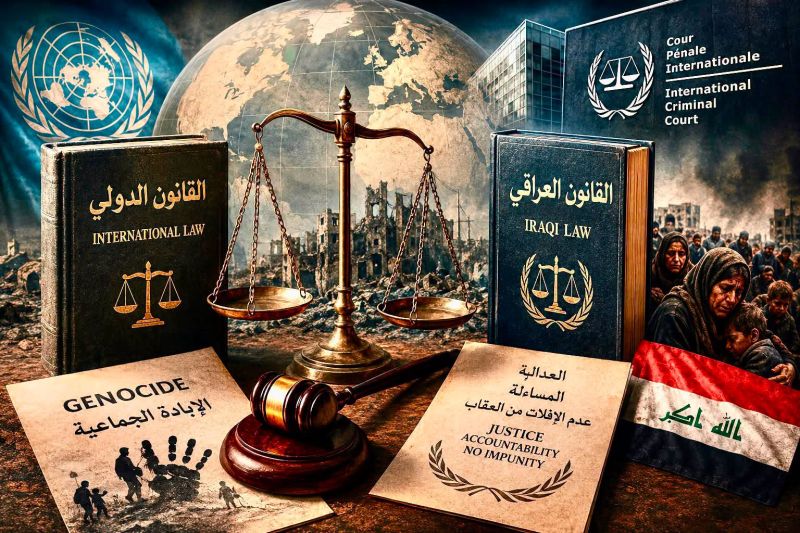
International law considers the crime of genocide to be one of the most serious international crimes, obligating all states to prevent it and not tolerate its perpetrators. It also establishes individual criminal responsibility for anyone who commits, plans, incites, or assists in its commission, regardless of their official position or military status.
International law affirms that this crime is not subject to statute of limitations, and perpetrators cannot be granted immunity or amnesty that would prevent their prosecution. States also bear an obligation to cooperate in extraditing the accused and bringing them before national or international courts.
Fifth: The Position of Iraqi Law:
Iraq has been keen to combat international crimes and has acceded to numerous international conventions related to human rights. The Yazidi Female Survivors Law No. (8) of 2021 was also enacted, which recognized the crimes committed by the terrorist ISIS gangs against Yazidis and others, and provided for a set of rights, compensation, care, and rehabilitation for the victims.
Although the Iraqi Penal Code punishes crimes of murder and terrorism, legal scholars call for the explicit incorporation of the crime of genocide into Iraqi legislation, in line with the rules of international criminal law.
Sixth: The Crime of Genocide Against the Yazidis:
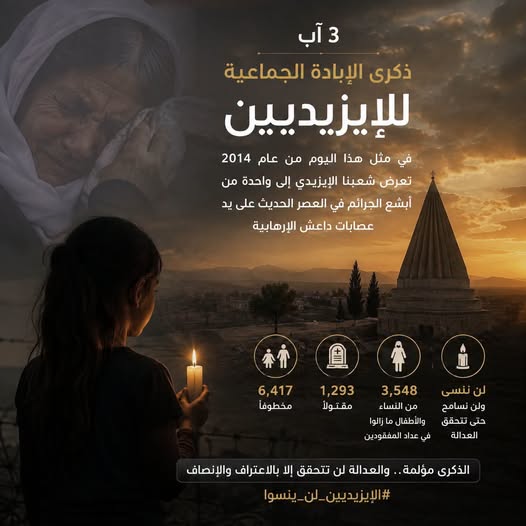
The crimes committed by the terrorist ISIS gangs against the Yazidis in the Sinjar district in 2014 represent one of the clearest examples of genocide in the modern era. These gangs pursued a systematic policy aimed at eliminating the Yazidi component, through mass killings, field executions, forced displacement, the abduction of women and children, sexual slavery, torture, forced recruitment of children, and the destruction of religious shrines and cultural heritage.
The United Nations and the International Investigation Team (UNITAD) have confirmed that the crimes committed against the Yazidis amount to the crime of genocide in accordance with the 1948 Convention, given the presence of both the physical and mental elements of the crime, particularly the specific intent aimed at eliminating this religious group.
This crime remains a testament to the need to strengthen international cooperation to ensure that perpetrators do not escape punishment, and to achieve justice and redress for the victims.
Conclusion:
The crime of genocide constitutes an assault on all of humanity, as it targets human groups because of their identity and belonging. International law has established a comprehensive system to prevent and punish this crime. However, the success of this system remains dependent on political will and international judicial cooperation, as well as the development of national legislation in line with the rules of international criminal law.
The Iraqi experience, particularly the crimes suffered by the Yazidis, stands as clear evidence of the importance of documenting international crimes, providing justice to victims, and ensuring non-repetition, thereby achieving justice and preserving human dignity.
Sources:
-
Convention on the Prevention and Punishment of the Crime of Genocide, 1948.
-
Rome Statute of the International Criminal Court, 1998.
-
The Four Geneva Conventions of 1949 and the two Additional Protocols of 1977.
-
Yazidi Female Survivors Law No. (8) of 2021.
-
William A. Schabas, Genocide in International Law, Cambridge University Press.
-
Antonio Cassese, International Criminal Law, Oxford University Press.
-
Reports of the United Nations Investigative Team to Promote Accountability for Crimes Committed by Da’esh (UNITAD).
-
Malcolm N. Shaw, International Law, Cambridge University Press.