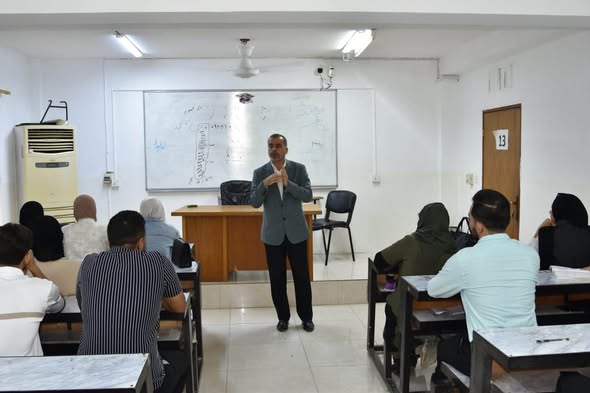
28 August، 2026
Legal Article on the Occasion of International Lawyers’ Day
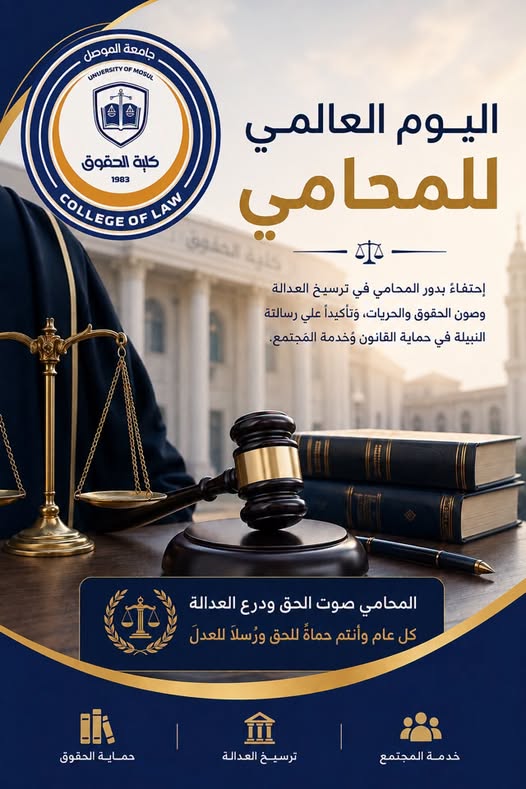
The Legal Profession – A Mission of Justice and the Voice of Truth
A Legal Article on the Occasion of International Lawyers’ Day
Dr. Ahmed Fares Idris
University of Mosul – College of Law
Introduction:
The legal profession is considered one of the noblest legal professions and the most closely connected to the achievement of justice and the protection of rights and freedoms. It is not merely a profession practiced for a fee, but rather a humanitarian and legal mission based on defending the truth, supporting the oppressed, providing legal counsel, and contributing to the revelation of truth before the judiciary.
Historically, the legal profession has been tied to a fundamental principle: the right of every individual to access justice and defend their rights. The existence of an independent and competent lawyer represents one of the essential guarantees for a fair trial and the rule of law.
First: The Legal Profession – Between Career and Mission:
The legal profession distinguishes itself from many other professions by its direct engagement with human rights, fundamental freedoms, and individuals’ core interests. A lawyer may stand as a defender of a person who has lost their freedom, a family seeking their right, an individual who has suffered injustice, or an institution striving to protect its legitimate interests.
Therefore, the value of a lawyer is not measured solely by the number of cases won, but rather by their commitment to the law and professional ethics, and their ability to defend their client within the framework of truth and justice.
Second: The Lawyer as a Partner in Achieving Justice:
A lawyer should not be viewed as an adversary to the judiciary; rather, the lawyer and the judge, each in their respective role, are participants in a unified system whose ultimate goal is the achievement of justice and the application of the law.
The lawyer presents to the court their client’s arguments and legal evidence, reveals the strengths and weaknesses of the case, and contributes to clarifying the facts and legal texts, thereby enhancing the quality of the judicial process.
In Iraq, the Legal Profession Law No. (173) of 1965, as amended, regulates the practice of the profession and the rights and duties of lawyers. It grants registered lawyers, in accordance with the law, the authority to provide legal advice, represent others, and defend rights before judicial and investigative authorities within the boundaries set by law.
Third: Lawyer Independence and Professional Immunity:
The independence of the lawyer is a fundamental pillar of the profession. A lawyer who fears exercising their role freely cannot perform their mission as required.
For this reason, lawyers must be provided with legal and professional guarantees that ensure their right to practice defense, while simultaneously adhering to the law and the principles and etiquette of the profession. Professional immunity is not a personal privilege for the lawyer, but rather a means to ensure the independent and responsible exercise of defense.
The Iraqi legal framework has witnessed ongoing debate regarding the development of the Legal Profession Law in line with the profession’s requirements and contemporary challenges, including the protection of lawyers, the expansion of their scope of work, and the elevation of professional practice standards.
Fourth: Legal Ethics:
The value of the legal profession is not complete through law alone; it requires a well-established system of professional ethics.
Among the most important principles that a lawyer should embody are:
-
Honesty and integrity.
-
Maintaining client confidentiality.
-
Respecting the judiciary, colleagues, and opponents.
-
Not misleading the court or providing information the lawyer knows to be untrue.
-
Defending the client within the limits permitted by law.
-
Respecting the independence of the judiciary.
-
Upholding the dignity and reputation of the profession.
A true lawyer is one who combines legal knowledge with professional conscience, because legal knowledge without ethics may transform from a means of achieving justice into a tool for undermining it.
Fifth: The Lawyer in the Era of Digital Transformation and Artificial Intelligence:
The legal profession today no longer resembles its traditional image. Technological developments, artificial intelligence, and digital transformation have imposed new challenges on lawyers, including data protection and legal information security, handling digital evidence, understanding electronic contracts, confronting cybercrimes, and using modern technologies in legal research.
However, no matter how advanced technology becomes, it cannot replace the humanitarian role of the lawyer. Justice is not merely a computational process; it is an understanding of individuals, circumstances, rights, and interests, and it is both an ethical and legal responsibility.
Conclusion:
On International Lawyers’ Day, we do not merely celebrate a profession; we celebrate a mission whose hallmark is justice, truth, and freedom. The lawyer who stands in the courtroom does not merely carry a file, but carries with them the trust of a human being, the right of a family, the freedom of an accused, the interest of a citizen, and sometimes the hope of justice for the oppressed.
Therefore, respecting the lawyer and their independence does not mean respecting their person alone, but rather respecting the right of defense, the rule of law, and justice.
Best wishes to all honorable lawyers. May the legal profession grow stronger, more independent, and more upright with each passing year. And may its highest motto remain:
That truth shall never be a stranger,
That the oppressed shall never be alone,
And that justice shall never be without a voice.