12 August، 2026
Three special astronomical sights in about 24 hours
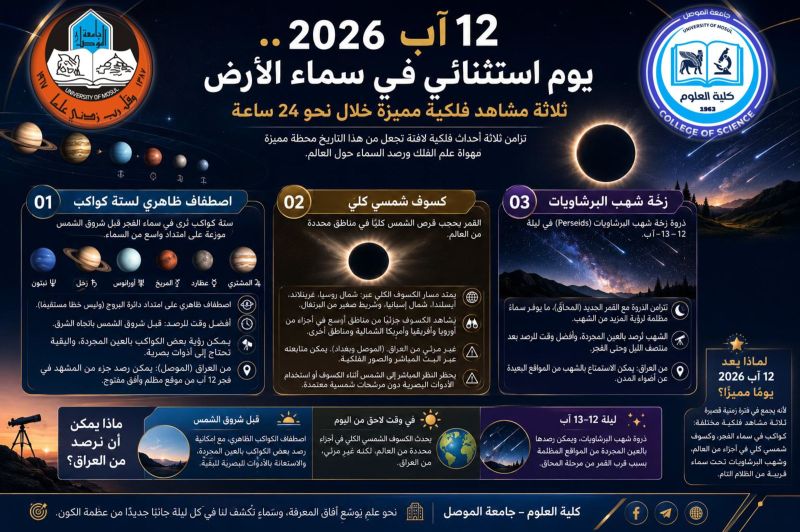
August 2026.. An extraordinary day in the sky of the Earth On Wednesday, August 12, 2026, three remarkable astronomical scenes coincided during a period of approximately 24 hours, making this date a distinctive stop for astronomy enthusiasts and sky watchers around the world. First 🪐 a virtual alignment of six planets In the hours before sunrise, six planets of the solar system distributed over a wide stretch of the sky will appear, namely: Jupiter ♃ – Mercury ☿ – Mars ♂ – Uranus ♅ – Saturn ♄ – Neptune ♆ This scene is known in the media as the ” parade of planets “or” alignment of planets”, but the more accurate scientific expression is” apparent alignment”; the planets do not actually line up in a straight line in space, but from the perspective of the earth they seem to converge along an area close to the Zodiacal circle (the apparent path of the sun on the dome of the sky), as a result of their different positions in their orbits and the position of the Earth relative to it. It will also appear in the sky in the form of a wide arc, and not a perfect straight line. This scene is observed before sunrise, and the chances of observation are better from sites with an open horizon and far from sources of light pollution, especially towards the eastern horizon. The visibility of each planet varies depending on the location of the Observer, the time of observation and the clarity of the sky. What can be seen 🔭 (chuckles) * Saturn: one of the easiest planets to observe with the naked eye, it appears with a clear brightness. * Mars: visible to the naked eye, it is characterized by its reddish color. * Mercury: it can be observed with the naked eye under suitable conditions, but it will be very low and close to the horizon, and the light of Dawn will also make it more difficult to observe. * Jupiter: very bright, but it will be very low above the horizon and close to the light of Dawn, which makes its observation more difficult. * Uranus: needs binoculars or a telescope to observe it clearly. * Neptune: very dim and not visible to the naked eye, needs a telescope. Thus, the observation of all six planets requires excellent observation conditions and suitable optical instruments, in particular for the observation of Uranus and Neptune, while a number of planets can be seen with the naked eye. الرصد monitoring from Iraq Residents of Iraq can observe part of the apparent alignment of the planets at dawn on August 12, provided there is a clear sky and an open horizon, especially towards the East. As for the city of Mosul, it is preferable to choose a location far from the lights of the city, and start monitoring well before dawn, using binoculars or a telescope to try to identify Uranus and Neptune. ⸻ Second: total solar eclipse On the same day, a total solar eclipse occurs when the moon passes between the Earth and the sun, completely obscuring the sun’s disk for observers located within the narrow path of the total eclipse. The path of the total eclipse extends across areas of northern Russia, Greenland, Iceland, northern Spain and a small strip of Portugal, while the eclipse is partially visible from wider areas in parts of Europe, Africa, North America and other regions. 🌑 Where is the most prominent viewing Iceland, Greenland and northern Spain are some of the most prominent areas where the total eclipse phase can be viewed, with the duration of the totality and the height of the sun above the horizon varying from location to location. Iraq, including Mosul and Baghdad, is not within the viewing areas of this solar eclipse; therefore, the eclipse will not be visible locally from Iraq. Thus, for observers in Iraq, the event will be an important global astronomical event that can be followed via live broadcasts, photos and astronomical coverage, but it will not be visible from Mosul or Baghdad. ⚠️ Important scientific alert It is forbidden to look directly at the sun during an eclipse with the naked eye, and it is also not allowed to use cameras, binoculars or telescopes without dedicated and approved solar filters for monitoring; as this may lead to serious and permanent damage to the eye. ⸻ ثالثا third: the meteor shower of bribes By the night of August 12-13, the Perseids meteor shower reaches its peak period of activity almost annually. The observation conditions in 2026 are characterized by an exceptional feature, as the peak of the barchawiyat coincides with the phase of the Mahak (new moon), which means that the moonlight will be almost non-existent, and provides a dark sky that helps to see a larger number of faint meteors. Barchas generally last from mid-July to late August, while the peak falls around August 12-13. Do meteors need a telescope ☄️ No. The best way to observe meteors is with the naked eye, because meteors can appear in different parts of a wide area of the sky, while the telescope limits the field of view. The best opportunity for observation is from rural areas or locations far from the lights of cities, especially from after midnight until dawn hours. 🇮 🇶 And from Iraq? – Residents of Iraq can enjoy observing the barshawe meteors on the night of August 12-13, if the sky is clear and the observation site is far from the sources of light pollution. Amateur astronomers can also invest this night to observe stars, planets and other celestial bodies, taking advantage of the proximity of the moon to the ecliptic phase and the resulting Celestial Darkness.