BP – Department of Architecture Engineering
Bologna Process

Department of Architecture Engineering
The Bachelor of Science (B.Sc.) in Architectural Engineering at the University of Mosul is a five-year, full-time undergraduate program comprising 300 ECTS credits, aligned with the Bologna Process. It is an academic program designed to prepare Architectural engineers with the scientific and technical knowledge, as well as the design and professional skills, required to practice architecture and contribute to the development of the built environment and society.The program integrates theoretical knowledge with practical applications through Architectural design studios, engineering courses, building materials and construction courses, urban planning and design, building engineering services, and digital technologies, in addition to scientific research, with the aim of developing students’ technical competence and professional skills. Graduates acquire the analytical, practical, communication, and problem-solving skills required to design, construct, operate, and maintain architectural buildings, as well as to plan sustainable cities and indoor and outdoor spaces.
The program also prepares graduates for professional engineering practice, lifelong learning, and postgraduate studies, while promoting ethical responsibility, teamwork, innovation, a commitment to addressing societal needs, and support for sustainable development.
For more details, please visit the following link: https://uomosul.edu.iq/en/engineering/42344-2/ Program-Catalogue-2025-2026-1.pdf and Vision, Mission, and Goals – Department of Architectural Engineering – College of Engineering.
The Architecture Engineering Program aims to:
- Preparing architectural graduates based on sound scientific principles that enable them to practice the profession efficiently in the fields of architectural design, urban design, city planning, and interior and exterior spatial planning, in addition to the preservation of heritage and antiquities using specialized scientific methods.
- Preparing scientifically, professionally, and educationally qualified personnel in various fields of knowledge, in accordance with high-quality standards.
- Promoting scientific research in theoretical and applied sciences, encouraging initiatives related to development programs, and ensuring that they keep pace with global scientific developments and future planning.
- Continuously developing curricula at both the undergraduate and postgraduate levels to keep pace with modern scientific, methodological, and technological developments.
- Contributing to community service through continuous interaction with state institutions, providing scientific consultations, and promoting continuing education programs.
- Linking the field of architecture with other engineering disciplines and developing relationships and cooperation with them, recognizing architecture as an essential component of societal development and advancement.
- Emphasizing the role of architecture in building society and improving the living environment, thereby enhancing the quality of life.
- Implementing clear and practical programs that focus on sustainability technologies and architectural aesthetic standards, while keeping pace with developments adopted in developed countries by providing an architectural education program based on modern technologies in engineering, artistic, and technical fields.
- Focusing on the quality of the educational process in architectural education through the continuous selection and development of specialized and modern curricula, and the completion of self-assessment reports with the aim of obtaining academic accreditation.
For more details, please visit the following link: Program-Catalogue-2025-2026-1.pdf and Vision, Mission, and Goals – Department of Architecture Engineering – College of Engineering
Upon successful completion of the program requirements, graduates are awarded the Bachelor of Science (B.Sc.) degree in Architecture Engineering by the University of Mosul.
The program is classified at Level 6 of the Iraqi National Qualifications Framework (INQF), or its equivalent, in accordance with the regulations and guidelines of the Ministry of Higher Education and Scientific Research (MOHESR).
Admission to the Bachelor of Science (B.Sc.) in Architecture Engineering program is governed by the regulations and admission policies of the Ministry of Higher Education and Scientific Research (MOHESR) and the University of Mosul. Applicants must meet the approved admission criteria for engineering programs.
To be awarded the Bachelor of Science (B.Sc.) in Architecture Engineering, students must successfully satisfy all graduation requirements, including:
▪ Successful completion of all 300 ECTS credits, including all compulsory and elective courses specified in the curriculum.
▪ Achievement of the minimum graduation requirements in accordance with the
regulations of the Ministry of Higher Education and Scientific Research (MOHESR) and the University of Mosul.
▪ Successful completion of all required laboratory work, field training, and other practical components of the program, where applicable.
▪ Compliance with all academic regulations governing assessment, progression, and graduation as approved by the Ministry of Higher Education and Scientific Research (MOHESR) and the University of Mosul.
For more details, please visit the following link: Program-Catalogue-2025-2026-1.pdf
Recognition of Prior Learning (RPL) and transfer of academic credits are considered only in cases of student transfer or course equivalency, in accordance with the regulations and instructions of the Ministry of Higher Education and Scientific Research (MO HESR) and the University of Mosul.
Upon successful completion of the Bachelor of Science (B.Sc.) in Architecture Engineering program, graduates are expected to achieve the following Program Learning Out comes (PLOs) or Graduate Outcomes (GOs), which describe the knowledge, skills, and professional competencies required upon graduation:
GO1: An ability to distinguish, identify, define, formulate, and solve engineering problems by applying principles of engineering and mathematics
GO2: The ability to produce engineering designs that meet desired needs within specified constraints by applying analysis and synthesis processes in the design process
GO3: The ability to carry out appropriate measurements and test while ensuring quality, analyze and interpret results and ability to conduct engineering judgment on them to reach conclusions
GO4: Ability to communicate effectively with a rang of people and editorially with various managerial levels
GO5: The ability to recognize ethical and professional responsibilities in engineering and societal issues
GO6: Ability to work collectively within the engineering team and meet deadlines within the ethics of the engineering profession and how to obtain, evaluate, accumulate and apply it
properly.
For more details, please visit the following link: Graduate Outcomes – Department of Architecture Engineering – College of Engineering
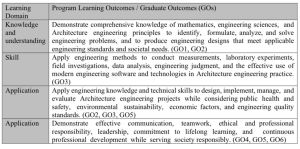
The Bachelor of Science (B.Sc.) in Architecture Engineering program is aligned with the Iraqi National Qualifications Framework (INQF) at Level 6. The following table illustrates how the program’s Graduate Outcomes correspond to the key learning domains defined by the INQF, ensuring that graduates acquire the knowledge, skills, competencies, and professional values required for effective engineering practice and lifelong learning:
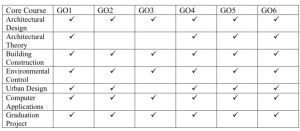
The Program Learning Out comes (PLOs) are achieved through the integrated delivery of the Architecture Engineering curriculum. The following matrix presents the alignment between the core courses and the Program Learning Outcomes (PLOs), demonstrating how each course contributes to the development of the knowledge, skills, and professional competencies expected of graduates.
Graduates of the Bachelor of Science (B.Sc.) in Architectural Engineering are qualified to pursue professional careers and diverse employment pathways across a wide range of public and private sectors, in accordance with their architectural and engineering knowledge and skills. These include:
▪ Architectural and engineering consulting firms and offices, participating in architectural and engineering design, project development, and preparation of design documents.
▪ Construction and contracting companies, contributing to the implementation of architectural projects, site follow-up, and coordination between design and construction aspects.
▪ Government institutions and agencies, including municipalities, urban planning departments, housing authorities, public works departments, and organizations concerned with urban development and construction projects.
▪ Urban planning and design offices and institutions, participating in the preparation of urban plans and the design and development of public spaces and residential areas.
▪ Architectural and urban heritage conservation institutions, contributing to the documentation, rehabilitation, restoration, and preservation of historic buildings and heritage sites and their architectural and cultural values.
▪ Project management and real estate development companies and institutions, contributing to the management of architectural projects, monitoring design and construction stages, and coordinating among different stakeholders.
▪ Engineering consulting and project supervision organizations, participating in technical supervision, quality control, and the review of architectural and engineering drawings and technical documentation.
▪ Interior design and built-environment design firms, contributing to the development of design solutions for interior and exterior spaces that meet functional, aesthetic, and environmental requirements.
▪ Architectural technology and digital design companies, working in areas such as three-dimensional modeling, parametric design, Building Information Modeling (BIM), digital fabrication, and architectural visualization.
▪ Organizations working in sustainable architecture and building energy efficiency, contributing to the analysis and assessment of building environmental performance and the development of sustainable design solutions.
▪ Universities, research centers, and higher education institutions, following the completion of postgraduate studies, contributing to teaching, scientific research, and academic development in the fields of architecture, design, and the built environment.
Graduates of the Bachelor of Science (B.Sc.) in Architecture Engineering may pursue postgraduate studies and professional development opportunities in the following areas:
▪ Postgraduate Studies
- Master’s degree in Architecture Engineering.
- Master’s degree in Architecture Engineering / Urban Design.
- Doctor of Philosophy (Ph.D.) in Architecture Engineering.
For more details, please visit the following link: Postgraduate-Studies-–- Department-of- Architecture -Engineering-2025-2026.pdf
▪ Professional Development
o Professional training in architectural and engineering software, including Autodesk AutoCAD, Autodesk Revit, , 3ds Max, Lumion, as well as other specialized architectural design, modeling, visualization, and documentation applications.
o Professional training in Building Information Modeling (BIM) for architectural design, documentation, coordination, and project management.
The Architecture Engineering Program adopts the examination, assessment, and grading regulations approved by the Ministry of Higher Education and Scientific Research (MOHESR) and the University of Mosul. Student performance is assessed through a variety of continu ous and summative assessment methods, including:
- Continuous assessment (quizzes, assignments, and classroom activities).
- Midterm examinations.
- Final examinations.
- Laboratory reports and practical assessments.
- Engineering design projects and coursework.
- Summer training.
- Oral presentations and seminars.
- Graduation project assessment.
- Compliance with academic integrity regulations and institutional policies regarding academic misconduct, cheating, and plagiarism.
To be eligible for the award of the Bachelor of Science (B.Sc.) in Architecture Engineering, students must successfully fulfill all graduation requirements in accordance with the regulations of the Ministry of Higher Education and Scientific Research (MOHESR) and the University of Mosul, including:
- Successful completion of all 300 ECTS credits and all compulsory and elective courses specified in the curriculum.
- Achievement of the minimum graduation requirements, including the required cumulative Grade Point Average (GPA), in accordance with the applicable regulations.
- Successful completion of the graduation project and all required laboratory, practical, and summer training components.
- Fulfillment of all academic and administrative requirements for the award of the bachelor’s degree.
The Bachelor of Science (B.Sc.) in Architecture Engineering is a five-year, full-time undergraduate program delivered in accordance with the Bologna Process and comprising 300 ECTS credits. The program adopts a student-centered learning approach that integrates theoretical lectures, laboratory experiments, practical applications, engineering design, field training, project-based learning, and modern engineering software. Students are trained to utilize industry-standard software for Computer-Aided Architectural Drawing and Architectural Visualization, such as and other specialized engineering applications. These learning activities are further supported by seminars, technical workshops, and practical training to enhance students’ technical competence, digital skills, and readiness for professional engineering practice.
Program Coordinator of the Bachelor of Science (B.Sc.) in Architecture Engineering The Program Coordinator is responsible for the overall coordination, implementation, and continuous improvement of the Bachelor of Science (B.Sc.) in Architecture Engineering program.
The role includes overseeing the implementation of the curriculum, monitoring the achievement of the Graduate Outcomes, coordinating academic activities among faculty members and students, supervising laboratory and field training activities, and ensuring alignment with the University of Mosul’s quality assurance policies, the Ministry of Higher Education and Scientific Research (MOHESR) regulations, and program accreditation requirements. The Program Coordinator also supports curriculum review and enhancement to ensure that the program remains responsive to advances in Architecture engineering , industry needs, and emerging technologies.