BP – Department of Communications and Intelligent Digital Systems Engineering
Bologna Process

Department of Communications and Intelligent Digital Systems Engineering
The Bachelor’s program in Communications and Intelligent Digital Systems Engineering at the University of Mosul is a four-year undergraduate engineering program designed to prepare specialized engineers in modern communications, networking, signal processing, embedded and digital systems, the Internet of Things (IoT), AI-enabled communications, and cybersecurity.
The program combines fundamental engineering, science, and mathematics with communications and digital-system topics and emphasizes analytical problem solving, engineering design, experimentation, data analysis, programming, teamwork, professional responsibility, and lifelong learning. The Department’s academic direction also emphasizes smart connectivity, digital transformation, secure intelligent technologies, applied research, innovation, consultancy, community service, and sustainable development.
The Department has adopted the Bologna Education System and the European Credit Transfer and Accumulation System (ECTS), with implementation beginning in the 2025–2026 academic year. In the supplied Level 1 study plan, each semester carries 30 ECTS credits, for a total of 60 ECTS credits in the first academic level. Learning is delivered through theory, tutorials, laboratory and practical activities, programming exercises, projects, discussion, and other module-specific activities.
The program structure stated in the academic-program document comprises institution requirements, college requirements, department requirements, and summer training. The document lists 3 institution-requirement courses (6 credit hours; 4.5%), 5 college-requirement courses (14 credit hours; 10.4%), 42 department-requirement courses (114 credit hours; 85.1%), plus summer training.
For more details following the link : https://uomosul.edu.iq/en/engineering/42757-2/
The Communications and Intelligent Digital Systems Engineering Program aims to:
- Prepare professional engineers specialized in communications, networking, signal processing, embedded and digital systems, the Internet of Things (IoT), AI-enabled communications, and cybersecurity, capable of meeting modern labor-market needs and contributing to national development.
- Develop postgraduate and specialized engineering cadres (MSc/PhD) in communications and intelligent digital systems to strengthen research capacity and technical leadership.
- Provide academic, scientific, and applied consultancy services to the public, mixed, and private sectors through cooperation agreements and the College of Engineering consultancy structures.
- Conduct applied and innovative research that contributes to solving engineering, industrial, and digital-transformation problems, with measurable impact and publishable outcomes in reputable journals and conferences.
- Disseminate and transfer modern technological advances to engineers and practitioners through continuing education, professional training courses, workshops, and specialized short programs.
- Develop faculty capabilities and international engagement through conference participation, joint research, seminars, collaborative workshops, and academic exchange with regional and global institutions, while also contributing to organizing scientific events locally and internationally.
Upon successful completion of the approved undergraduate program requirements, graduates are awarded a Bachelor’s degree in Communications and Intelligent Digital Systems Engineering by the University of Mosul. The College of Engineering lists the Department of Communications and Intelligent Digital Systems Engineering as offering a four-year Bachelor’s degree program.
The program is classified at Level 6 of the Iraqi National Qualifications Framework (INQF), or its equivalent, in accordance with the regulations and guidelines of the Ministry of Higher Education and Scientific Research (MOHESR).
Admission to the Department of Communications and Intelligent Digital Systems Engineering is determined through the official admission plan according to the Department’s capacity. The Scientific Committee determines the required number of new students, and the proposal is forwarded to the College, University, and Ministry for the required approvals.
Applicants are required to meet the following conditions:
- Iraqi nationality.
- An Iraqi secondary-school certificate issued by a school accredited by the Ministry of Education.
- A medical certificate confirming that the applicant meets the required health conditions.
- Commitment to full-time enrollment.
- The applicant must not be admitted to another college simultaneously.
- Non-Iraqi students holding an Iraqi secondary-school certificate are admitted through central admission.
- Gifted students may be accepted in accordance with the applicable regulations.
Admission is supervised by the Ministry of Higher Education and Scientific Research, which manages and assigns admission to government institutions and colleges on the basis of the approved admission regulations and secondary-school grades.
To qualify for the Bachelor’s degree in Communications and Intelligent Digital Systems Engineering, students must successfully satisfy the requirements of the approved curriculum and the applicable regulations of the Ministry of Higher Education and Scientific Research and the University of Mosul, including:
- Successful completion of all compulsory and other approved courses in the curriculum and the ECTS credits prescribed for the program.
- Successful completion of the required theoretical, tutorial, laboratory, practical, project, and other module-specific learning activities.
- Successful completion of summer training where required by the program structure.
- Achievement of passing results in continuous/formative assessment, midterm examinations, final examinations, and other assessment components specified for each module.
- Compliance with the University and Ministry regulations governing academic progression, examinations, assessment, and graduation.
Recognition of Prior Learning (RPL) and transfer of academic credits are considered only in cases of student transfer or course equivalency, in accordance with the regulations and instructions of the Ministry of Higher Education and Scientific Research (MOHESR) and the University of Mosul.
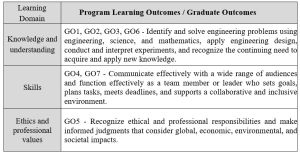
Upon successful completion of the program, graduates are expected to achieve the following Graduate Outcomes (GOs), as stated in the academic-program document according to ICAEE:
GO1: Ability to identify, formulate, and solve engineering problems in Communications Engineering and Smart Digital Systems by applying engineering, science, and mathematics principles.
GO2: Ability to apply the engineering design process to produce solutions meeting specified needs while considering public health and safety, and global, cultural, social, environmental, and economic factors relevant to the specialization.
GO3: Ability to develop and conduct appropriate experiments, analyze and interpret data, and use engineering judgment to draw conclusions.
GO4: Ability to communicate effectively with a wide range of audiences.
GO5: Ability to recognize ethical and professional responsibilities in engineering situations and make informed judgments that consider the impact of engineering solutions in global, economic, environmental, and societal contexts.
GO6: Ability to recognize the ongoing need to acquire new knowledge, select appropriate learning strategies, and apply this knowledge.
GO7: Ability to function effectively as a member or leader of a team that sets goals, plans tasks, meets deadlines, and creates a collaborative and inclusive environment.
The program learning outcomes can be organized across the principal knowledge, skills, and professional-values domains used in the academic-program document. This alignment supports presentation of the program within the Iraqi National Qualifications Framework (INQF) at Bachelor’s level.
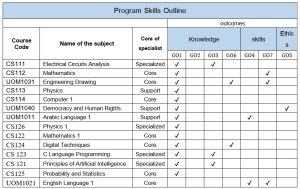
The following matrix presents the alignment between the Level 1 courses and the Program Learning Outcomes / Graduate Outcomes (GO1–GO7) using the mappings given in the supplied Program Skills Outline.
Graduates of the Bachelor’s program in Communications and Intelligent Digital Systems Engineering are prepared for engineering roles associated with modern communications and digital transformation. Based on the program objectives and graduate outcomes, relevant professional fields include:
- Communications and telecommunications engineering.
- Computer networks and networked communication systems.
- Signal processing and digital communication systems.
- Embedded and digital systems.
- Internet of Things (IoT) systems and smart connected devices.
- AI-enabled communications and intelligent digital systems.
- Cybersecurity and information security for communication and digital systems.
- Technical engineering roles in telecommunications, information technology, industrial, governmental, and digital-transformation projects.
- Engineering consultancy, applied technical solutions, training, and professional services.
- Research and academic careers after completing appropriate postgraduate studies.
The program is intended to prepare engineers who can identify and solve engineering problems, design solutions, conduct and interpret experiments, communicate effectively, act responsibly and ethically, continue learning, and work effectively in teams.
Graduates may progress to postgraduate study and continuing professional development in communications and intelligent digital systems and related engineering fields.
Postgraduate study opportunities listed by the College of Engineering for the Department include:
- Higher Diploma — 1 year.
- Master’s degree — 2 years.
- Doctorate / PhD — approximately 3–4 years.
The academic-program objectives specifically emphasize developing postgraduate and specialized engineering cadres (MSc/PhD) in communications and intelligent digital systems. Relevant advanced-study and research areas may include communications, computer networks, signal processing, embedded and digital systems, IoT, AI-enabled communications, cybersecurity, and related intelligent technologies.
Professional development may also include continuing-education courses, specialized training, workshops, seminars, conference participation, joint research, scientific publication, and academic exchange with regional and international institutions.
Student performance is evaluated through continuous/formative and summative assessment in accordance with the approved module descriptions and University regulations. Depending on the module, assessment may include:
- Quizzes.
- Assignments.
- Classwork and tutorial activities.
- Projects and laboratory work.
- Reports and practical activities.
- Midterm examinations.
- Final examinations.
The program-level evaluation description states that assessment includes weekly, monthly, and daily quizzes in addition to the end-of-semester examination. Individual module descriptions provide the detailed assessment weights and relevant learning outcomes.
Grading Scheme
A — Excellent: 90–100 — Outstanding performance.
B — Very Good: 80–89 — Above average with some errors.
C — Good: 70–79 — Sound work with notable errors.
D — Satisfactory: 60–69 — Fair but with major shortcomings.
E — Sufficient: 50–59 — Work meets minimum criteria.
FX — Fail: 45–49 — More work required.
F — Fail: 0–44 — Considerable amount of work required.
To be eligible for graduation from the Bachelor’s program in Communications and Intelligent Digital Systems Engineering, students must fulfill the approved academic and administrative requirements of the University of Mosul and the Ministry of Higher Education and Scientific Research, including:
- Successful completion of all courses and ECTS credits prescribed in the approved four-year curriculum.
- Successful completion of the required theoretical, tutorial, laboratory, practical, project, and other curriculum components.
- Successful completion of summer training where required by the program structure.
- Achievement of passing grades in the assessment components and examinations required for each module.
- Fulfillment of all applicable academic progression and administrative requirements for the award of the Bachelor’s degree.
The Bachelor’s program in Communications and Intelligent Digital Systems Engineering is a four-year, full-time undergraduate program. The Department has adopted the Bologna Education System and the European Credit Transfer and Accumulation System (ECTS), with implementation beginning in the 2025–2026 academic year. The supplied Level 1 curriculum is organized into two semesters of 30 ECTS credits each. Teaching and learning combine theoretical explanation with student participation in problem solving, discussion, tutorials, laboratories, practical exercises, programming activities, projects, and other module-specific learning activities. Course descriptions also emphasize interactive learning, experimentation, engineering analysis, the use of software tools, and the development of critical-thinking and problem-solving skills.
The Program Coordinator is responsible for the overall academic coordination, implementation, monitoring, and continuous improvement of the Bachelor’s program.
The role includes coordinating curriculum delivery, monitoring achievement of the Graduate Outcomes (GO1–GO7), supporting the implementation of the Bologna Process and ECTS requirements, coordinating academic activities among faculty members and students, following up module delivery and assessment, and supporting laboratory, practical, project, and training activities.
The Program Coordinator also supports program review and development so that the curriculum remains responsive to developments in communications, networking, signal processing, embedded and digital systems, IoT, AI-enabled communications, cybersecurity, labor-market needs, quality-assurance requirements, and the regulations of the University of Mosul and the Ministry of Higher Education and Scientific Research.