BP – Department of Mechatronics Engineering
Bologna Process

Department of Mechatronics Engineering
The Bachelor of Science (B.Sc.) in Mechatronics Engineering at the University of Mosul is a four-year, full-time undergraduate program comprising 240 ECTS credits and aligned with the Bologna Process. The program integrates mechanical, electrical, electronic, computer, control, automation, robotics, and related engineering disciplines to provide students with a comprehensive interdisciplinary engineering education. It provides a strong foundation in mathematics, basic sciences, engineering mechanics, electrical and electronic engineering, computer engineering, control systems, and mechatronic systems, complemented by specialized study in robotics, automation, sensors and actuators, embedded systems, artificial intelligence, and intelligent electromechanical systems. The curriculum combines theoretical instruction with laboratory and workshop activities, engineering design, practical applications, hands-on projects, industrial training, and research activities. It is designed to develop analytical thinking, practical problem-solving, engineering design, programming, communication, teamwork, and system-integration skills required to analyze, design, implement, operate, and evaluate modern mechatronic systems. The program prepares graduates for professional engineering practice, lifelong learning, and postgraduate studies while promoting professional ethics, innovation, creativity, teamwork, and responsible engineering practice. It also encourages the application of engineering knowledge and emerging technologies to support sustainable development and contribute to societal and technological advancement. For more details, please visit the following link: https://uomosul.edu.iq/en/engineering/42365-2/ Program-Catalogue-2025-2026-2.pdf and Vision, Mission and Objectives – Department of Mechatronics Engineering – College of Engineering.
The Mechatronics Engineering Program aims to:
- Provide students with a strong foundation in mathematics, basic sciences, and the fundamental principles of mechatronics engineering, including mechanical, electrical, electronic, computer, control, and automation engineering.
- Develop students’ ability to apply engineering design methodologies, standards, and analytical tools to solve mechatronics engineering problems while considering realistic constraints and the economic, environmental, ethical, societal, and cultural impacts of engineering solutions.
- Develop analytical thinking, creativity, problem-solving, communication, and technical skills required for the analysis, design, implementation, and evaluation of integrated mechatronic systems.
- Prepare graduates for professional engineering practice in multidisciplinary and evolving work environments and enable them to pursue postgraduate studies in mechatronics engineering and related fields.
- Promote professional and ethical responsibility, self-confidence, learner autonomy, and commitment to lifelong learning and continuous professional development.
- Develop students’ ability to analyze and solve complex engineering problems using appropriate engineering knowledge, methods, and modern technological tools.
- Provide students with opportunities to work effectively in multidisciplinary teams, either as team members or leaders, while developing teamwork, leadership, responsibility, and project coordination skills.
- Deliver engineering courses in English to strengthen students’ technical communication skills and prepare bilingual engineers capable of functioning effectively in local and international professional environments.
Upon successful completion of the program requirements, graduates are awarded the Bachelor of Science (B.Sc.) degree in Mechatronics Engineering by the University of Mosul.
The program is classified at Level 6 of the Iraqi National Qualifications Framework (INQF), or its equivalent, in accordance with the regulations and guidelines of the Ministry of Higher Education and Scientific Research (MOHESR).
Admission to the Bachelor of Science (B.Sc.) in Mechatronics Engineering program is governed by the regulations and admission policies of the Ministry of Higher Education and Scientific Research (MOHESR) and the University of Mosul. Applicants must meet the approved admission criteria for engineering programs. Admission is conducted through the centralized electronic admission system and is based on academic performance, applicants’ preferences, program requirements, and competition.
To be awarded the Bachelor of Science (B.Sc.) in Mechatronics Engineering, students must successfully satisfy all graduation requirements, including:
- Successful completion of all 240 ECTS credits, including all compulsory and elective modules specified in the curriculum.
- Achievement of the minimum graduation requirements in accordance with MOHESR and University of Mosul regulations.
- Successful completion of all required laboratory work, practical components, industrial/summer training, and graduation project requirements, where applicable.
- Compliance with all academic regulations governing assessment, progression, and graduation as approved by MOHESR and the University of Mosul.
For more details, please visit the following link: Program-Catalogue-2025-2026-2.pdf
Recognition of Prior Learning (RPL) and transfer of academic credits are considered in cases of student transfer or course equivalency, in accordance with the regulations and instructions of MOHESR and the University of Mosul. Course equivalence and compatibility are evaluated by the Department Scientific Committee in coordination with the Head of Department and the Registrar’s Office.
Upon successful completion of the Bachelor of Science (B.Sc.) in Mechatronics Engineering program, graduates are expected to achieve the following Program Learning Outcomes (PLOs) or Graduate Outcomes (GOs):
GO1: An ability to identify, evaluate, and solve engineering problems utilizing the acquired principal knowledge of engineering, science, and mathematics.
GO2: An ability to design an integrated system and its various components and processes to produce solutions that fulfill the needs of society.
GO3: An ability to outline and conduct experiments as well as analyze and interpret data.
GO4: An ability to communicate effectively using oral, written, and graphic forms with different levels of audiences.
GO5: An understanding of the responsibility of engineers to practice professionally and ethically at all times.
GO6: An ability to acquire new engineering knowledge and skills in the mechatronics engineering fields.
GO7: An ability to function on multi-disciplinary teams to analyze, solve problems, and meet deadlines.
For more details, please visit the following link: Program Outcomes – College of Engineering
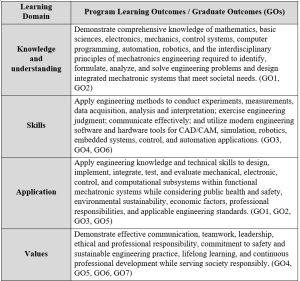
The Bachelor of Science (B.Sc.) in Mechatronics Engineering program is aligned with the Iraqi National Qualifications Framework (INQF) at Level 6. The following table illustrates how the program’s Graduate Outcomes correspond to the key learning domains defined by the INQF, ensuring that graduates acquire the knowledge, skills, competencies, and professional values required for effective engineering practice and lifelong learning:
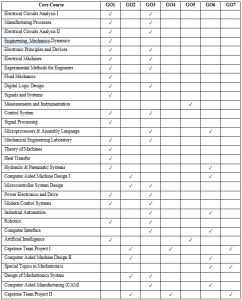
The Program Learning Outcomes (PLOs) are achieved through the integrated delivery of the Mechatronics Engineering curriculum. The following matrix presents the alignment between representative core courses and the Program Learning Outcomes (PLOs), demonstrating how each course contributes to the development of the knowledge, skills, and professional competencies expected of graduates.
Graduates of the Bachelor of Science (B.Sc.) in Mechatronics Engineering are qualified to pursue professional careers in a wide range of public and private sectors, including:
- Robotics and automation companies.
- Manufacturing industries specializing in automated production systems.
- Automotive and aerospace sectors focusing on intelligent control and electromechanical integration.
- Electronics and embedded systems firms.
- Industrial control and instrumentation companies.
- Energy and renewable technology organizations developing smart and sustainable solutions.
- Medical device and biomedical engineering industries.
- Project management, systems integration, and quality assurance organizations.
- Governmental and private institutions requiring mechatronics expertise.
- Universities, research centers, and higher education institutions following the completion of postgraduate studies.
Graduates of the Bachelor of Science (B.Sc.) in Mechatronics Engineering may pursue postgraduate studies and professional development opportunities in the following areas:
Postgraduate Studies:
- Master’s degree in Mechatronics Engineering.
- Postgraduate studies in Robotics and Automation, Control Systems Engineering, Embedded Systems, Artificial Intelligence, and related interdisciplinary engineering fields.
- Doctoral studies and further research in Mechatronics Engineering or related interdisciplinary specializations.
- In addition, the Department of Mechatronics Engineering at the University of Mosul has offered a Master’s Program in Mechatronics Engineering since the academic year 2025–2026.
Professional Development:
- Professional certification programs such as Project Management Professional (PMP).
- Advanced training in robotics and automation software, including MATLAB/Simulink, LabVIEW, and ROS (Robot Operating System).
- Professional courses in CAD/CAM and mechanical design software, such as SolidWorks, CATIA, and Autodesk Inventor.
- Specialized training in electronics and embedded systems, including Arduino, FPGA, microcontroller programming, PLCs, SCADA, and industrial control systems.
- Continuing education, technical workshops, and professional engineering development activities.
The Mechatronics Engineering Program adopts the examination, assessment, and grading regulations approved by MOHESR and the University of Mosul. Student performance is assessed through a variety of continuous and summative assessment methods, including:
- Continuous assessment (quizzes, assignments, homework, and classroom activities).
- Midterm examinations.
- Final examinations.
- Laboratory reports and practical assessments.
- Engineering design projects and coursework.
- Industrial/summer training.
- Oral presentations and seminars.
- Graduation project assessment.
- Compliance with academic integrity regulations and institutional policies regarding academic misconduct, cheating, and plagiarism.
To be eligible for the award of the Bachelor of Science (B.Sc.) in Mechatronics Engineering, students must successfully fulfill all graduation requirements in accordance with MOHESR and University of Mosul regulations, including:
- Successful completion of all 240 ECTS credits and all compulsory and elective modules specified in the curriculum.
- Achievement of the minimum graduation requirements, including the required cumulative Grade Point Average (GPA), in accordance with the applicable regulations.
- Successful completion of the graduation project and all required laboratory, practical, and industrial/summer training components.
- Fulfillment of all academic and administrative requirements for the award of the bachelor’s degree.
The Bachelor of Science (B.Sc.) in Mechatronics Engineering is a four-year, full-time undergraduate program delivered in accordance with the Bologna Process and comprising 240 ECTS credits. The program consists of eight semesters, with 30 ECTS credits per semester, and adopts a student-centered learning approach integrating theoretical lectures, laboratory and workshop activities, practical applications, engineering design, programming, project-based learning, and industrial training. Engineering courses are taught in English. Students are trained to utilize modern engineering software and computational tools for computer-aided design, mechanical modeling, electronic circuit simulation, control-system analysis, automation, and robotics programming, including SolidWorks, Autodesk Inventor, MATLAB/Simulink, LabVIEW, ROS (Robot Operating System), and other specialized mechatronics applications. These learning activities are further supported by seminars, technical workshops, and practical training to enhance students’ technical competence, digital skills, and readiness for professional engineering practice in interdisciplinary fields such as robotics, automation, embedded systems, and intelligent control.
Program Coordinator of the Bachelor of Science (B.Sc.) in Mechatronics Engineering
The Program Coordinator is responsible for the overall coordination, implementation, and continuous improvement of the Bachelor of Science (B.Sc.) in Mechatronics Engineering program. The role includes overseeing the implementation of the curriculum, monitoring the achievement of the Graduate Outcomes, coordinating academic activities among faculty members and students, supervising laboratory, workshop, project, and industrial training activities, and ensuring alignment with the University of Mosul’s quality assurance policies, MOHESR regulations, and program accreditation requirements. The Program Coordinator also supports curriculum review and enhancement to ensure that the program remains responsive to advances in mechatronics engineering, industry needs, and emerging technologies in robotics, automation, embedded systems, and intelligent control.
Program Coordinator: Zaid Ayad Sediq, M.Sc. in Electrical Engineering, Assistant Lecturer.
E-mail: [email protected]