BP – Department of Electrical Engineering
Bologna Process

Department of Electrical Engineering
Part I – Electronic and Communication Branch
The Bachelor of Science (B.Sc.) in Electrical Engineering – Electronic and Communication at the University of Mosul is a four-year, full-time undergraduate program comprising 240 ECTS credits, aligned with the Bologna Process. The program provides students with a strong foundation in mathematics, engineering sciences, and fundamental electrical engineering principles, followed by advanced study in electronic circuits, digital systems, analog and digital communications, signal processing, microprocessors, embedded systems, computer networks, antennas, microwave systems, optical communications, and modern mobile communication technologies. The curriculum integrates theoretical knowledge with laboratory experiments, simulation, design activities, engineering training, undergraduate research, and project-based learning to develop technical competence and professional skills. Graduates acquire the analytical, practical, communication, and problem-solving abilities required to design, implement, operate, test, and maintain electronic, communication, signal processing, networking, and embedded digital systems. The program prepares graduates for professional engineering practice, lifelong learning, and postgraduate studies while promoting ethical responsibility, teamwork, innovation, quality assurance, public safety, and service to society.
Part II – Power and Machines Branch
The Bachelor of Science (B.Sc.) in Electrical Engineering – Power and Machines at the University of Mosul is a four-year, full-time undergraduate program comprising 240 ECTS credits, aligned with the Bologna Process. The program provides students with a strong foundation in mathematics, engineering sciences, and fundamental electrical engineering principles, followed by advanced study in electrical power systems, electrical machines, power electronics, electrical drives, high-voltage engineering, protection systems, renewable energy, and smart grids. The curriculum integrates theoretical knowledge with laboratory experiments, simulation, design activities, engineering training, undergraduate research, and project-based learning to develop technical competence and professional skills. Graduates acquire the analytical, practical, communication, and problem-solving abilities required to design, implement, operate, test, and maintain electric power, machine, drive, protection, and energy conversion systems. The program prepares graduates for professional engineering practice, lifelong learning, and postgraduate studies while promoting ethical responsibility, teamwork, innovation, quality assurance, public safety, and service to society.
For more details, please visit the following link: https://uomosul.edu.iq/en/engineering/42659-2/ Program-Catalogue-2025-2026-1.pdf and Vision, Mission, and Goals – Department of Electrical Engineering – College of Engineering
The Electrical Engineering Programs aims to:
- Provide students with a comprehensive engineering education that establishes a strong foundation in mathematics, science, engineering principles, and the core disciplines of the Electronic and Communication and the Power and Machines Branches.
- Prepare graduates for successful professional careers and postgraduate studies by developing their ability to analyze, design, implement, operate, and maintain electronic, communication, signal processing, networking, and embedded digital systems according to recognized engineering standards and ethical practices.
- Develop students’ technical and practical competencies through laboratories, simulation, engineering design, undergraduate research, and the effective use of modern engineering software and analytical tools.
- Enhance graduates’ communication, leadership, teamwork, and project management skills, enabling them to work efficiently in multidisciplinary engineering environments.
- Promote research, innovation, sustainability, occupational health and safety, lifelong learning, and readiness to meet labor market needs in electrical engineering
For more details, please visit the following link: Program-Catalogue-2025-2026-1.pdf and Vision, Mission, and Goals – Department of Electrical Engineering – College of Engineering
Upon successful completion of the program requirements, graduates are awarded the Bachelor of Science (B.Sc.) degree in Electrical Engineering by the University of Mosul.
The programs are classified at Level 6 of the Iraqi National Qualifications Framework (INQF), or its equivalent, in accordance with the regulations and guidelines of the Ministry of Higher Education and Scientific Research (MOHESR).
Admission to the Bachelor of Science (B.Sc.) in Electrical Engineering programs are governed by the regulations and admission policies of the Ministry of Higher Education and Scientific Research (MOHESR) and the University of Mosul. Applicants must meet the approved admission criteria for engineering programs.
To be awarded the Bachelor of Science (B.Sc.) in Electrical Engineering, students must successfully satisfy all graduation requirements, including:
- Successful completion of all 240 ECTS credits, including all compulsory and elective courses specified in the curriculum.
- Successful completion of all required laboratory work, design work, practical training, and branch-specific components of the Electronic and Communication, Power and Machines Branches.
- Achievement of the minimum graduation requirements in accordance with MOHESR and University of Mosul regulations.
- Compliance with all academic regulations governing assessment, progression, academic integrity, and graduation.
For more details, please visit the following link: Program-Catalogue-2025-2026-1.pdf
Recognition of Prior Learning (RPL) and transfer of academic credits are considered only in cases of student transfer or course equivalency, in accordance with the regulations and instructions of the Ministry of Higher Education and Scientific Research (MOHESR) and the University of Mosul.
Part I – Electronic and Communication Branch
Upon successful completion of the Bachelor of Science (B.Sc.) in Electrical Engineering – Electronic and Communication, graduates are expected to achieve the following Program Learning Outcomes (PLOs) or Graduate Outcomes (GOs):
GO1: An ability to recognize, identify, formulate, and solve engineering problems in electrical engineering and the Electronic and Communication Branch by applying principles of engineering, science, and mathematics.
GO2: An ability to produce engineering designs that meet required needs within specified constraints for public health and safety, and global, cultural, social, environmental, and economic factors.
GO3: An ability to create and implement appropriate measurements, experiments, simulations, and tests related to electronic, communication, signal processing, networking, and embedded digital systems, analyze and interpret results, and make sound engineering judgments.
GO4: An ability to communicate effectively with engineering teams, stakeholders, and various segments of society.
GO5: An ability to recognize ethical and professional responsibilities in engineering issues and make sound judgments that consider financial, environmental, societal, and global consequences.
GO6: An ability to recognize the necessity of continuing self-development of professional knowledge and to obtain, evaluate, accumulate, and apply it properly.
GO7: An ability to work effectively within teams, set goals, plan activities, meet deadlines, and manage risk.
For more details, please visit the following link: Graduate Outcomes – Department of Electrical Engineering – College of Engineering
Part II – Power and Machines Branch
Upon successful completion of the Bachelor of Science (B.Sc.) in Electrical Engineering – Power and Machines, graduates are expected to achieve the following Program Learning Outcomes (PLOs) or Graduate Outcomes (GOs):
GO1: An ability to recognize, identify, formulate, and solve engineering problems in electrical engineering and the Power and Machines Branch by applying principles of engineering, science, and mathematics.
GO2: An ability to produce engineering designs that meet required needs within specified constraints for public health and safety, and global, cultural, social, environmental, and economic factors.
GO3: An ability to create and implement appropriate measurements, experiments, simulations, and tests related to electric power, machine, drive, protection, and energy conversion systems, analyze and interpret results, and make sound engineering judgments.
GO4: An ability to communicate effectively with engineering teams, stakeholders, and various segments of society.
GO5: An ability to recognize ethical and professional responsibilities in engineering issues and make sound judgments that consider financial, environmental, societal, and global consequences.
GO6: An ability to recognize the necessity of continuing self-development of professional knowledge and to obtain, evaluate, accumulate, and apply it properly.
GO7: An ability to work effectively within teams, set goals, plan activities, meet deadlines, and manage risk.
For more details, please visit the following link: Graduate Outcomes – Department of Electrical Engineering – College of Engineering
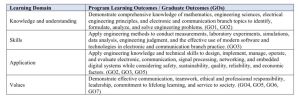
The Bachelor of Science (B.Sc.) in Electrical Engineering (Electronic and Communication-Power and Machines) are aligned with the Iraqi National Qualifications Framework (INQF) at Level 6. The following table illustrates how the program’s Graduate Outcomes correspond to the key learning domains defined by the INQF:
Part I – Electronic and Communication Branch
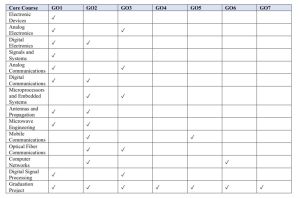
The Program Learning Outcomes (PLOs) are achieved through the integrated delivery of the Electrical Engineering curriculum for the Electronic and Communication Branch. The following matrix presents the alignment between representative core courses and the Program Learning Outcomes:
Part II – Power and Machines Branch
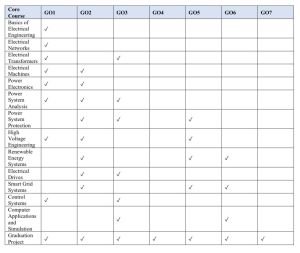
The Program Learning Outcomes (PLOs) are achieved through the integrated delivery of the Electrical Engineering curriculum for the Power and Machines Branch. The following matrix presents the alignment between representative core courses and the Program Learning Outcomes:
Part I – Electronic and Communication Branch
Graduates of the Bachelor of Science (B.Sc.) in Electrical Engineering – Electronic and Communication are qualified to pursue professional careers in public and private sectors, including:
- Telecommunications companies, mobile network operators, and internet service providers.
- Electronics, embedded systems, instrumentation, and control industries.
- Broadcasting, satellite, microwave, and optical communication organizations.
- Computer networking, cybersecurity, IoT, and digital systems sectors.
- Engineering consulting firms, design offices, and technical service providers.
- Oil, gas, industrial, and governmental institutions requiring electronic and communication systems.
- Universities, research centers, and higher education institutions following postgraduate study.
Part II – Power and Machines Branch
Graduates with a Bachelor of Science in Electrical Engineering – Power and Machines are qualified for professional careers in diverse public and private sectors, including:
- Electric power generation, transmission, and distribution companies.
- Ministry of Electricity directorates and public utility institutions.
- Industrial plants, oil and gas facilities, and manufacturing sectors requiring power and machine expertise.
- Renewable energy, smart-grid, and energy management organizations.
- Engineering consulting firms, design offices, and EPC contractors.
- Testing, commissioning, operation, maintenance, and protection departments.
- Universities, research centers, and higher education institutions following postgraduate study.
Part I – Electronic and Communication Branch
Graduates of the Bachelor of Science (B.Sc.) in Electrical Engineering – Electronic and Communication may pursue postgraduate studies and professional development opportunities in the following areas:
Postgraduate Studies
- Master’s degree in communications engineering.
- Master’s degree in electronics engineering.
- Master’s degree in signal processing, embedded systems, computer networks, antennas, microwave engineering, or optical communications.
- Doctor of Philosophy (Ph.D.) in Electrical Engineering or related specializations.
Professional Development
- Professional training in MATLAB/Simulink, RF planning tools, Cisco networking, embedded-system design, LabVIEW, and communication-system simulation.
- Professional certification programs such as Cisco CCNA/CCNP, project management, and specialized telecommunications training.
Part II – Power and Machines Branch
Graduates of the Bachelor of Science (B.Sc.) in Electrical Engineering – Power and Machines may pursue postgraduate studies and professional development opportunities in the following areas:
Postgraduate Studies
- Master’s degree in electrical power engineering.
- Master’s degree in electrical machines and drives.
- Master’s degree in power electronics, renewable energy, high-voltage engineering, protection, or smart grids.
- Doctor of Philosophy (Ph.D.) in Electrical Engineering or related specializations.
Professional Development
- Professional training in ETAP, DIgSILENT Power Factory, MATLAB/Simulink, PSCAD, PLC/SCADA, and power-system protection.
- Professional certification programs such as Project Management Professional (PMP) and energy management training.
The Electrical Engineering Programs adopts the examination, assessment, and grading regulations approved by the Ministry of Higher Education and Scientific Research (MOHESR) and the University of Mosul. Student performance is assessed through a variety of continuous and summative assessment methods, including: Continuous assessment (quizzes, assignments, and classroom activities).
- Continuous assessment, quizzes, assignments, and classroom activities.
- Midterm examinations and final examinations.
- Laboratory reports, practical assessments, and simulation assignments.
- Engineering design projects and coursework.
- Summer training, oral presentations, seminars, and graduation project assessment.
- Compliance with academic integrity regulations and institutional policies regarding academic misconduct, cheating, and plagiarism.
To be eligible for the award of the Bachelor of Science (B.Sc.) in Electrical Engineering (Electronic and Communication- Power and Machines), students must successfully fulfill all graduation requirements in accordance with MOHESR and University of Mosul regulations, including:
- Successful completion of all 240 ECTS credits and all compulsory and elective courses specified in the curriculum.
- Achievement of the minimum graduation requirements, including the required cumulative Grade Point Average (GPA), in accordance with the applicable regulations.
- Successful completion of the graduation project and all required laboratory, practical, and summer training components.
- Fulfillment of all academic and administrative requirements for the award of the bachelor’s degree.
Part I – Electronic and Communication Branch:
The Bachelor of Science (B.Sc.) in Electrical Engineering – Electronic and Communication is a four-year, full-time undergraduate program delivered in accordance with the Bologna Process and comprising 240 ECTS credits. The program adopts a student-centered learning approach that integrates theoretical lectures, laboratory experiments, practical applications, engineering design, simulation, project-based learning, and modern engineering software. Students are trained to use MATLAB/Simulink, Multisim, Proteus, Cisco Packet Tracer, LabVIEW, and specialized RF, antenna, and communication-system simulation tools. These activities are supported by seminars, technical workshops, and practical training to enhance students’ technical competence, digital skills, and readiness for professional engineering practice. Curriculum reference: Bachelor’s degree in Electrical Engineering – Electronic and communication (First cycle); Four years (Eight semesters) – 240 ECTS credits – 1 ECTS = 25 hrs.
Part II – Power and Machines Branch:
The Bachelor of Science (B.Sc.) in Electrical Engineering – Power and Machines is a four-year, full-time undergraduate program delivered in accordance with the Bologna Process and comprising 240 ECTS credits. The program adopts a student-centered learning approach that integrates theoretical lectures, laboratory experiments, practical applications, engineering design, simulation, project-based learning, and modern engineering software. Students are trained to use MATLAB/Simulink, ETAP, DIgSILENT Power Factory, PSCAD, AutoCAD Electrical, and specialized power-system analysis tools. These activities are supported by seminars, technical workshops, and practical training to enhance students’ technical competence, digital skills, and readiness for professional engineering practice. Curriculum reference: Bachelor’s degree in Electrical Engineering – Power and Machines (First cycle); Four years (Eight semesters) – 240 ECTS credits – 1 ECTS = 25 hrs.
Programs Coordinator of the Bachelor of Science (B.Sc.) in Electrical Engineering (Electronic and Communication- Power and Machines). The Programs Coordinator is responsible for the overall coordination, implementation, and continuous improvement of the Bachelor of Science (B.Sc.) in Electrical Engineering (Electronic and Communication- Power and Machines). The role includes overseeing curriculum implementation, monitoring achievement of Graduate Outcomes, coordinating academic activities among faculty members and students, supervising laboratory and practical training activities, and ensuring alignment with University of Mosul quality assurance policies, MOHESR regulations, and accreditation requirements. The Programs Coordinator also supports curriculum review and enhancement to ensure that the programs remain responsive to advances in electrical engineering, industry needs, and emerging technologies.