BP – Department of Environmental Engineering
Bologna Process

Department of Environmental Engineering
The Bachelor of Science (B.Sc.) in Environmental Engineering at the University of Mosul is a four-year, full-time undergraduate program comprising 240 ECTS credits, aligned with the Bologna Process. The program provides students with a strong foundation in mathematics, basic sciences, and core environmental engineering principles, followed by advanced study in essential environmental engineering domains including water supply and wastewater treatment, air pollution control, solid and hazardous waste management, environmental impact assessment, and sustainable resource management. The curriculum integrates theoretical knowledge with laboratory experiments, field training, engineering design, research activities, and project-based learning to develop technical competence and professional skills. Graduates acquire the analytical, practical, communication, and problem-solving abilities required to design, construct, operate, and maintain sustainable environmental infrastructure and ecological protection systems. The program also prepares graduates for professional engineering practice, lifelong learning, and postgraduate studies while promoting ethical responsibility, teamwork, innovation, and a commitment to serving the needs of society and supporting sustainable environmental development.
For more details, please visit the following link: https://uomosul.edu.iq/en/engineering/42463-2/
https://uomosul.edu.iq/en/engineering/vision-mission-and-goals-7/,
The Environmental Engineering Program aims to:
• Build successful careers in environmental engineering and related fields through strong technical knowledge and professionalism.
• Develop and implement innovative engineering solutions that contribute to comprehensive sustainable development and address societal and environmental challenges.
• Demonstrate leadership, effective communication, and professional ethics in diverse and multidisciplinary work environments.
• Engage in long-life learning and professional development through postgraduate studies and professional licensure.
For more details, please visit the following link: https://uomosul.edu.iq/en/engineering/vision-mission-and-goals-7/, https://uomosul.edu.iq/en/engineering/42463-2/
Upon successful completion of the program requirements, graduates are awarded the Bachelor of Science (B.Sc.) degree in Environmental Engineering by the University of Mosul.
The program is classified at Level 6 of the Iraqi National Qualifications Framework (INQF), or its equivalent, in accordance with the regulations and guidelines of the Ministry of Higher Education and Scientific Research (MOHESR).
Admission to the Bachelor of Science (B.Sc.) in Environmental Engineering program is governed by the regulations and admission policies of the Ministry of Higher Education and Scientific Research (MOHESR) and the University of Mosul. Applicants must meet the approved admission criteria for engineering programs.
To be awarded the Bachelor of Science (B.Sc.) in Environmental Engineering, students must successfully satisfy all graduation requirements, including:
• Successful completion of all 240 ECTS credits, including all compulsory and elective courses specified in the curriculum.
• Achievement of the minimum graduation requirements in accordance with the regulations of the Ministry of Higher Education and Scientific Research (MOHESR) and the University of Mosul.
• Successful completion of all required laboratory work, field training, environmental sampling, and other practical components of the program, where applicable.
• Compliance with all academic regulations governing assessment, progression, and graduation as approved by the Ministry of Higher Education and Scientific Research (MOHESR) and the University of Mosul.
For more details, please visit the following link: https://uomosul.edu.iq/en/engineering/42463-2/
Recognition of Prior Learning (RPL) and transfer of academic credits are considered only in cases of student transfer or course equivalency, in accordance with the regulations and instructions of the Ministry of Higher Education and Scientific Research (MOHESR) and the University of Mosul.
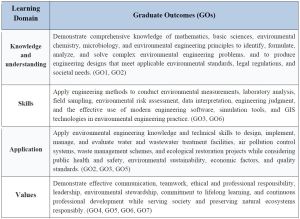
Upon successful completion of the Bachelor of Science (B.Sc.) in Environmental Engineering program, graduates are expected to achieve the Graduate Outcomes (GOs), which describe the knowledge, skills, and professional competencies required upon graduation:
1. An ability to identify, formulate, and solve environmental engineering problems by applying principles of engineering, science, and mathematics.
2. An ability to apply the engineering design process to produce solutions that meet specified needs with consideration for public health and safety, and global, cultural, social, environmental, economic, and other factors as appropriate to the environmental engineering discipline
3. An ability to develop and conduct appropriate environmental engineering experimentation, analyze and interpret data, and use engineering judgment to draw conclusion
4. An ability to communicate effectively with a range of audiences
5. An ability to recognize ethical and professional responsibilities in engineering situations and make informed judgments, which must consider the impact of engineering solutions in global, economic, environmental, and societal contexts
6. An ability to recognize the ongoing need to acquire new knowledge, to choose appropriate learning strategies, and to apply this knowledge
7. An ability to function effectively as a member or leader of a team that establishes goals, plans tasks, meets deadlines, and creates a collaborative and inclusive environment.
For more details, please visit the following link: https://uomosul.edu.iq/en/engineering/42304-2/
The Bachelor of Science (B.Sc.) in Environmental Engineering program is aligned with the Iraqi National Qualifications Framework (INQF) at Level 6. The following table illustrates how the program’s Graduate Outcomes correspond to the key learning domains defined by the INQF, ensuring that graduates acquire the knowledge, skills, competencies, and professional values required for effective engineering practice and lifelong learning:
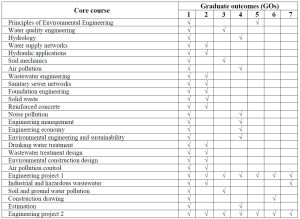
The Program Learning Outcomes (PLOs) are achieved through the integrated delivery of the Environmental Engineering curriculum. The following matrix presents the alignment between core courses and Graduate Outcomes (GOs), demonstrating how each course contributes to the development of the knowledge, skills, and professional competencies expected of graduates.
Graduates of the Bachelor of Science (B.Sc.) in Environmental Engineering are qualified to pursue professional careers in a wide range of public and private sectors, including:
• Environmental protection agencies and ministries (Ministry of Environment, Ministry of Water Resources).
• Water supply and municipal wastewater treatment entities.
• Environmental consulting firms and specialized design offices.
• Industrial and manufacturing companies in environmental compliance, safety, and waste management roles.
• Oil, gas, energy, and petrochemical corporations (environmental safety and emission control).
• Municipalities and urban planning authorities managing solid waste and sanitation.
• Environmental impact assessment and quality assurance consultancy firms.
• Non-governmental organizations (NGOs) and international bodies focused on sustainability and ecological conservation.
• Universities, research centers, and higher education institutions following the completion of postgraduate studies.
Graduates of the Bachelor of Science (B.Sc.) in Environmental Engineering may pursue postgraduate studies and professional development opportunities in the following areas:
Postgraduate Studies:
• Master’s degree in Environmental Engineering.
• Master’s degree in Environmental Management and Sustainable Development.
• Master’s degree in Sanitary & Bio-environmental Engineering.
• Doctor of Philosophy (Ph.D.) in Environmental Engineering or specialized environmental sub-fields.
Professional Development:
• Professional certification programs, such as LEED Green Associate/AP, ISO 14001 Environmental Management Systems, and Project Management Professional (PMP).
• Professional training in environmental simulation software (e.g., EPANET, SewerCad, AERMOD, ArcGIS, WaterCAD, HEC-RAS).
• Specialized workshops on environmental health and safety (OSHA / NEBOSH) and ecological risk analysis.
The Environmental Engineering Program adopts the examination, assessment, and grading regulations approved by the Ministry of Higher Education and Scientific Research (MOHESR) and the University of Mosul. Student performance is assessed through a variety of continuous and summative assessment methods, including:
• Continuous assessment (quizzes, assignments, and classroom activities).
• Midterm examinations.
• Final examinations.
• Laboratory reports and analytical practical assessments.
• Engineering design projects and environmental coursework.
• Summer field training.
• Oral presentations and research seminars.
• Graduation project assessment.
• Compliance with academic integrity regulations and institutional policies regarding academic misconduct, cheating, and plagiarism.
To be eligible for the award of the Bachelor of Science (B.Sc.) in Environmental Engineering, students must successfully fulfill all graduation requirements in accordance with the regulations of the Ministry of Higher Education and Scientific Research (MOHESR) and the University of Mosul, including:
• Successful completion of all 240 ECTS credits and all compulsory and elective courses specified in the curriculum.
• Achievement of the minimum graduation requirements, including the required cumulative Grade Point Average (GPA), in accordance with the applicable regulations.
• Successful completion of the graduation project and all required laboratory, practical, and summer field training components.
• Fulfillment of all academic and administrative requirements for the award of the bachelor’s degree.
The Bachelor of Science (B.Sc.) in Environmental Engineering is a four-year, full-time undergraduate program delivered in accordance with the Bologna Process and comprising 240 ECTS credits. The program adopts a student-centered learning approach that integrates theoretical lectures, laboratory experiments, field monitoring, practical applications, engineering design, field training, project-based learning, and modern engineering software. Students are trained to utilize industry-standard software for environmental modeling, computer-aided design, hydraulic analysis, GIS mapping, and environmental risk evaluation, including SewerCad, EPANET, TNM3.2, WaterCAD, AERMOD, AutoCAD, and other specialized engineering applications. These learning activities are further supported by seminars, technical workshops, and field visits to treatment facilities and environmental monitoring sites to enhance students’ technical competence, digital skills, and readiness for professional engineering practice.
Program Coordinator of the Bachelor of Science (B.Sc.) in Environmental Engineering
The Program Coordinator is responsible for the overall coordination, implementation, and continuous improvement of the Bachelor of Science (B.Sc.) in Environmental Engineering program. The role includes overseeing the implementation of the curriculum, monitoring the achievement of the Graduate Outcomes, coordinating academic activities among faculty members and students, supervising laboratory and field training activities, and ensuring alignment with the University of Mosul’s quality assurance policies, the Ministry of Higher Education and Scientific Research (MOHESR) regulations,
and program accreditation requirements. The Program Coordinator also supports curriculum review and enhancement to ensure that the program remains responsive to advances in environmental engineering, ecological sustainability, industry needs, and emerging green technologies.