BP – Department of Sustainable Energy Engineering
Bologna Process

x Department
The Bachelor’s program in Sustainable Energy Engineering at the University of Mosul is a four-year undergraduate engineering program designed to prepare specialized engineers in renewable energy, energy conversion and utilization, energy efficiency, sustainable energy systems, and environmentally responsible engineering. The program combines fundamental engineering, science, mathematics, and computing with specialized subjects including thermodynamics, fluid mechanics, heat transfer, electrical systems, power electronics, solar thermal and photovoltaic systems, wind energy, fuel cells, energy storage, power plants, smart grids, and sustainable building design.
The program emphasizes engineering problem solving, system design, laboratory and practical work, numerical analysis, computer-aided engineering, teamwork, innovation, professional responsibility, and lifelong learning. It integrates theoretical and practical learning through lectures, laboratories, projects, and engineering design activities. Graduates are prepared to contribute to the development, design, operation, and optimization of sustainable and renewable energy systems and to support efficient, reliable, and environmentally responsible energy infrastructure.
The Department has adopted the Bologna Education System and the European Credit Transfer and Accumulation System (ECTS), with implementation commencing in the 2025–2026 academic year. According to the Level 1 study plan, each semester is allocated 30 ECTS credits, resulting in a total of 60 ECTS credits for the first academic level. Teaching and learning are delivered through a combination of theoretical instruction, tutorials, laboratory and practical sessions, programming exercises, projects, discussions, and other module-specific learning activities.
The academic program is structured into institution requirements, college requirements, department requirements, and summer training. The program includes 3 institution-requirement courses (6 credit hours; 4.5%), 5 college-requirement courses (14 credit hours; 10.4%), and 42 department-requirement courses (114 credit hours; 85.1%), in addition to summer training.
For More details following the link: https://uomosul.edu.iq/en/engineering/42749-2/
- The department aims to offer high-quality educational programs in sustainable energy engineering at the undergraduate level, with the goal of graduating highly capable engineers. These graduates will be empowered to develop their skills continuously and provide technical support to both governmental and private sectors in their engineering projects and needs.
- The department contributes to advancing research and innovation in sustainable energy by supporting faculty members and researchers in developing cutting-edge research projects. It also plays a role in enhancing the technical qualifications of engineers working in government institutions and projects by supporting continuing education programs, organized either in collaboration with the college or independently by the department.
- The department seeks to raise awareness about the importance of sustainable energy and to contribute to its realization through educational programs, public outreach, and community-based activities.
- It is committed to equipping graduates with the knowledge and skills necessary to design, implement, and manage sustainable energy projects, thereby contributing to the development of the energy workforce.
- The department aims to build strong partnerships with industrial and production institutions involved in sustainable energy. These collaborations help align research and education efforts with practical industrial needs and applications.
- The department promotes a strong commitment to the goals of sustainable development at the local, national, and global levels through active participation in relevant research initiatives, projects, and community engagement.
Upon successful completion of the approved undergraduate program requirements, graduates are awarded a Bachelor’s degree in Sustainable Energy Engineering by the University of Mosul. The College of Engineering lists the Department of Sustainable Energy Engineering as offering a four-year Bachelor’s degree program.
To be awarded the Bachelor’s degree in Sustainable Energy Engineering, students are required to successfully complete all requirements of the approved academic program and comply with the relevant regulations and policies of the Ministry of Higher Education and Scientific Research and the University of Mosul. These requirements include:
- Successfully completing all compulsory and approved courses specified in the curriculum and obtaining the required ECTS credits for the program.
- Successfully completing all prescribed theoretical, tutorial, laboratory, practical, engineering design, project-based, and other module-specific learning activities.
- Successfully completing the required summer training in accordance with the program structure.
- Satisfying the assessment requirements of each module, including continuous/formative assessment, midterm examinations, final examinations, and other approved assessment components.
- Meeting all applicable University and Ministry requirements concerning academic progression, examinations, assessment, and graduation.
The admission capacity for the Department of Sustainable Energy Engineering is determined annually as part of the official enrollment plan, in line with the department’s human and physical resources. The department’s scientific committee proposes the number of students to be admitted, which is then submitted to the college deanery, the university presidency, and ultimately to the Ministry of Higher Education and Scientific Research for official approval.
The admission process is overseen by the Ministry of Higher Education and Scientific Research through a centralized system, which allocates students to public universities and colleges based on their preparatory school (high school) grades.
Basic Admission Requirements:
1. The applicant must be of Iraqi nationality.
2. The applicant must hold a preparatory school certificate – scientific branch, or its equivalent.
3. The applicant must meet the minimum grade threshold set annually by the ministry.
4. The applicant must not have been expelled or subjected to disciplinary action by any public educational institution.
5. Applicants must submit a medical certificate to ensure they meet the necessary health conditions.
6. The applicant must commit to full-time study.
7. Concurrent enrollment is not allowed: a student cannot be admitted if already enrolled in another college or university.
8. International students: Non-Iraqi applicants holding a recognized Iraqi preparatory certificate may be admitted in accordance with centralized admission regulations.
9. Talented students: A designated percentage of seats is reserved for talented students according to criteria set by the ministry.
o be awarded the Bachelor’s degree in Sustainable Energy Engineering, students are required to successfully complete all requirements of the approved academic program and comply with the relevant regulations and policies of the Ministry of Higher Education and Scientific Research and the University of Mosul. These requirements include:
- Successfully completing all compulsory and approved courses specified in the curriculum and obtaining the required ECTS credits for the program.
- Successfully completing all prescribed theoretical, tutorial, laboratory, practical, engineering design, project-based, and other module-specific learning activities.
- Successfully completing the required summer training in accordance with the program structure.
- Satisfying the assessment requirements of each module, including continuous/formative assessment, midterm examinations, final examinations, and other approved assessment components.
- Meeting all applicable University and Ministry requirements concerning academic progression, examinations, assessment, and graduation.
Recognition of Prior Learning (RPL) and transfer of academic credits are considered in cases of student transfer or course equivalency, in accordance with the regulations and instructions of MOHESR and the University of Mosul. Course equivalence and compatibility are evaluated by the Department Scientific Committee in coordination with the Head of Department and the Registrar’s Office.
A – Knowledge
A1– Ability to recognize, identify, define, and solve engineering problems by applying principles of engineering, science, and mathematics.
A2- Ability to produce engineering designs that meet specified needs within defined constraints by applying both analysis and synthesis in the design process.
A3- Ability to recognize the ongoing need for professional knowledge growth and to find, evaluate, compile, and properly apply it.
A4- Ability to effectively use modern technologies and contemporary engineering tools in analyzing and solving engineering problems.
B – Skills
B1- Ability to perform and test measurements accurately while ensuring quality, analyze and interpret results, and apply engineering judgment to draw conclusions.
B2- Ability to communicate effectively—verbally with groups and in writing across various administrative levels.
B3- Ability to work efficiently in teams by setting goals, planning activities, meeting deadlines, and managing risks and uncertainties.
B4- Ability to apply critical thinking methodologies and modern analytical tools to make effective decisions in solving complex engineering problems and addressing unconventional challenges.
C – Ethics
C1- Ability to recognize ethical and professional responsibilities in engineering issues and make informed decisions while considering the financial, environmental, and societal consequences.
C2- Ability to work effectively in teams by setting goals, planning activities, meeting deadlines, and managing risks and uncertainties.
Iraqi National Qualifications Framework (NQF) Matrix Iraqi National Qualifications Framework (NQF) Matrix Iraqi National Qualifications Framework (NQF) Matrix Iraqi National Qualifications Framework (NQF) Matrix Iraqi National Qualifications Framework (NQF) Matrix Iraqi National Qualifications Framework (NQF) Matrix Iraqi National Qualifications Framework (NQF) Matrix Iraqi National Qualifications Framework (NQF) Matrix Iraqi National Qualifications Framework (NQF) Matrix Iraqi National Qualifications Framework (NQF) Matrix Iraqi National Qualifications Framework (NQF) Matrix Iraqi National Qualifications Framework (NQF) Matrix Iraqi National Qualifications Framework (NQF) Matrix Iraqi National Qualifications Framework (NQF) Matrix Iraqi National Qualifications Framework (NQF) Matrix
Course and Programme Learning Outcomes Matrix Course and Programme Learning Outcomes Matrix Course and Programme Learning Outcomes Matrix Course and Programme Learning Outcomes Matrix Course and Programme Learning Outcomes Matrix Course and Programme Learning Outcomes Matrix Course and Programme Learning Outcomes Matrix Course and Programme Learning Outcomes Matrix Course and Programme Learning Outcomes Matrix Course and Programme Learning Outcomes Matrix Course and Programme Learning Outcomes Matrix Course and Programme Learning Outcomes Matrix Course and Programme Learning Outcomes Matrix Course and Programme Learning Outcomes Matrix Course and Programme Learning Outcomes Matrix Course and Programme Learning Outcomes Matrix Course and Programme Learning Outcomes Matrix Course and Programme Learning Outcomes Matrix Course and Programme Learning Outcomes Matrix Course and Programme Learning Outcomes Matrix Course and Programme Learning Outcomes Matrix Course and Programme Learning Outcomes Matrix Course and Programme Learning Outcomes Matrix Course and Programme Learning Outcomes Matrix Course and Programme Learning Outcomes Matrix Course and Programme Learning Outcomes Matrix Course and Programme Learning Outcomes Matrix Course and Programme Learning Outcomes Matrix
Graduates of the Bachelor of Science (B.Sc.) in Sustainable Energy Engineering are qualified to pursue professional careers in a wide range of public and private sectors, including:
- Sustainable energy systems
- Industries specializing in energy production and energy conservation systems.
- EV Automotive integration.
- Project management, systems integration, and quality assurance organizations.
- Governmental and private institutions requiring energy management expertise.
- Universities, research centers, and higher education institutions following the completion of postgraduate studies.
Graduates of the Bachelor of Science (B.Sc.) in Sustainable Energy Engineering may pursue postgraduate studies and professional development opportunities in the following areas:
Postgraduate Studies:
- Master’s degree in energy and sustainable energy Engineering.
- Renewable Energy Systems Engineering
Professional Development:
- Professional certification programs such as Project Management Professional (PMP).
- Advanced training in energy and industrial software, including MATLAB/Simulink, LabVIEW, Automation studio, CFDturbo, etc …
- Professional courses in CAD/CAM software.
- Continuing education, technical workshops, and professional engineering development activities.
Types of examinations and assessments are:
- Midterm and final examinations (theoretical and practical).
- Quizzes (daily and weekly).
- Scientific and technical reports.
- Evaluation of individual or group projects and research.
- Assessment of student performance in laboratories and practical experiments.
- Classroom participation and scientific discussions.
Faculty members are responsible for providing the University with an individual evaluation of each student’s work in their classes. Student performance in a course is evaluated by the course instructor using grade point values in the course system. Beginning with the 2024-2025 academic year, evaluations also include letter grades in the new Bologna system courses. Table 1 shows the grade point values and the corresponding letter grades.
Table 5.2.1 The Letter Grades and the Corresponding Grade Point Values
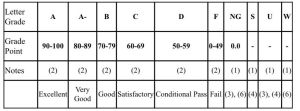
W =Withdrawal; S = Satisfactory; U = Unsatisfactory; NG = ‘Non-Gradable’ or ‘Nil Grade’ due to absenteeism.
(2) A student who receives A, A-, B, C, & D from a course is considered to have succeeded in that course. Grades C-, D+, and D, however, are ‘Conditionally Passing’ grades,’ and if the CGPA is less than 50, which is the minimum cumulative grade point average required for graduation, courses passed with these will need to be repeated.
(3) A student who receives an F, NG, or U from a course is required to take that course again in the next semester that it is offered.
(4) S and U are given for ‘Non-Credit’ Course or Program requirements.
- The grade “W” is given to students who were allowed to withdraw from a registered course between the 3rd and 11th weeks of the semester.
- Students who do not comply with the required level of attendance and/or do not fulfill the requirements for the evaluation of the course are given the “NG” grade by the Instructor of the Course based on the criteria determined by the Faculty/School Academic Council.
The types and distribution of grades vary depending on the subject. Each course typically includes a combination of semester examinations, daily assessments, homework assignments, and laboratory reports. In some subjects, students are also required to complete projects and undergo oral examinations. Certain evaluations are conducted by a panel of instructors; for instance, in the final year, students must complete a graduation project, present it orally, and participate in a formal discussion of their work as part of the assessment process. A student who does not meet these requirements will fail the course. A final printout of the course grades is submitted to the Registrar’s Office of the college, accompanied by the signatures of the exam committee and the Chair of the Department.
According to the ‘Education, Examinations, and Success Regulations’ of UoM, students eligible for graduation must fulfill all departmental requirements and achieve a minimum CGPA of 50.0. Each student’s graduation is initiated by the Department Council, reviewed by the Faculty Academic Council, and finalized upon approval by the Rector.
Graduation certificates are issued by the Registrar’s Office, specifying the completed program, graduation date, awarded title, and level. Each document bears the signatures of the Registrar, Dean of the Faculty, Rector, and the university stamp.
According to the Bylaws and Regulations, students must complete the four-year program within a maximum of six years unless valid reasons are specified. Periods of leave of absence are excluded from this time frame. Students who do not graduate within the stipulated period face dismissal from the University. However, graduating students who meet specific requirements may be granted an extension. The requirements, extension criteria, and rules governing graduating students are outlined in the Course Registration Bylaws.
The department collaborates with the Registrar’s Office to compile an ‘Academic Record Sheet’ for each student. This sheet includes the student’s name, academic term, and status. It lists course codes and references for all required graduation courses, whether for credit or noncredit, along with the academic year, semester, and grades obtained.
These details are available for advisor evaluation. This continuous monitoring ensures both the department and students stay informed about academic progress and related matters. The student’s remaining requirements, status, and obligations are determined and communicated to the department, registrar, and student.
The Bachelor of Science (B.Sc.) in Mechatronics Engineering is a four-year, full-time undergraduate program delivered in accordance with the Bologna Process and comprising 240 ECTS credits. The program consists of eight semesters, with 30 ECTS credits per semester, and adopts a student-centered learning approach integrating theoretical lectures, laboratory and workshop activities, practical applications, engineering design, programming, project-based learning, and industrial training. Engineering courses are taught in English.
Students are trained to utilize modern engineering software and computational tools for computer-aided design, mechanical and electrical modeling, control-system analysis, MATLAB/Simulink, LabVIEW, and other specialized energy related applications. These learning activities are further supported by seminars, technical workshops, and practical training to enhance students’ technical competence, and readiness for professional engineering practice in interdisciplinary fields.
Program Coordinator of the Bachelor of Science (B.Sc.) in Sustainable Energy Engineering. The Program Coordinator is responsible for the overall coordination, implementation, and continuous improvement of the Bachelor of Science (B.Sc.) in Sustainable Energy Engineering program. The role includes overseeing the implementation of the curriculum, monitoring the achievement of the Graduate Outcomes, coordinating academic activities among faculty members and students, supervising laboratory, workshop, project, and industrial training activities, and ensuring alignment with the University of Mosul’s quality assurance policies, MOHESR regulations, and program accreditation requirements. The Program Coordinator also supports curriculum review and enhancement to ensure that the program remains responsive to advances in Sustainable Energy engineering, industry needs, and energy emerging technologies.
Program Coordinator: Ali A. Mohammed, Ph. D. in Wind energy Engineering, Assistant Professor.
E-mail: [email protected]