BP – Department of Computer Engineering
Bologna Process

Department of Computer Engineering
The Bachelor of Science (B.Sc.) in Computer Engineering at the University of Mosul is a four-year, full-time undergraduate program comprising 240 ECTS credits. The program integrates mathematics, engineering sciences, electrical and electronic fundamentals, computer hardware, software, computer architecture, microprocessors, embedded systems, computer networks, operating systems, control, cybersecurity, digital signal processing, image processing, and intelligent computing. The curriculum combines theoretical study with laboratory experiments, programming and hardware implementation, system design, technical projects, summer training, and a graduation project. Graduates develop the analytical, design, implementation, testing, communication, teamwork, and problem-solving competencies required to build and evaluate modern computer-based systems. The program emphasizes professional ethics, cybersecurity awareness, innovation, lifelong learning, and responsiveness to labor-market and societal needs.
Program scope: This description covers the department’s undergraduate academic program, the Bachelor of Science (B.Sc.) in Computer Engineering.
For program and department information: https://uomosul.edu.iq/en/engineering/42576-2/ Department of Computer Engineering – College of Engineering
The Computer Engineering Program aims to:
- Provide a rigorous foundation in mathematics, science, electrical and electronic engineering, programming, digital systems, computer architecture, and the core principles of computer engineering.
- Prepare graduates to analyze, design, implement, integrate, test, and evaluate hardware-software computer systems and networked solutions that meet defined requirements and recognized engineering practices.
- Develop practical competence through laboratories, programming assignments, hardware implementation, system simulation, engineering design, technical projects, summer training, and effective use of modern engineering tools.
- Strengthen graduates’ communication, teamwork, leadership, project planning, documentation, and multidisciplinary collaboration skills for professional engineering environments.
- Promote innovation, research awareness, cyber-security and privacy responsibility, professional ethics, sustainable engineering practice, and lifelong learning so graduates can adapt to rapidly evolving computing technologies and labor-market needs. For more details visit the link: : Department of Computer Engineering – College of Engineering, Vision, Mission and Objectives – Department of Computer Engineering
Upon successful completion of the program requirements, graduates are awarded the Bachelor of Science (B.Sc.) degree in Computer Engineering by the University of Mosul.
The program is classified at Level 6 of the Iraqi National Qualifications Framework (INQF), or its equivalent, in accordance with the regulations and guidelines of the Ministry of Higher Education and Scientific Research (MOHESR).
Admission to the Bachelor of Science (B.Sc.) in Computer Engineering program is governed by the regulations and admission policies of the Ministry of Higher Education and Scientific Research (MOHESR) and the University of Mosul. Applicants must satisfy the approved admission criteria for engineering programs.
To be awarded the Bachelor of Science (B.Sc.) in Computer Engineering, students must successfully satisfy all graduation requirements, including:
- Successful completion of all 240 ECTS credits and all compulsory and elective courses specified in the approved curriculum.
- Achievement of the minimum graduation requirements in accordance with MOHESR and University of Mosul regulations.
- Successful completion of required laboratory work, practical activities, summer training, and the graduation project.
- Compliance with academic regulations governing assessment, progression, academic integrity, and graduation as approved by the Ministry of Higher Education and Scientific Research (MOHESR) and the University of Mosul.
RPL and transfer of academic credits are considered only in cases of student transfer or course equivalency, in accordance with the regulations and instructions of the Ministry of Higher Education and Scientific Research (MOHESR) and the University of Mosul.
Upon successful completion of the Bachelor of Science (B.Sc.) in Computer Engineering program, graduates are expected to achieve the following outcomes:
GO1: An ability to identify, formulate, analyze, and solve complex computer engineering problems by applying principles of engineering, science, and mathematics.
GO2: An ability to design hardware, software, embedded, networked, or integrated computer-system solutions that meet specified needs while considering safety, security, environmental, cultural, and economic constraints.
GO3: An ability to develop and conduct appropriate experiments and tests on computer hardware, software, signals, networks, and embedded systems; analyze and interpret data; and use engineering judgment to draw conclusions.
GO4: An ability to communicate effectively with technical and non-technical audiences through written reports, documentation, presentations, and professional discussion.
GO5: An ability to recognize ethical and professional responsibilities in computer engineering and make informed judgments considering cyber-security, privacy, safety, legal, societal, economic, environmental, and global impacts.
GO6: An ability to acquire and apply new knowledge as needed and maintaining continuous professional development in rapidly evolving computing technologies.
GO7: An ability to function effectively as a member or leader of a team, establish goals, plan tasks, and contribute to multidisciplinary engineering projects.
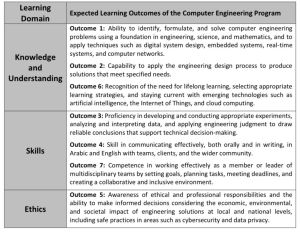
The Bachelor of Science (B.Sc.) in Computer Engineering program is aligned with the Iraqi National Qualifications Framework (INQF) at Level 6. The following table illustrates how the program’s Graduate Outcomes correspond to the key learning domains defined by the INQF, ensuring that graduates acquire the knowledge, skills, competencies, and professional values required for effective engineering practice and lifelong learning:
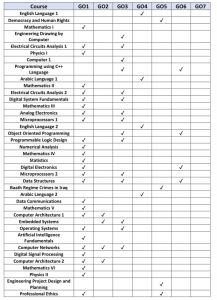
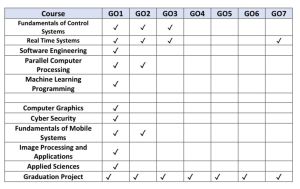
The Program Learning Outcomes (PLOs) are achieved through the integrated delivery of the Computer Engineering curriculum. The following matrix presents the alignment between the core courses and the Program Learning Outcomes (PLOs), demonstrating how each course contributes to the development of the knowledge, skills, and professional competencies expected of graduates.
Graduates of the Bachelor of Science (B.Sc.) in Computer Engineering are qualified to pursue professional careers in a wide range of technology, hardware, software, and engineering sectors, including:
- Computer hardware and digital-system design and support.
- Embedded systems, Internet of Things (IoT), and microcontroller-based applications.
- Computer networks, network administration, and infrastructure support.
- Cybersecurity, system security, and secure computing support.
- Software development, systems programming, and engineering applications.
- Computer architecture, operating systems, and real-time systems.
- Digital signal and image processing, intelligent systems, and data-driven applications.
- Technical support, system integration, testing, quality assurance, and engineering project roles.
Graduates may pursue postgraduate studies in Computer Engineering or closely related fields at universities and institutions where such programs are offered, in accordance with the admission requirements and regulations of the receiving institution. The program described in this document is the Bachelor of Science (B.Sc.) in Computer Engineering.
Graduates of the Bachelor of Science (B.Sc.) in Computer Engineering may continue their academic and professional development through postgraduate study, professional certification, specialized technical training, research activities, and continuing education, subject to the applicable regulations and the availability of such opportunities.
- Postgraduate Studies
- Master’s degree in computer engineering.
- Doctor of Philosophy (Ph.D.) in computer Engineering
For more details, please visit the postgraduate program for computer engineering
The Computer Engineering Program adopts the examination, assessment, and grading regulations approved by the Ministry of Higher Education and Scientific Research (MOHESR) and the University of Mosul. Student performance is assessed using a combination of continuous and summative methods, including:
- Continuous assessment: quizzes, assignments, programming exercises, and classroom activities.
- Midterm examinations.
- Final examinations.
- Laboratory reports, practical examinations, and hardware/software implementation tasks.
- Engineering design projects, coursework, and technical documentation.
- Summer training and related reports, where applicable.
- Oral presentations, seminars, and team activities.
- Graduation project proposal, implementation, report, presentation, and defense.
- Compliance with academic integrity regulations and institutional policies regarding misconduct, cheating, and plagiarism.
The student is eligible for a Bachelor of Science (B.Sc.) degree In computer engineering after fulfilling all academic and training requirements, learning outcomes and administrative requirements specified in the approved study plan according to the Bologna track.
Degree granting requirements include the following :
- Complete the study plan: Complete all compulsory and elective courses and the requirements of the university, college and specialization specified in the study plan.
- Complete 240 ECTS: The student must successfully complete 240 ECTS, spread over four academic years and at a rate of 60 ECTS per academic year.
- Passing courses: Passing all the required courses according to the requirements of success approved at the university.
- Achieving learning outcomes: Demonstrate the achievement of the program’s learning outcomes through success in courses, educational activities and various assessments.
- Practical training: Successful completion of the practical/summer training requirements specified in the program, in accordance with the approved controls and instructions. The training aims to provide the student with practical experience and professional skills, and link the theoretical and practical knowledge acquired during the study to the real work environment in government or industrial institutions or private sector institutions related to the field of computer engineering.
- Graduation Project: Successful completion of the graduation project during the final academic year. The graduation project represents an integrated engineering experience in which the student employs the knowledge and skills acquired during the years of study, and demonstrates his ability to identify and analyze a complex engineering problem, design, implement, test and evaluate the appropriate solution, taking into account engineering, ethical and professional standards.
- Academic rate and achievement: Achieving the requirements for the cumulative average and success in accordance with the university’s instructions and approved academic regulations.
- Complete the administrative requirements: Complete all documents and administrative procedures required for graduation and approve the academic record from the competent authorities in the department and college.
To ensure the safety and accuracy of academic records, the competent authorities in the college maintain an integrated academic file for each student, including the academic record, evaluation results, acquired study units, training documents, graduation project, and any other documents related to academic progress and the fulfillment of graduation requirements.
The student is not awarded a Bachelor of Science degree in Computer Engineering until after officially verifying that he has met all academic, training and administrative requirements, and completing 240 ECTS and graduating from the competent authorities.
The Bachelor of Science program in Computer Engineering (B.Sc.) at the Department of Computer Engineering, College of Engineering, University of Mosul, adopts a Morning and Attendance-based mode of study. The program is implemented according to the Bologna Process and the semester-based academic system, ensuring that the educational process is organized around courses It is a four-year, fill-time program consisting of 240 ECTS, credit units, and intended learning outcomes.
Courses are delivered through theoretical lectures, practical activities, and laboratory sessions, with students required to attend and participate in the approved educational activities and assessment processes. The program also supports the educational process through e-learning platforms, particularly Google Classroom, which are used to provide course materials, assignments, announcements, and academic communication between students and faculty members.
The mode of study also incorporates mandatory practical summer training and the Graduation Project as essential requirements for completing the program and awarding the Bachelor of Science degree in Computer Engineering.
The Program Coordinator is tasked with the overall coordination, implementation and continuous improvement of the Bachelor of Science (B.Sc.) in Computer Engineering program
Key Responsibilities:
- Curriculum Implementation: Overseeing the delivery of up-to-date curricula covering hardware, software integration, embedded systems, and computer networks.
- Graduate Outcomes: Monitoring and evaluating the achievement of Graduate Outcomes to ensure student readiness for the tech industry.
- Academic Coordination: Harmonizing academic activities, fostering effective communication between faculty members and students.
- Practical Training & Labs: Supervising specialized computer engineering laboratories, hands-on projects, and field training/internship programs.
- Quality Assurance & Accreditation: Ensuring full alignment with the University of Mosul’s quality assurance policies, the Ministry of Higher Education and Scientific Research (MOHESR) regulations, and program accreditation standards (e.g., ABET).
- Curriculum Enhancement: Driving continuous program updates to reflect rapid advancements in computer engineering, modern computing architectures, and emerging smart technologies.