BP – Department of Arabic Language
Bologna Process

Department of Arabic Language
The Academic Program Description provides a concise overview of the program’s vision,
mission, and objectives, including a clear description of the intended learning outcomes that
the program seeks to achieve in the fields of Arabic language, Arabic literature, and Arabic
language teaching methodologies. The program aims to develop students’ linguistic, literary,
pedagogical, research, and professional competencies in accordance with academic quality
standards and the requirements of the educational and professional environment.
The Academic Program Description provides a concise overview of the program’s vision,
mission, and objectives, including a clear description of the intended learning outcomes that
the program seeks to achieve in the fields of Arabic language, Arabic literature, and Arabic
language teaching methodologies. The program aims to develop students’ linguistic, literary,
pedagogical, research, and professional competencies in accordance with academic quality
standards and the requirements of the educational and professional environment.
Modules Catalogue – Bologna Process 2026-2027
Program Catalogue – Bologna Process2026-2027
Program Curriculum – Bologna Process 2026-2027
Bologna Module Description 2026-2027
The Course Description provides a brief summary of the main characteristics of each course and
the learning outcomes expected to be achieved by students. It also highlights the available
learning opportunities and demonstrates the course’s alignment with the program objectives
and intended learning outcomes.
PLO1 – General Knowledge and Understanding
Demonstrate the knowledge, skills, values, and competencies required upon successful
completion of the academic program, enabling female graduates to effectively apply Arabic
language, literature, and teaching methodologies in academic, educational, professional, and
research contexts.
PLO2 – Knowledge and Understanding
A1. Demonstrate comprehensive knowledge of the Arabic language, including its grammatical,
morphological, phonological, and semantic systems, as well as its rules, structures, and patterns
of use.
PLO3 – Knowledge and Understanding
A2. Demonstrate knowledge and understanding of the major concepts, genres, periods, and
trends in classical and modern Arabic literature and literary criticism.
A3. Demonstrate knowledge of the principles, theories, and contemporary methods of teaching
and learning Arabic language and its various skills.
A4. Demonstrate understanding of the fundamental principles of Arabic linguistic sciences,
linguistics, rhetoric, philology, and the analysis of linguistic and literary texts.
PLO4 – Cognitive and Intellectual Skills
B1. Analyze and interpret linguistic structures and phenomena critically and systematically.
B2. Analyze, interpret, and evaluate Arabic literary texts using appropriate critical approaches
and methods
Apply critical thinking, problem-solving, and analytical skills in academic, educational, and
professional contexts.
B4. Conduct basic academic research using appropriate research methodologies and reliable
scholarly sources, while adhering to academic documentation and citation standards.
PLO5 – Practical and Professional Skills
C1. Communicate effectively and accurately in Arabic, both orally and in writing, and apply
listening, speaking, reading, and writing skills in various contexts.
C2. Apply appropriate teaching methods, strategies, assessment techniques, and educational
technologies in Arabic language teaching.
C3. Plan, deliver, and evaluate effective Arabic language lessons in accordance with learners’
needs and educational objectives.
C4. Apply linguistic and literary analysis skills when dealing with Arabic texts, including editing
and evaluating texts according to appropriate linguistic and scholarly standards.
PLO6 – Research and Documentation Skills
Apply the principles of academic research, source criticism, analysis, interpretation,
documentation, and scholarly writing when dealing with primary and secondary sources and
transferring knowledge from them.
PLO7 – Digital Skills
Use appropriate digital applications and tools in linguistic and literary research, and in the
preservation, archiving, and electronic accessibility of Arabic texts, sources, and documents.
PLO8 – Academic Integrity and Professional Ethics
Adhere to standards of academic integrity and professional ethics in conducting research and in
analyzing, documenting, and handling texts, while respecting intellectual property rights and
preserving Arabic linguistic, literary, and cultural heritage.
PLO9 – Teamwork
Work effectively within academic and professional multidisciplinary teams and contribute to
educational, research, and cultural projects related to Arabic language and literature in
cooperation with specialists in relevant fields.
PLO10 – Scientific Communication
Communicate clearly and effectively, both orally and in writing, and present scientific, literary,
and educational ideas and findings to academic and community audiences through research,
presentations, and scholarly discussions.
PLO11 – Artificial Intelligence and Digital Technologies
Use artificial intelligence tools and digital technologies responsibly and ethically in linguistic,
literary, and educational research, including text analysis, linguistic data processing, and
searching digital resources, while verifying the accuracy of results and maintaining academic
integrity.
PLO12 – Sustainability and Lifelong Learning
Consider the principles of sustainability and digital transformation when using educational and
research resources and tools, contribute to reducing reliance on printed materials through the
effective use of digital resources and platforms, and develop lifelong learning and professional
development skills.
Upon successful completion of the program requirements, female graduates are awarded the
Bachelor of Education in Arabic Language degree by the University of Mosu
The program is classified at Level 6 of the Iraqi National Qualifications Framework (INQF), or its
equivalent, in accordance with the regulations and guidelines of the Ministry of Higher
Education and Scientific Research (MOHESR) and the University of Mosul
Admission to the Bachelor of Education in Arabic Language program is governed by the
regulations and admission policies of the Ministry of Higher Education and Scientific Research
(MOHESR) and the University of Mosul. Applicants must meet the approved admission criteria
for the Arabic Language program.
Admission to the Bachelor of Education in Arabic Language program is governed by the
regulations and admission policies of the Ministry of Higher Education and Scientific Research
(MOHESR) and the University of Mosul. Applicants must meet the approved admission criteria
for the Arabic Language program.
To be awarded the Bachelor of Education in Arabic Language degree, students must
successfully satisfy all graduation requirements, including:
▪ Successful completion of all 240 ECTS credits, including all compulsory and elective courses
specified in the curriculum.
▪ Achievement of the minimum graduation requirements in accordance with the regulations of
the Ministry of Higher Education and Scientific Research (MOHESR) and the University of Mosul.
▪ Successful completion of all required field training, practical applications, and other practical
components of the program, where applicable.
▪ Compliance with all academic regulations governing assessment, progression, and graduation
as approved by the Ministry of Higher Education and Scientific Research (MOHESR) and the
University of Mosul.
Recognition of Prior Learning (RPL) and the transfer of academic credits are considered only in
cases of student transfer or course equivalency, in accordance with the regulations and
instructions of the Ministry of Higher Education and Scientific Research (MOHESR) and the
University of Mosul.
Upon successful completion of the Bachelor of Education in Arabic Language program, female
graduates are expected to achieve the following Program Learning Outcomes (PLOs) or
Graduate Outcomes (GOs), which describe the knowledge, skills, and professional competencies
required upon graduation.
PLO1 – General Knowledge and Understanding
Demonstrate the knowledge, skills, values, and competencies required upon successful
completion of the academic program, enabling female graduates to effectively apply Arabic
language, literature, and teaching methodologies in academic, educational, professional, and
research contexts.
PLO2 – Knowledge and Understanding
A1. Demonstrate comprehensive knowledge of the Arabic language, including its grammatical,
morphological, phonological, and semantic systems, as well as its rules, structures, and patterns
of use.
PLO3 – Knowledge and Understanding
A2. Demonstrate knowledge and understanding of the major concepts, genres, periods, and
trends in classical and modern Arabic literature and literary criticism.
A3. Demonstrate knowledge of the principles, theories, and contemporary methods of teaching
and learning Arabic language and its various skills.
A4. Demonstrate understanding of the fundamental principles of Arabic linguistic sciences,
linguistics, rhetoric, philology, and the analysis of linguistic and literary texts.
PLO4 – Cognitive and Intellectual Skills
B1. Analyze and interpret linguistic structures and phenomena critically and systematically.
B2. Analyze, interpret, and evaluate Arabic literary texts using appropriate critical approaches
and methods.
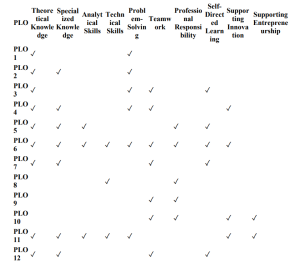
The Bachelor of Education in Arabic Language program is aligned with the Iraqi National
Qualifications Framework (INQF) at Level 6. The following table illustrates how the program’s
Graduate Outcomes correspond to the key learning domains defined by the INQF, ensuring that
female graduates acquire the knowledge, skills, competencies, and professional values required
for effective professional and academic practice and lifelong learning.
The Program Learning Outcomes (PLOs) are achieved through the integrated delivery of
the Arabic Language curriculum. The following matrix presents the alignment between
the core courses and the Program Learning Outcomes (PLOs), demonstrating how each
course contributes to the development of the knowledge, skills, and professional
competencies expected of female graduates.
Graduates of the Department of Arabic Language can work in the following fields:
1. Ministry of Education – Education Sector
Employment as Arabic language teachers in schools and educational institutions, with the ability
to contribute to educational and pedagogical activities, support curricula, develop students’
language skills, and promote awareness of the Arabic language and its literature.
2. Ministry of Higher Education and Scientific Research – Universities and Research Centers
Employment in academic and research fields related to Arabic language and literature, with
opportunities to pursue postgraduate studies and specialize in areas such as linguistics,
grammar, morphology, rhetoric, literature, literary criticism, language teaching methodologies,
and related fields, in accordance with applicable regulations and instructions.
3. Cultural and Media Institutions and the Publishing Sector
Working in media and cultural institutions, publishing houses, journals, newspapers, and digital
platforms in areas such as language editing, proofreading, content writing, journalistic editing,
and the preparation of cultural and educational materials.
4. Governmental and Community Institutions
Contributing to positions that require linguistic, writing, and communication skills, including
preparing documents, correspondence, and reports, language editing and proofreading, and
participating in cultural and community activities.
5. Cultural and Heritage Institutions, Libraries, and Manuscript Centers
Working in institutions concerned with Arab cultural heritage, libraries, documentation centers,
and manuscript repositories, contributing to the cataloguing of sources and documents, textual
editing, and the documentation, preservation, and digitization of Arabic heritage.
6. Technology and Artificial Intelligence Sector – Arabic Language Processing and Digital
Humanities
Contributing to the development of Arabic digital content, linguistic databases, digital
educational resources, Arabic language processing applications, and artificial intelligence tools
related to language and texts, in cooperation with specialists in computer science and artificial
intelligence.
7. Training Centers and Private Educational Institutions
Working in training centers and private educational institutions in areas related to Arabic
language teaching, educational content development, language training, and professional
development.
8. Freelancing and Entrepreneurship
Establishing individual or collaborative projects and initiatives in areas such as e-learning, Arabic
content creation, language editing and proofreading, language training, and cultural and digital
services.
Opportunities to Further Study or Progression to Postgraduate Studies
Graduates of the Bachelor of Education in Arabic Language program may pursue postgraduate
studies and professional development opportunities in the following areas:
Postgraduate Studies
• Master’s degree in Arabic Language and Linguistics.
• Master’s degree in Arabic Literature and Literary Criticism.
• Master’s degree in Arabic Language Teaching Methodologies.
• Postgraduate studies in related fields in accordance with the approved regulations and
admission requirements.
Graduates of the Bachelor of Education in Arabic Language program may pursue postgraduate
studies and professional development opportunities in the following areas:
Postgraduate Studies
• Master’s degree in Arabic Language and Linguistics.
• Master’s degree in Arabic Literature and Literary Criticism.
• Master’s degree in Arabic Language Teaching Methodologies.
• Postgraduate studies in related fields in accordance with the approved regulations and
admission requirements
The Arabic Language Program adopts the examination, assessment, and grading regulations
approved by the Ministry of Higher Education and Scientific Research (MOHESR) and the
University of Mosul. Student performance is assessed through a variety of continuous and
summative assessment methods, including:
• Continuous assessment, including quizzes, assignments, and classroom activities.
• Midterm examinations.
• Final examinations.
• Reports, activities, and practical applications, where applicable.
• Field training and practical teaching.
• Oral presentations and seminars.
• Graduation project assessment, in accordance with program requirements
Compliance with academic integrity regulations and institutional policies regarding
academic misconduct, cheating, and plagiarism
To be eligible for the award of the Bachelor of Education in Arabic Language, students must
successfully fulfill all graduation requirements in accordance with the regulations of the Ministry
of Higher Education and Scientific Research (MOHESR) and the University of Mosul, including:
• Successful completion of all approved academic credits and all compulsory and elective
courses specified in the curriculum.
• Achievement of the minimum graduation requirements, including the required
cumulative Grade Point Average (GPA), in accordance with the applicable regulations.
• Successful completion of the graduation project, field training, and all required practical
components of the program, where applicable.
• Fulfillment of all academic and administrative requirements for the award of the
bachelor’s degree.
The Bachelor of Education in Arabic Language is a four-year undergraduate program delivered
in accordance with the Bologna Process and comprising the academic credits specified in the
approved curriculum.
The program adopts a student-centered educational approach that integrates theoretical
lectures, practical applications, field training, project-based learning, and modern digital and
educational technologies in the study and teaching of Arabic language and literature. These
educational activities are supported by seminars, workshops, and practical training to enhance
students’ specialized competencies, digital and research skills, and readiness for academic,
educational, and professional practice.
Program Coordinator of the Bachelor of Education in Arabic Language
The Program Coordinator is responsible for the overall coordination, implementation, and
continuous improvement of the Bachelor of Education in Arabic Language program.
The role includes overseeing the implementation of the curriculum, monitoring the
achievement of the Program Learning Outcomes, coordinating academic activities among
faculty members and students, supervising field training and practical activities, and ensuring
alignment with the University of Mosul’s quality assurance policies, the Ministry of Higher
Education and Scientific Research (MOHESR) regulations, and program accreditation
requirements.
The Program Coordinator also supports curriculum review and enhancement to ensure that the
program remains responsive to developments in Arabic language and literature, Arabic language
teaching methodologies, labor market needs, and emerging educational technologies