BP – Department of Physical Education and Sport Sciences
Bologna Process

Department of Physical Education and Sport Sciences
The academic description of the program provides a brief presentation of the program’s
vision, mission, and goals, and includes a clear description of the targeted learning outcomes
that the program seeks to achieve in the fields of science in physical education and sports
sciences.
Course Description
The course description provides a brief summary of the main characteristics of each
course and the learning outcomes that students are expected to achieve. It also highlights the
learning opportunities available and demonstrates the alignment of the course with the
program’s objectives and targeted learning outcomes.
Program Vision
Leadership and excellence in preparing scientifically and professionally qualified
graduates in the field of physical education and sports sciences, capable of contributing to the
development of sports, promoting health, physical activity, and community service, and keeping
pace with modern scientific and technical developments at the national and regional levels.
Program Mission
The Bachelor of Physical Education and Sport Sciences program at the University of Mosul is
committed to providing high-quality academic education in accordance with the requirements of
the Bologna Track, quality standards, and academic accreditation, through student-centered
learning, applied training, scientific, professional and digital competency development,
preparing graduates capable of working in the fields of physical education, sports, health, sports
management, and scientific research, in a way that contributes to community service and
sustainable developm.
Modules Catalogue – Bologna Process 2026-2027
Program Catalogue – Bologna Process2026-2027
Program Curriculum – Bologna Process 2026-2027
Bologna Module Description 2026-2027
| The Bachelor of Physical Education and Sport Science program aims to: 1. Providing students with basic and applied scientific knowledge in the fields of physical education and sports sciences, in accordance with the Iraqi higher education standards and the requirements of the Bologna track. 2. Developing practical, professional and leadership skills necessary to plan, implement and evaluate educational and training programs and sports activities according to modern scientific foundations. 3. Developing the analytical, research, and digital capabilities of students through the employment of modern technologies, statistical software, and artificial intelligence applications in the fields of sports and scientific research. 4. Preparing graduates capable of working in the fields of physical education, sports training, sports management, health and fitness, and organizing sports events, in a way that meets the needs of the labor market. 5. Promoting the understanding of physical activity, human movement, health and sport in the light of the social, cultural and humanitarian dimensions, in a way that contributes to improving the quality of life and building a healthy and physically active society. 6. Consolidating the values of professional and ethical responsibility, teamwork, and lifelong learning, and encouraging graduates to pursue continuous professional development and pursue postgraduate studies. |
| Upon successful completion of the program’s requirements, graduates are awarded a Bachelor’s degree in Education – Physical Education and Sport Science from the University of Mosul. |
| The program is classified at the sixth level of the Iraqi National Qualifications Framework (INQF), or its equivalent, in accordance with the regulations and instructions approved by the Ministry of Higher Education and Scientific Research and the University of Mosul. |
| Admission to the Bachelor of Education – Physical Education and Sport Sciences program is subject to the regulations and admission policies approved by the Ministry of Higher Education and Scientific Research and the University of Mosul. Applicants must meet the approved admission criteria for admission to the Physical Education and Sport Sciences program. |
To be awarded a Bachelor of Education – Physical Education and Sport Science
degree, students must successfully meet all graduation requirements, including:
Completion of all 240 credits of ECTS, including all compulsory and elective courses
specified in the curriculum.
▪ Achieving the minimum graduation requirements in accordance with the regulations
and instructions of the Ministry of Higher Education and Scientific Research and the University
of Mosul.
▪ Complete all field training requirements, practical applications, and other practical
components required in the program, where applicable.
▪ Comply with all academic regulations related to assessment, transfer, and graduation,
approved by the Ministry of Higher Education and Scientific Research and the University of
Mosul.
Recognition of Prior Learning (RPL) and transfer of credits shall be considered only in
cases of transfer of female students or equivalence of courses, in accordance with the
regulations and instructions approved by the Ministry of Higher Education and Scientific
Research and the University of Mosul
The Bachelor of Physical Education and Sport Sciences program prepares its graduates
for continuing learning and continuous professional development by providing them with the
knowledge, skills, and competencies necessary to adapt to the rapid developments in the fields
of physical education and sport sciences.
The program enables graduates to:
Embrace the concept of lifelong learning and continuous professional development to
support their professional and personal growth.
• Join postgraduate programs (Higher Diploma, Master’s, and PhD) in Physical Education,
Sport Sciences and related disciplines, in accordance with the admission requirements and
approved regulations.
• Participate in training courses, workshops, specialized professional programs, and obtain
professional certificates and licenses in the fields of sports training, physical preparation,
sports management, refereeing, physical fitness, and sports rehabilitation.
• Employing digital technologies, statistical software, and artificial intelligence applications in
professional development, scientific research, and various fields of sports work.
• Contribute to the production of knowledge and the development of professional practices
through scientific research, self-learning, and interaction with scientific and technical
developments.
Through its focus on applied learning, field training, and the development of
professional, digital, and research skills, the program ensures that graduates are able to adapt to
the demands of the labor market, have professional and ethical responsibility, and are able to
contribute effectively to the development of physical education, sports sciences, community
service, and sustainable development
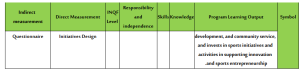
The Bachelor of Education – Specialization in Physical Education and Sport Sciences is
aligned with the sixth level of the Iraqi National Qualifications Framework (INQF). The
following table shows the extent to which the graduates’ outputs in the program are aligned
with the main areas of learning identified in the Iraqi National Qualifications Framework,
ensuring that graduates possess the knowledge, skills, competencies and professional values
necessary for effective professional and academic practice, and lifelong learning
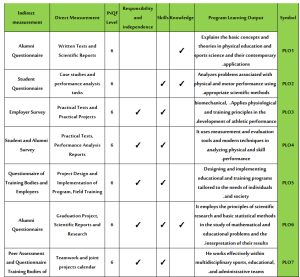
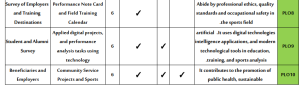
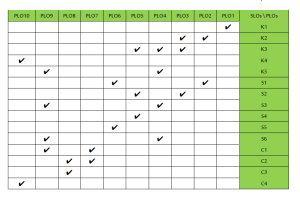
Through integration in the delivery of PLOs) are achieved ) Program Learning Outcomes
illustrates the extent to which the core Arabic language program courses. The following matrix
courses are aligned with the program’s learning outcomes, showing how each course
contributes to the development of the graduates’ expected professional knowledge, skills, and competencies.

The Bachelor of Physical Education and Sport Sciences program prepares graduates with
specialized knowledge, applied skills, and professional competencies that qualify them to work
in the fields of physical education, sports training, sports management, health and fitness, and
community activities. The program is designed according to a modern educational methodology
that combines scientific foundations, practical applications, and field training, in order to
enhance the readiness of graduates to integrate into the local and regional labor market.
The program also focuses on developing digital, research and entrepreneurial skills by
including modern courses and applications in the fields of sports statistics, modern learning
techniques, sports investment and marketing, and artificial intelligence and its applications in
sports sciences, which contributes to expanding the horizons of employment and raising the
competitiveness of graduates.
Graduates of the program can work in schools and educational institutions, sports clubs
and federations, fitness and sports rehabilitation centers, youth and sports departments, and
community institutions, in addition to the possibility of continuing postgraduate studies and
engaging in the fields of scientific research and continuous professional development.
The Bachelor of Physical Education and Sport Sciences program prepares its graduates
for continuing learning and continuous professional development by providing them with the
knowledge, skills, and competencies necessary to adapt to the rapid developments in the fields
of physical education and sport sciences.
The program enables graduates to:
• Embrace the concept of lifelong learning and continuous professional development to
support their professional and personal growth.
• Join postgraduate programs (Higher Diploma, Master’s, and PhD) in Physical Education,
Sport Sciences and related disciplines, in accordance with the admission requirements and
approved regulations.
• Participate in training courses, workshops, specialized professional programs, and obtain
professional certificates and licenses in the fields of sports training, physical preparation,
sports management, refereeing, physical fitness, and sports rehabilitation.
• Employing digital technologies, statistical software, and artificial intelligence applications in
professional development, scientific research, and various fields of sports work.
• Contribute to the production of knowledge and the development of professional practices
through scientific research, self-learning, and interaction with scientific and technical
developments.
Through its focus on applied learning, field training, and the development of
professional, digital, and research skills, the program ensures that graduates are able to adapt to
the demands of the labor market, have professional and ethical responsibility, and are able to
contribute effectively to the development of physical education, sports sciences, community
service, and sustainable development
The Bachelor of Physical Education and Sport Sciences program implements a
comprehensive and continuous evaluation system that is consistent with the principles of the
Bologna Track and the European System of Transfer and Clustering of Credit Hours (ECTS). The
assessment methods are designed to measure the extent to which students achieve program
learning outcomes (PLOs) in the areas of knowledge, intellectual skills, practical skills, and
transferable general skills. A variety of assessment tools are used to ensure fairness, honesty,
and reliability, taking into account the practical and practical nature of the program.
The main evaluation methods include:
Written exams: They are used to measure students’ understanding of theoretical concepts,
principles, and basic knowledge in physical education and sports sciences.
Practical Skills Assessment: Assessment of mathematical skills, teaching methods, physical
performance, and applied competencies through direct observation, performance tests, and
practical exams.
Continuous Assessment: Includes short quizzes, assignments, and classroom activities that
are carried out throughout the semester to monitor student progress and support formative
assessment.
Projects and Quarterly Works: Individual and group projects aimed at assessing problemsolving abilities, applying theory in practice, teamwork, and communication skills.
Evaluation of Field Training and Practical Application of Teaching: Evaluation of
students’ professional performance during supervised field training, based on specific
evaluation criteria, reflective reports, and feedback from supervisors.
Oral and practical presentations: Used to measure communication skills, conceptual
comprehension, and the ability to present practical ideas and tasks effectively.
Participation and Attendance: It is part of the formative calendar in practical and applied
courses, and reflects the level of interaction, discipline, and professional behavior.
Assessment weights are determined according to the nature of the course and its value
of credit hours (ECTS), ensuring that the learning load, learning activities, and assessment
requirements are aligned. Both the formative and concluding calendars are used to support
student learning, provide timely feedback, and ensure that targeted learning outcomes are
achieved
In order to be eligible for a Bachelor’s Degree in Education – Physical Education and
Sport Sciences, a student must successfully meet all graduation requirements, in accordance
with the regulations and instructions of the Ministry of Higher Education and Scientific
Research and the University of Mosul, including:
Completion of all credits and compulsory and elective courses specified in the study
plan.
Achieve minimum graduation requirements, including the required GPA, in accordance
with the applicable regulations.
Completion of the graduation project, field training, and practical applications required
in the program, where applicable.
Meet all the academic and administrative requirements necessary to award a bachelor’s
degree.
The Bachelor of Science in Physical Education and Sport Science program is a four-year
undergraduate program, fully compatible with the Bologna System and the European Balance
Transfer and Accumulation System (ECTS). The program consists of 240 credits of study (ECTS)
spread over eight semesters, with each credited unit equivalent to 25 hours of coursework,
including teaching hours, hands-on training, self-paced learning, and assessment activities.
The curriculum is designed to provide students with an integrated and cutting-edge
learning path, starting with core courses in physical education, human anatomy, basic
physiology, motor skills, and general fitness during the first year. In later years, the program
specializes in areas such as sports training principles, biomechanics, motor learning, sports
psychology, sports physiology, sports management, teaching methods, and applied
mathematical skills.The structure of the program ensures a balanced distribution of learning components
between the core, major, supportive and elective courses, achieving a balance between
theoretical and practical aspects and ensuring the achievement of targeted learning outcomes,
including mathematical skills training, field training, hands-on teaching training, and supervised
professional activities. Hands-on learning is a core component of the program, and is delivered
through structured sports sessions, applied training modules, and real-world learning and
training contexts.
The following table shows the percentage distribution of courses in the program

Programme Director: Assoc . Prof. Dr. Rasha Kedar Abdel Hamid
Specializations Kinesian Learning
Phone 07701661875
Official Email [email protected]
Programme coordinator Assoc. Prof Dr. Refqa Moayed Saeed
Specializations Teaching methods
Phone: 07723430350
Official Email [email protected]