BP – Department of Artificial Intelligence
Bologna Process

Department of Artificial Intelligence
University Name: University of Mosul
Faculty/Institute: College of Computer Science and Mathematics
Scientific Department: Department of Artificial Intelligence
Academic or Professional Program Name: Artificial Intelligence
Final Certificate Name: Bachelor of Science in Artificial Intelligence
Academic System: Bologna System / (First and Second Phase)
Description Preparation Date: 10/9/2025
File Completion Date: 10/9/2025
Modules_Catalogue – Bologna process 2025-2026
program Catalogue – Bologna process 2025-2026
1.The primary objective of the Artificial Intelligence Department is to equip students with the fundamental knowledge and skills required for the development and application of advanced AI technologies.
- The program aims to create employment opportunities in both the private and public sectors, including IT companies, engineering industries, digital marketing, the healthcare sector, and many other fields that actively seek AI graduates
Bachelor of Science in Artificial Intelligence (B.Sc. in Artificial Intelligence).
a Bachelor’s degree corresponds to Level 6.
Admission is based on the Centralized Admission System managed by the Ministry of Higher Education and Scientific Research. Applicants must hold an Iraqi Secondary School Certificate (Scientific or Applied branch) or its recognized equivalent, meeting the minimum grade threshold set for the College of Computer Science and Mathematics for the respective academic year.
To be awarded the degree, students must successfully complete all structural curriculum requirements (Institutional, College, and Department requirements). This includes passing all required core and elective courses, accumulating the total ECTS credit hours designated for the program (typically 240 ECTS over 4 years), and achieving a cumulative passing grade in accordance with the ministry’s academic regulations.
A-Knowledge – Cognitive Objectives
A1. Acquire fundamental knowledge of the concepts, theories, and algorithms underlying artificial intelligence, and understand its mathematical, computational, and programming foundations.
A2. Understand recent developments in artificial intelligence, including machine learning, deep learning, natural language processing, and computer vision, as well as their technological, economic, and social impacts.
A3. Demonstrate knowledge of problem-analysis methodologies, intelligent-system design, scientific research principles, artificial
intelligence ethics, data privacy, and data security.
B-Skills – Skills-Based Objectives
English:B1. Analyze real-world and complex problems, identify their requirements, and propose appropriate scientific solutions using artificial intelligence techniques.
B2. Apply and develop artificial intelligence and machine learning algorithms, evaluate their performance, and select the most appropriate algorithm according to the nature of the problem and the available data.
B3. Use modern programming languages (such as Python), tools, and specialized software platforms to design, implement, and test artificial intelligence systems.
B4. Design and develop intelligent models and systems that meet the needs of various sectors, including healthcare, industry, education, marketing, agriculture, and services.
B5. Prepare reports, projects, and scientific research, interpret the results of intelligent models, and present them clearly and scientifically to support decision-making
C- Values – Values-Based Objectives:
C1. Demonstrate commitment to professional ethics, academic integrity, and responsibility in the design, development, and use of artificial intelligence systems.
C2. Protect data privacy and confidentiality, respect intellectual property rights, and consider fairness, transparency, and the reduction of bias in intelligent systems.
C3. Work effectively as part of a team, share ideas and knowledge, assume responsibility, communicate professionally, and respect diversity and different viewpoints.
C4. Commit to lifelong learning, creativity, innovation, and keeping pace with rapid developments in artificial intelligence.
C5. Employ artificial intelligence technologies responsibly to serve society, support sustainable development, and address priority societal challenges
A-Knowledge – Cognitive Objectives
A1. Acquire fundamental knowledge of the concepts, theories, and algorithms underlying artificial intelligence, and understand its mathematical, computational, and programming foundations.
A2. Understand recent developments in artificial intelligence, including machine learning, deep learning, natural language processing, and computer vision, as well as their technological, economic, and social impacts.
A3. Demonstrate knowledge of problem-analysis methodologies, intelligent-system design, scientific research principles, artificial
intelligence ethics, data privacy, and data security.
B-Skills – Skills-Based Objectives
English:B1. Analyze real-world and complex problems, identify their requirements, and propose appropriate scientific solutions using artificial intelligence techniques.
B2. Apply and develop artificial intelligence and machine learning algorithms, evaluate their performance, and select the most appropriate algorithm according to the nature of the problem and the available data.
B3. Use modern programming languages (such as Python), tools, and specialized software platforms to design, implement, and test artificial intelligence systems.
B4. Design and develop intelligent models and systems that meet the needs of various sectors, including healthcare, industry, education, marketing, agriculture, and services.
B5. Prepare reports, projects, and scientific research, interpret the results of intelligent models, and present them clearly and scientifically to support decision-making
C- Values – Values-Based Objectives:
C1. Demonstrate commitment to professional ethics, academic integrity, and responsibility in the design, development, and use of artificial intelligence systems.
C2. Protect data privacy and confidentiality, respect intellectual property rights, and consider fairness, transparency, and the reduction of bias in intelligent systems.
C3. Work effectively as part of a team, share ideas and knowledge, assume responsibility, communicate professionally, and respect diversity and different viewpoints.
C4. Commit to lifelong learning, creativity, innovation, and keeping pace with rapid developments in artificial intelligence.
C5. Employ artificial intelligence technologies responsibly to serve society, support sustainable development, and address priority societal challenges
The Program Learning Outcomes (Knowledge, Skills, and Values) detailed in section (8) are mapped directly against the Level 6 descriptors of the Iraqi National Qualifications Framework (NQF) for Bachelor’s degrees or its equivalent, in accordance with the regulations and guidelines of the Ministry of Higher Education and Scientific Research
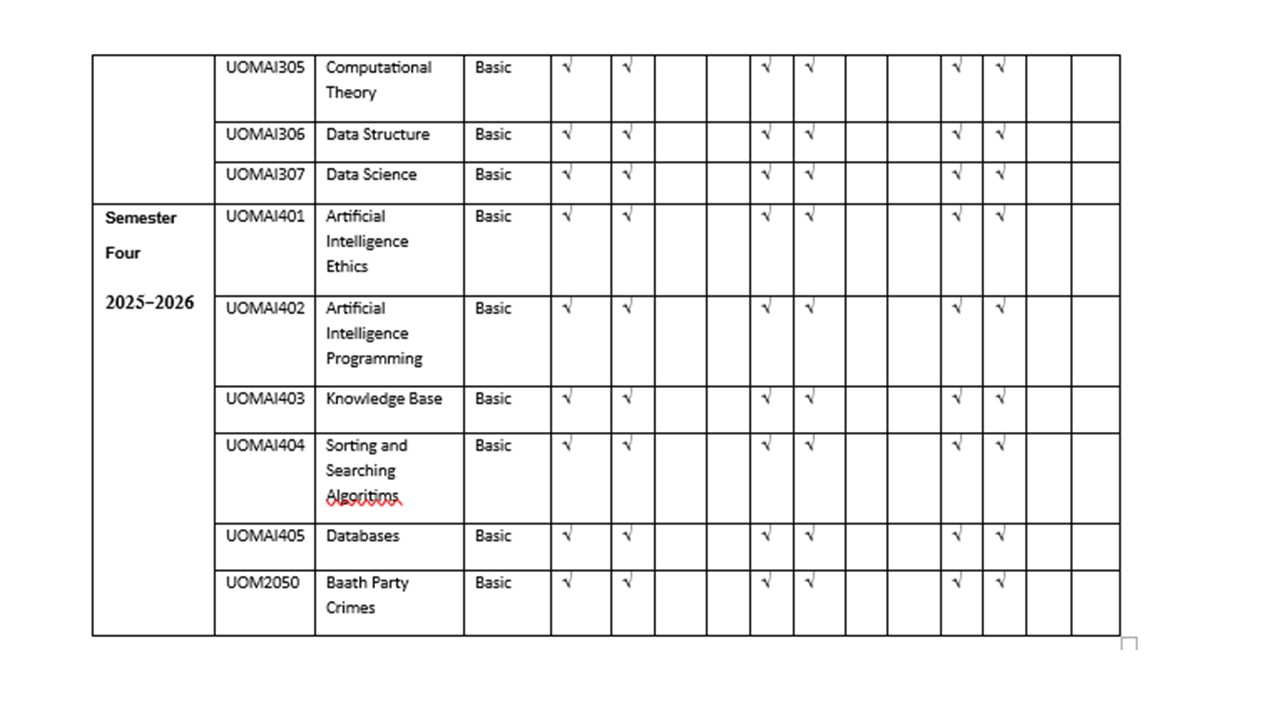
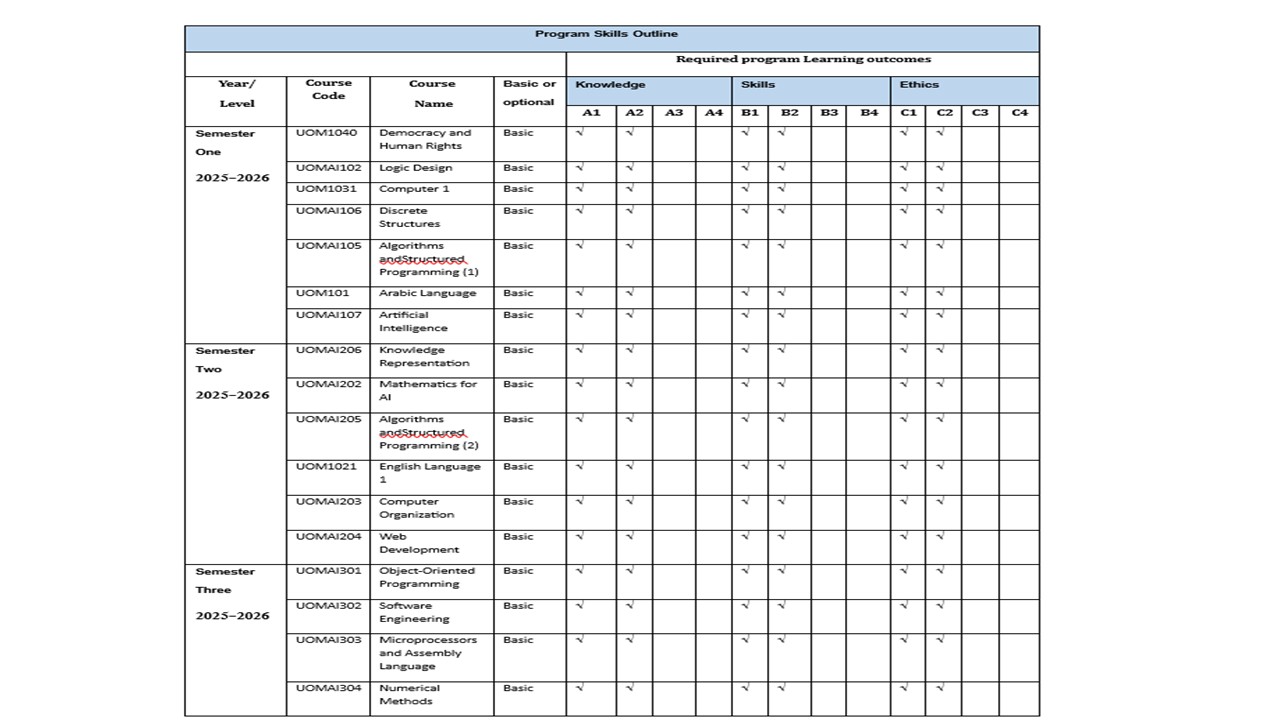
descriptors of the Iraqi National Qualifications Framework (NQF) for Bachelor’s degrees.
Graduates are qualified to pursue professional careers in technology sectors, holding roles such as: AI Engineer, Data Scientist, Machine Learning Developer, Software Developer, Intelligent Systems Analyst, and AI Data Security Specialist.
Graduates holding this Bachelor’s degree are eligible to directly apply for postgraduate studies (Master of Science – M.Sc. and Doctor of Philosophy – Ph.D.) in Artificial Intelligence, Computer Science, Data Science, Software Engineering, and other advanced specialized technological disciplines locally and internationally.
The program complies with the official Bologna Process regulations approved by the Iraqi Ministry of Higher Education and Scientific Research. Assessment is continuous throughout the semester and is split into: Formative Assessment (quizzes, midterms, hands-on laboratory activities, reports, and team projects) accounting for 40%, and a Summative Assessment (written final examination) accounting for 60%. The minimum overall grade required to pass any academic course is 50%.
To graduate, students must successfully complete all mandatory and elective courses within the curriculum, accumulating the total required credit units (typically 240 ECTS units over 4 years) in accordance with the Bologna Process. Additionally, students must maintain a cumulative average above the passing grade (50%), successfully complete and defend a capstone graduation project, and pass the mandatory summer internship program.
Full-Time / Face-to-Face (On-campus attendance for theoretical lectures and practical laboratory sessions).
Head of the Artificial Intelligence Department / The Academic Committee Overseeing the Programmed in the College of Computer Science and Mathematics.