BP – Department of Mathematics
Bologna Process

Department of Mathematics
The Bachelor of Science (B.Sc.) in Mathematics at the University of Mosul is a four-year, full-time undergraduate program comprising 240 ECTS credits aligned with the Bologna Process. The curriculum provides a rigorous foundation in calculus, linear algebra, and differential equations. Students then advance to specialized studies in complex analysis, topology, cryptography, numerical analysis and computational mathematics.
The program integrates theoretical proofs with practical computer programming labs and mathematical modeling. In their final year, students execute a graduation research project to apply their theoretical knowledge to complex problems.
Graduates secure the analytical, logical, and computational skills necessary to drive evidence-based solutions. They enter the labor market prepared for roles in algorithm development, data analysis, financial modeling, and education, or they can progress directly into postgraduate studies.
For more details, please visit the following links
Modules Catalogue – Bologna Process 2025-2026
Program Catalogue – Bologna Process 2025-2026
- Maintain continuous excellence in education, scientific research, and professional service.
- Prepare students for the labor market and develop their communication skills.
- Encourage teamwork and idea demonstration through graduation projects.
- Prepare specialized scientific leaders and qualify students for graduate studies.
- Foster interaction with other scientific disciplines.
Graduates earn a Bachelor of Science in Mathematics.
First Cycle within the Bologna Process.
The Department of Mathematics adheres to the admission systems approved by the University and the Ministry. Applicants must hold a high school diploma or equivalent, achieving the required score for the program within the approved capacity. Selection among applicants is based on academic average, while considering student preferences. Final admission is subject to official approval, with the College offering internal transfer opportunities according to specific regulations.
Students must complete 240 ECTS (European Credit Transfer and Accumulation System) units over four academic years (eight semesters).
The department evaluates previous academic records for transfer students. We convert approved prior studies into ECTS units to prevent course repetition and ensure smooth academic integration.
Knowledge (A)
- The student should grasp mathematical sciences and use scientific methods in proof and individual analysis as a foundation for research and study.
- Use analytical and numerical methods to solve any problem and find the optimal solution.
- Enhance the student’s proficiency in both general and specialized fields of mathematics.
Skills (B)
- Enable the student to develop logical thinking skills.
- Train the student in analysis and the application of course-related concepts.
- Enhance the student’s cognitive and self-learning abilities within the specialization, as this is a crucial aspect of their field.
- Equip the student with communication skills and the effective use of modern teaching technologies.
Ethics (C)
- Theoretical, practical, and applied lecture
- Computer-assisted teaching and topic presentations using data show
- Assigning students research projects.
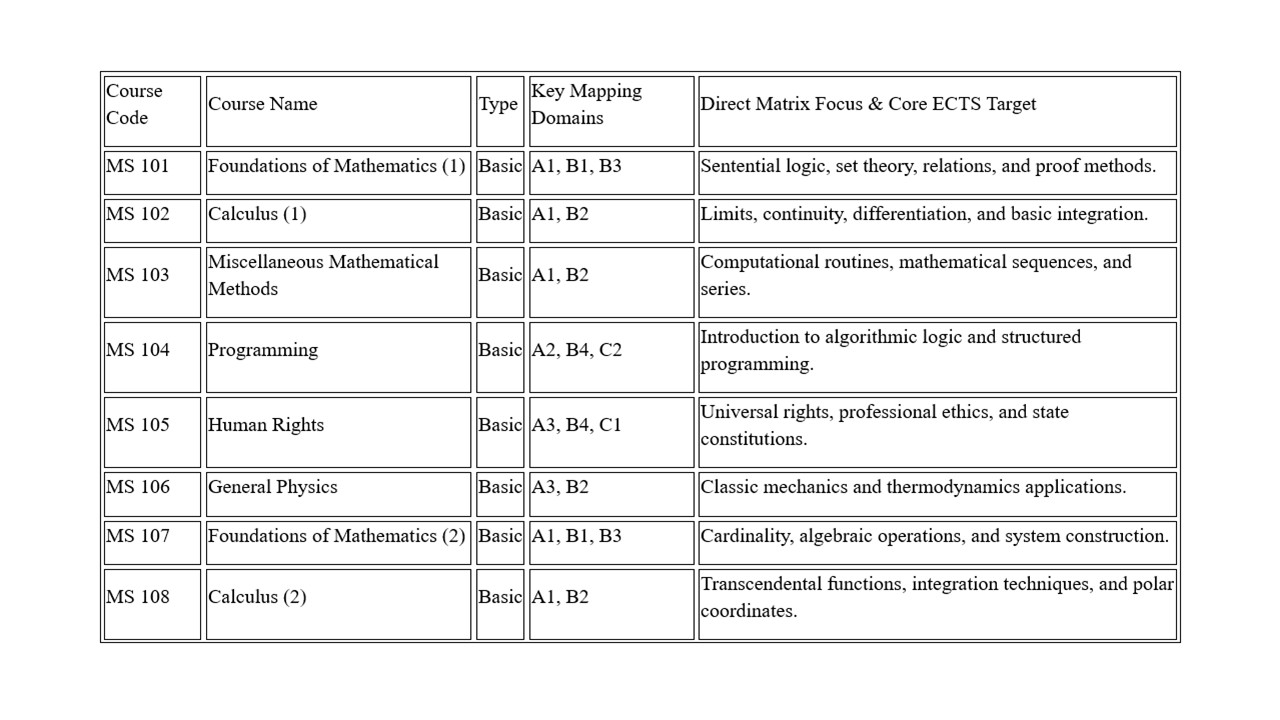
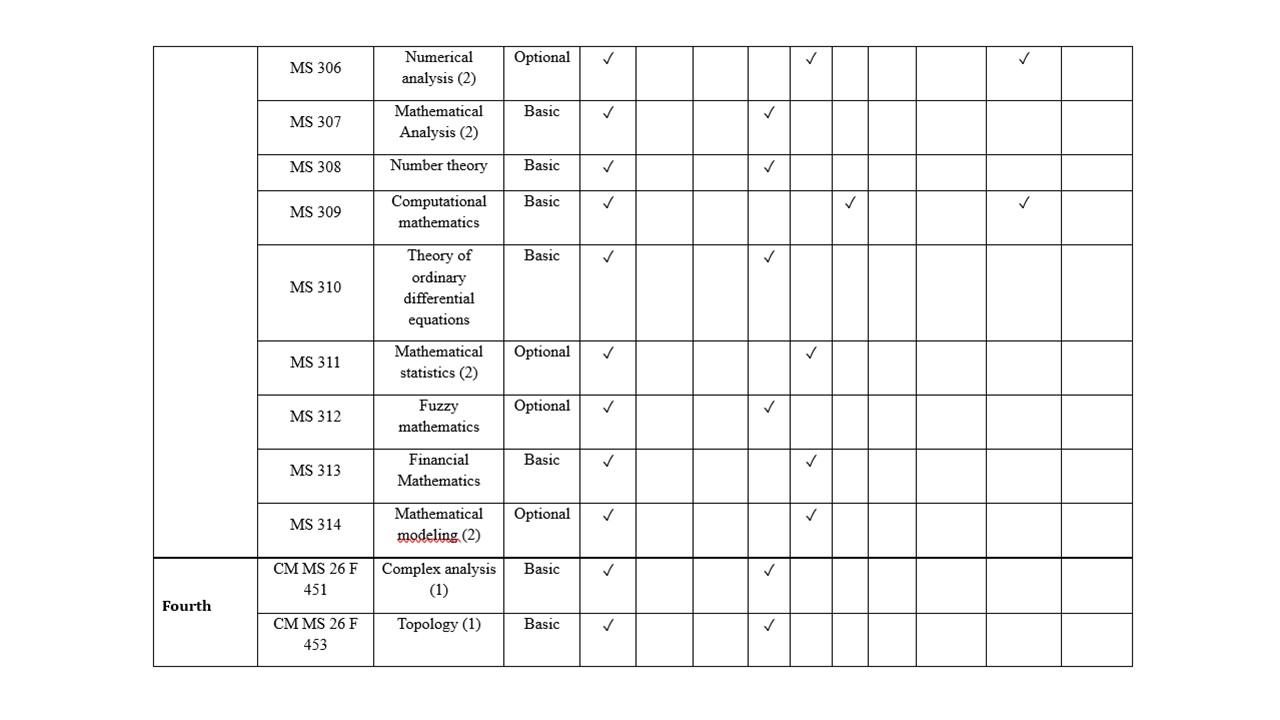
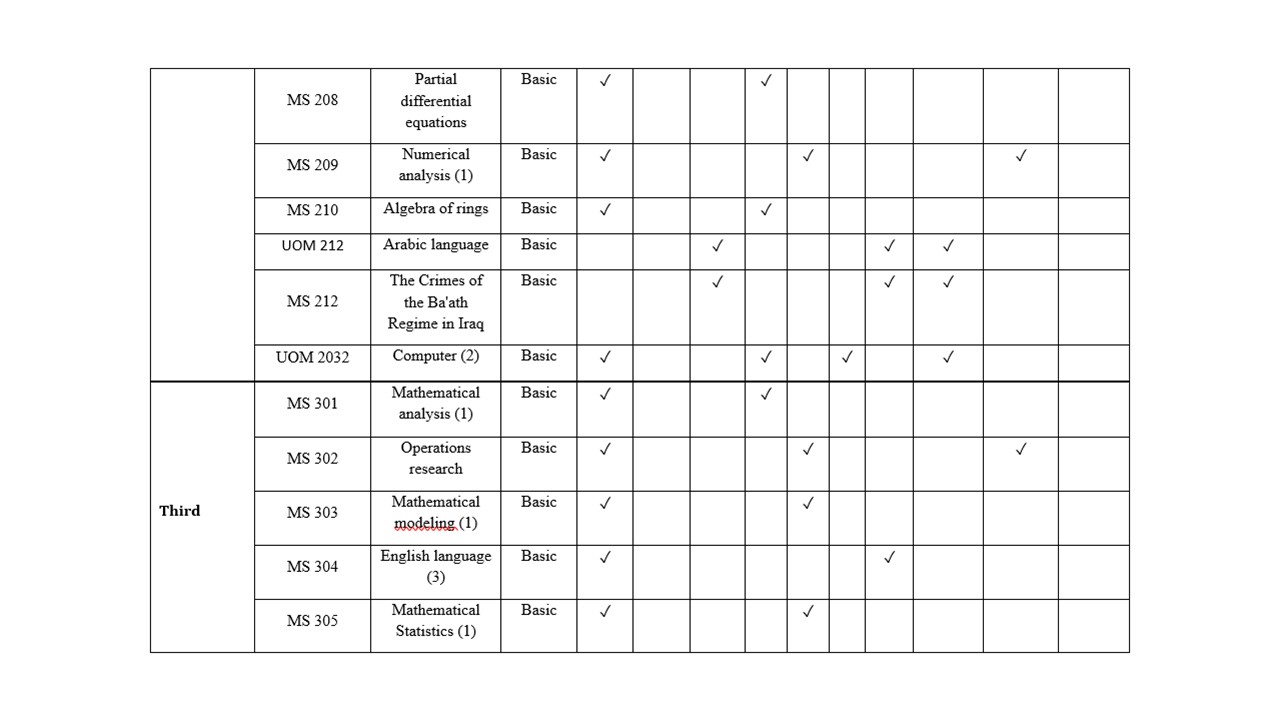
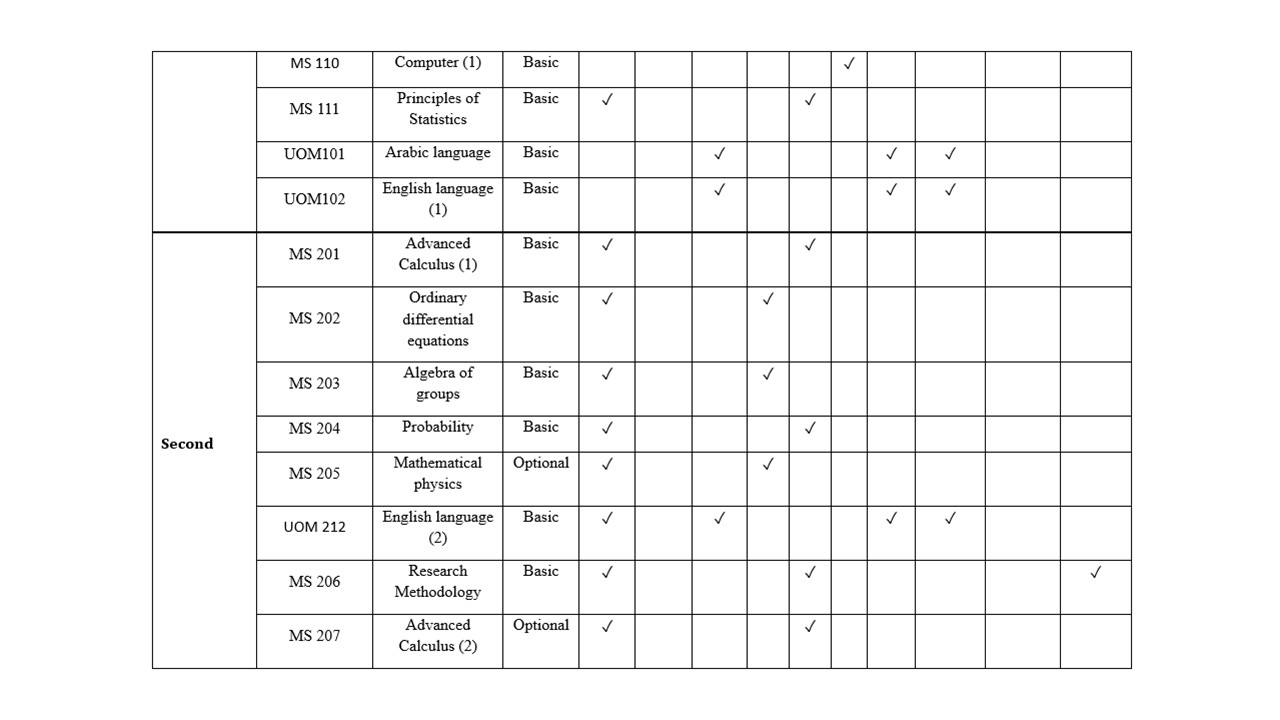
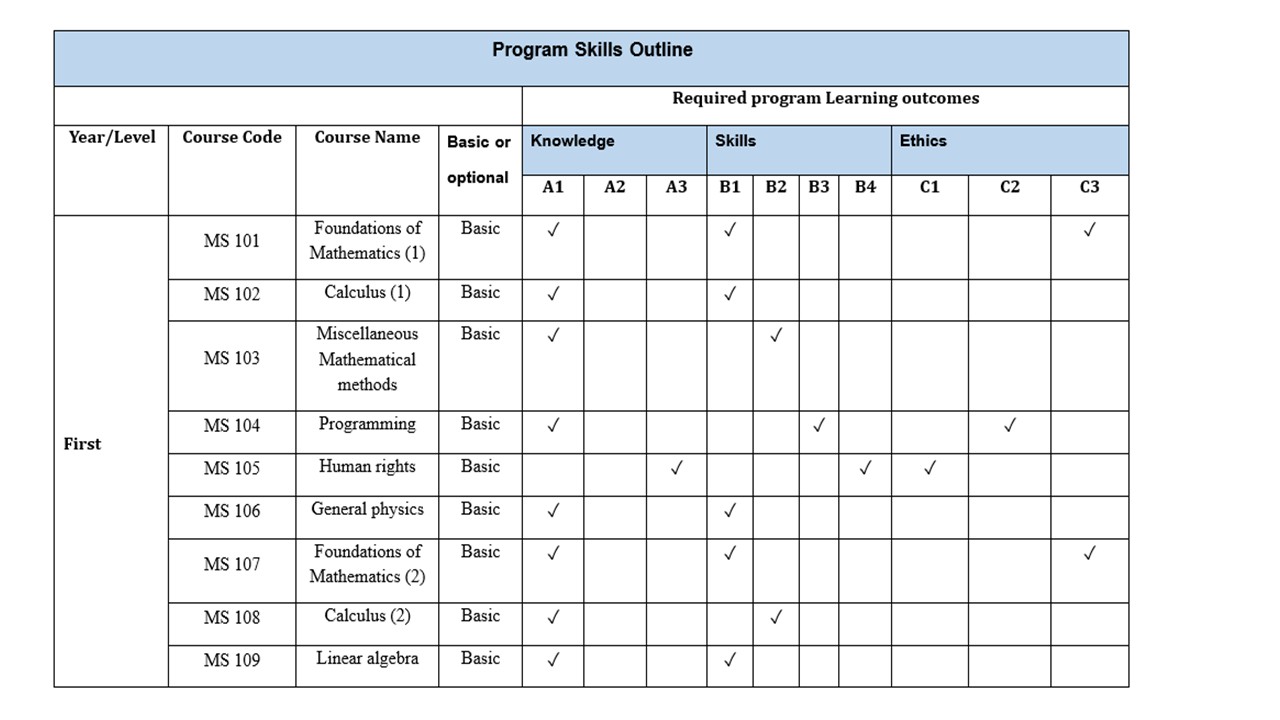
- Core Framework Architecture & Coding Key
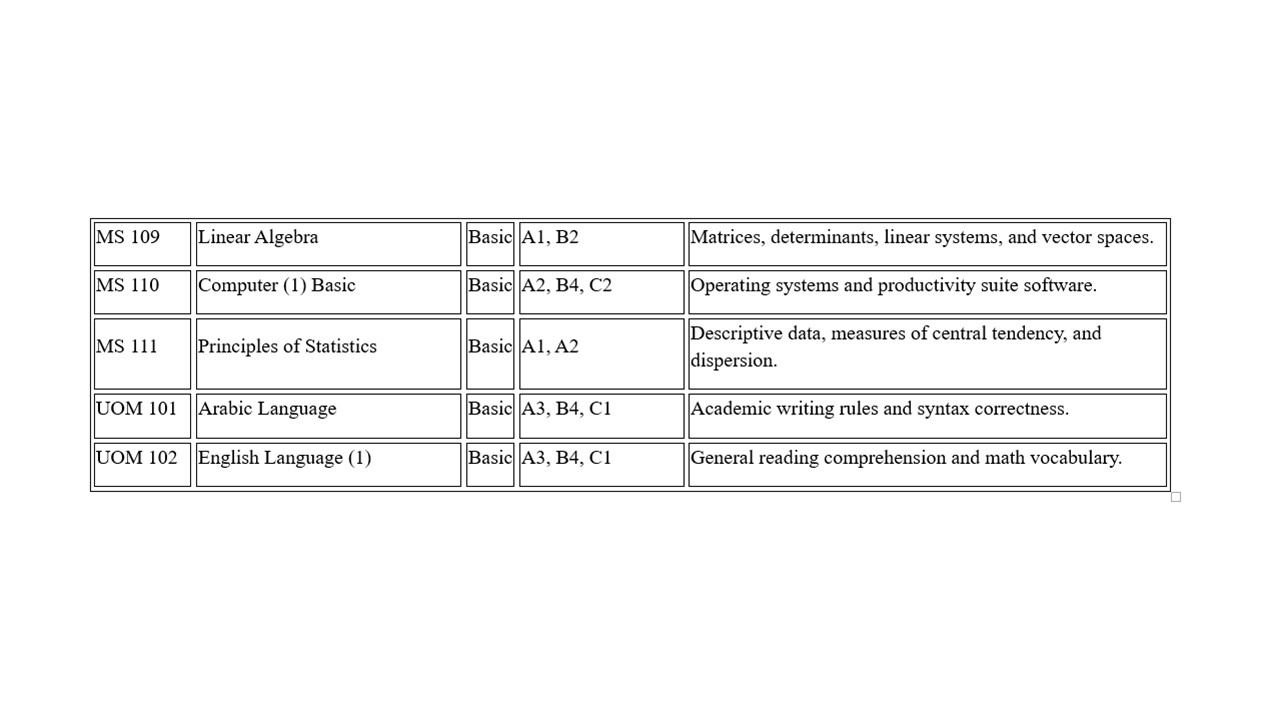
This matrix maps the structural progression of the 4-year degree program (First Cycle under the Bologna Process) to the standard Iraqi National Qualifications Framework (INQF) Level 7 requirements. A total of 240 ECTS credits must be completed across 8 semesters.
The curriculum codes align with the mandatory Program Skills Outline domains:
Knowledge (A):
A1: Grasping mathematical sciences and using scientific methods in proofs and analysis.
A2: Utilizing analytical and numerical methods to solve problems and find optimal solutions.
A3: Enhancing proficiency in general and specialized fields of mathematics.
Skills (B):
B1: Developing rigorous logical thinking and proof structures.
B2: Analysis and application of course-related concepts.
B3: Enhancing cognitive and self-learning abilities within the specialization.
B4: Equipping with communication skills and effective use of modern teaching technologies.
Ethics & Professional Practice (C):
C1: Theoretical, practical, and applied lecture delivery.
C2: Computer-assisted teaching and topic presentations using data show tools.
C3: Independent execution and defense of academic research projects.
- Year 1: Foundation Matrix
Focuses on establishing baseline technical knowledge, mathematical proofs, and introductory computation.
- Year 2: Intermediate Core Development Matrix
Transitions students into abstract algebraic environments, dynamic systems, and algorithmic tracking.
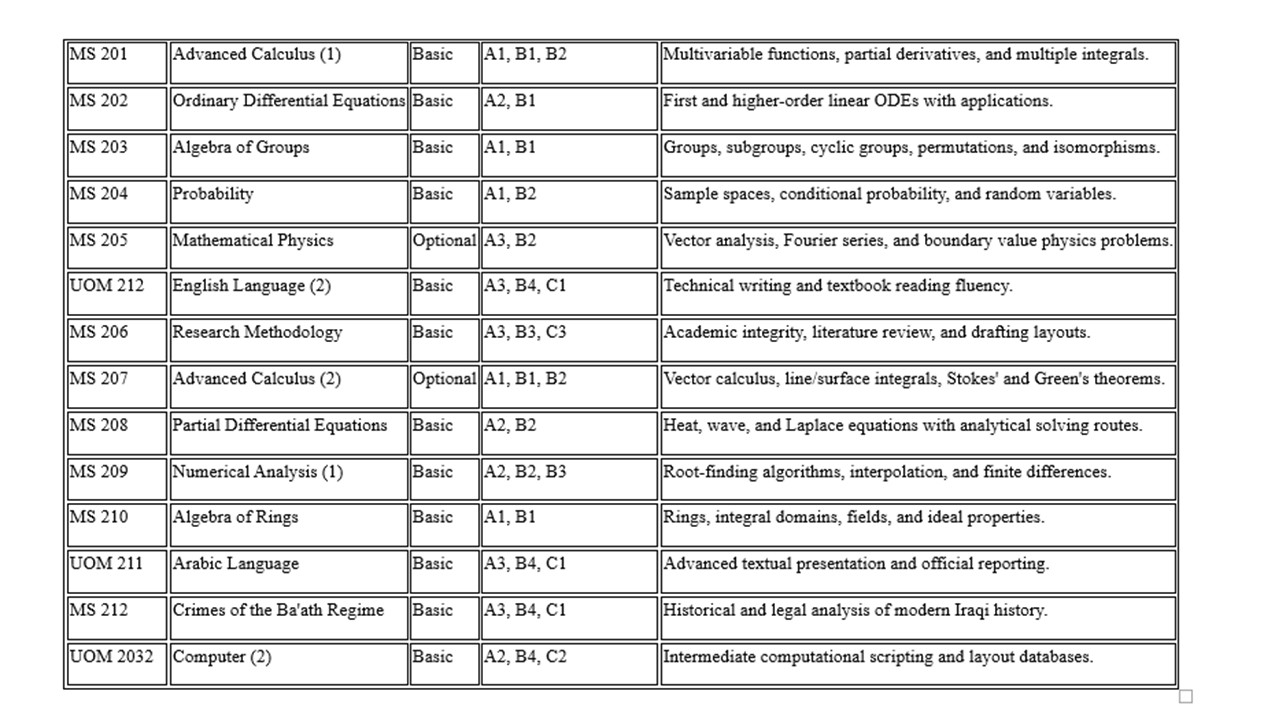
- Year 3: Pure & Applied Specialization Matrix
Deepens high-level rigorous mathematical analysis and specialized operational optimization.
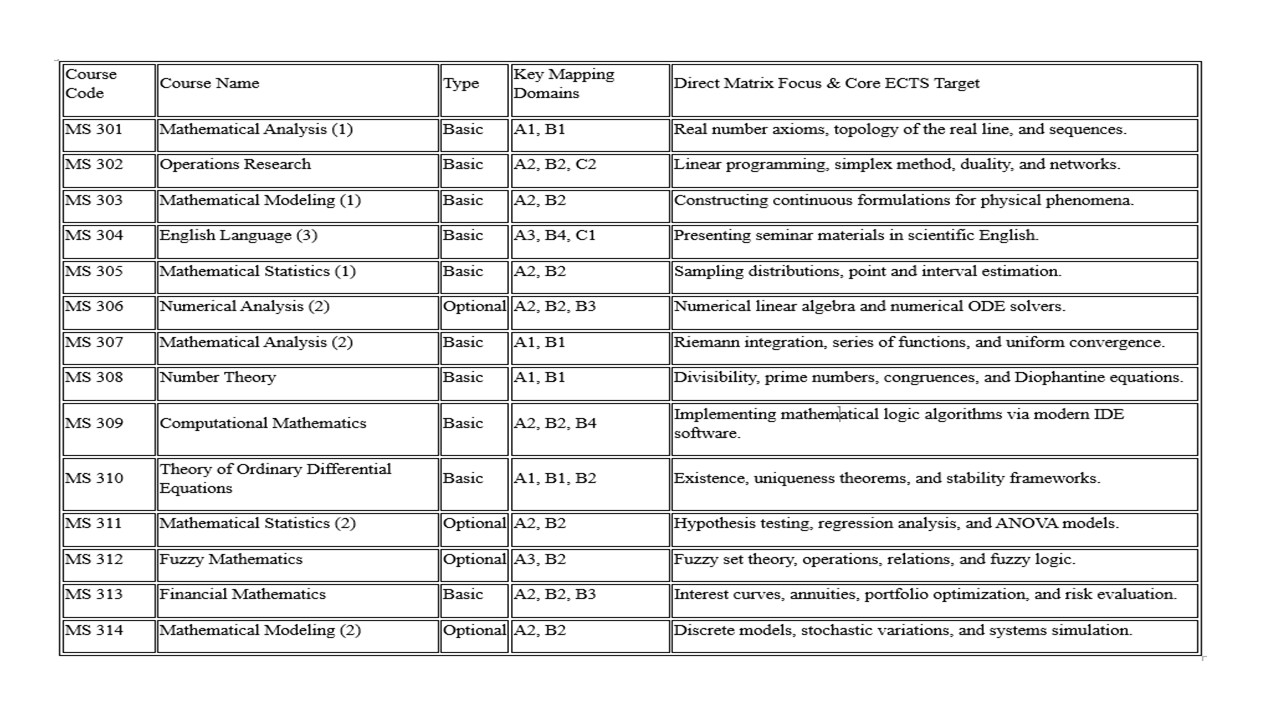
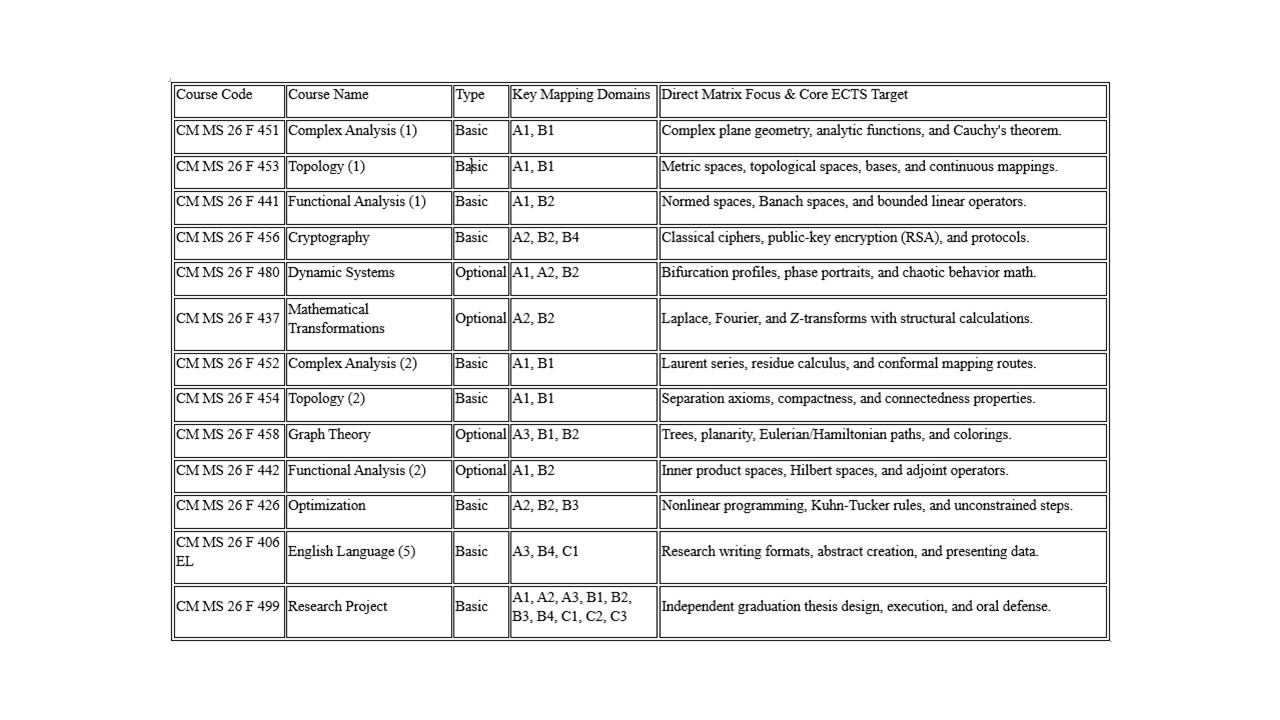
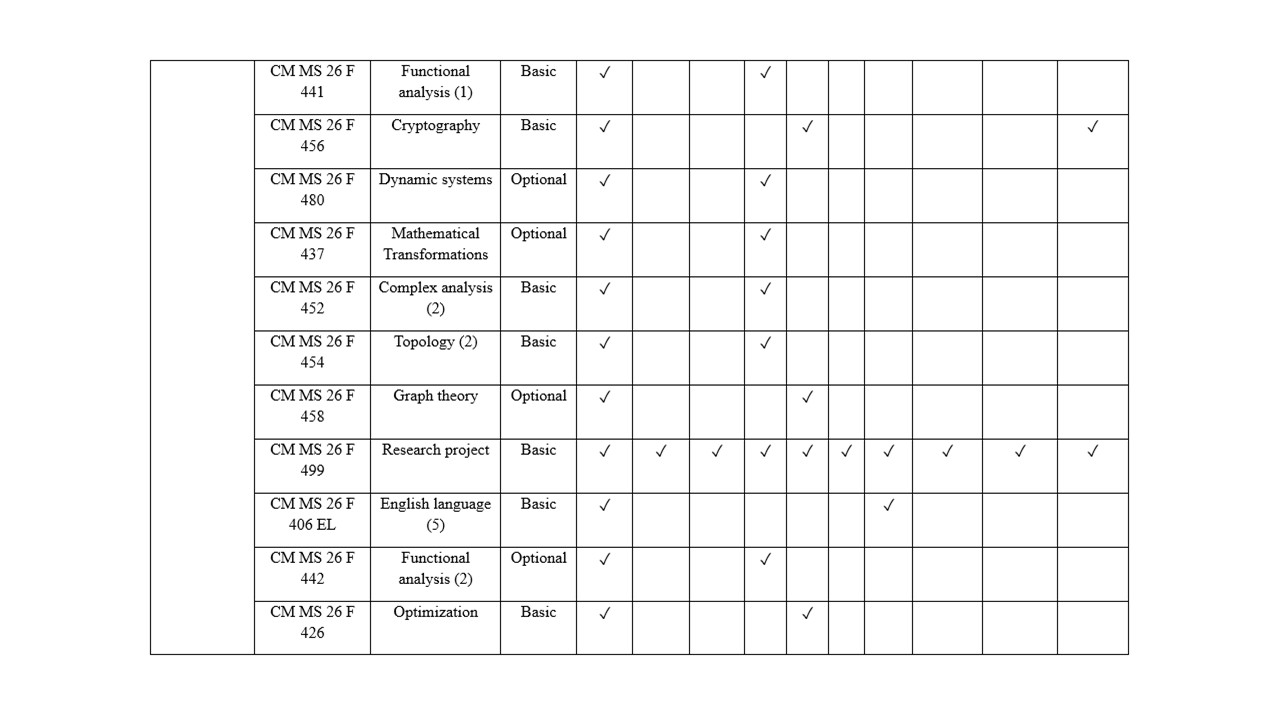
- Year 4: Advanced Synthesis & Autonomy Matrix
The mastery tier focuses on deep abstract topologies, functional properties, and independent research.
Graduates work in diverse sectors. Key roles include Mathematics Teacher, Data Analyst, Statistician, Algorithm Developer, and Financial Researcher.
Graduates qualify to pursue Master’s and Ph.D. degrees. Specializations include Algebra, Topology, Applied Mathematics, Differential Equations, Optimization, and Numerical Analysis.
The department uses diverse evaluation methods. We assess students through daily quizzes, midterm examinations, reports, assignments, and final examinations. Grading follows the standard Bologna ECTS scale.
Students graduate upon successfully acquiring 240 ECTS. Students must pass all mandatory courses and successfully complete and defend the final year research project.
Full-time, physical on-campus attendance.
Prof. Dr. Abdulghafoor Jasim Salim, Head of the Department of Mathematics.
Location: College of Computer Science and Mathematics, University of Mosul.