BP – Department of Software Engineering
Bologna Process

Department of Software Engineering
The Department of Software (established September 22, 2002) is to build qualified national cadres able to meet labor market demands in software fields. It provides an educational and research environment that supports creativity and innovation, focusing on modern scientific and technological developments in designing and maintaining large, complex, high quality software systems.
The department aims to strengthen its academic position through programs that support the university and society, especially in software analysis, design, and implementation. It prepares students with modern knowledge and practical skills to develop integrated solutions for public and private institutions and to engage with related disciplines.
The Department applies the Bologna system in the first three stages, following the Ministry’s directives to align curricula with international standards. The fourth stage still uses the previous course system, ensuring a smooth transition toward full Bologna implementation in the coming years.
It offers three postgraduate programmes: PhD, Master’s, and Diploma. It focuses on advanced research fields that serve academic and industrial needs, publishing in Scopus and Clarivate, and encouraging collaboration between students and staff to produce applied research that benefits society and the labor market.
The department has institutional accreditation and is progressing toward full national accreditation, confirming its commitment to quality and academic excellence.
Bologna Module Description 2025-2026
Modules Catalogue – Bologna Process 2025-2026
1. To prepare specialized academic cadres in the field of designing and building multi
service software systems to meet the requirements of government institutions and the labor market.
2. To prepare qualified graduates to work in building software engineering systems and provide them with the appropriate skills to maintain and develop them, in conjunction with related disciplines.
3. Equip students with the appropriate skills to find alternative solutions to problems and conduct studies in various fields to serve the requirements of state institutions and the labor market, while emphasizing the solidity of the practical aspect.
4. Disseminate knowledge in all areas of software and work to build systems that meet the requirements of state institutions in order to achieve the concept of e governance.
5. Promote scientific research and innovation in the field of software engineering and motivate students and faculty members to keep pace with modern developments.
6. Enhance research cooperation with other scientific disciplines to conduct applied research that serves state institutions and the labor market.
Degree Title: Bachelor of Science (B.Sc.) in Software.
Postgraduate Degrees Offered: High Diploma, Master of Science (M.Sc.), and Doctor of Philosophy (Ph.D.).
Bachelor’s qualifications are placed at Level 6 of the Iraqi National Qualifications Framework (INQF), in accordance with the regulations of the Ministry of Higher Education and Scientific Research.
Undergraduate admission is conducted through the Centralised Admission System of the Iraqi Ministry of Higher Education and Scientific Research. Applicants must satisfy the annual admission regulations issued by the Ministry and the admission criteria approved by the University of Mosul and the College of Computer Science and Mathematics. Admission to the Department of Software Sciences is determined according to the student’s preference and the applicable competitive admission criteria.
Duration: 4 academic years (8 semesters).
Credit Load: 240 ECTS credits in total, normally 60 ECTS per academic year and 30 ECTS per semester.
Curriculum Progression: Students must successfully complete the compulsory and elective modules specified in the approved curriculum, including foundational mathematics, core software sciences modules, practical and laboratory components, summer training, and the final year graduation project.
Assessment and Progression: Students must achieve the required passing grade in each module and satisfy the applicable progression requirements under the Bologna Process and University regulations.
Academic Regulations: Students must comply with the academic, attendance, assessment, and graduation regulations issued by the University of Mosul and the Iraqi Ministry of Higher Education and Scientific Research.
Course/ECTS credit transfers are permitted from recognised higher education institutions following approval by the scientific committee and equivalency board, subject to the regulations and instructions of the University of Mosul and the Iraqi Ministry of Higher Education and Scientific Research.
Upon successful completion of the Bachelor of Science in Software, graduates will be able to: Expected learning outcomes of the program Knowledge
Cognitive objectives (A)
A1: The ability to distinguish, identify, define, formulate, and solve scientific problems by applying scientific principles across all the scientific disciplines mentioned in this guide.
A2: Defining, enforcing, and documenting graduation procedures to ensure that graduating students meet all requirements. Skills
Skill objectives (B)
B1: The ability to apply and utilize these sciences to solve field problems and present them to the community.
B2: The ability to design and conduct appropriate scientific tests with quality assurance, and to analyze and interpret the results.
B3: The ability to communicate effectively and fluently, both orally with a group of people and in writing to various management levels.
B4: The ability to work effectively within a scientific team, setting goals, planning activities, meeting deadlines, and managing work related risks. Ethics
Value objectives (C)
C1: The ability to understand ethical and professional responsibilities towards society.
C2: The necessity of keeping pace with developments in the use of modern technologies, skills, and techniques.
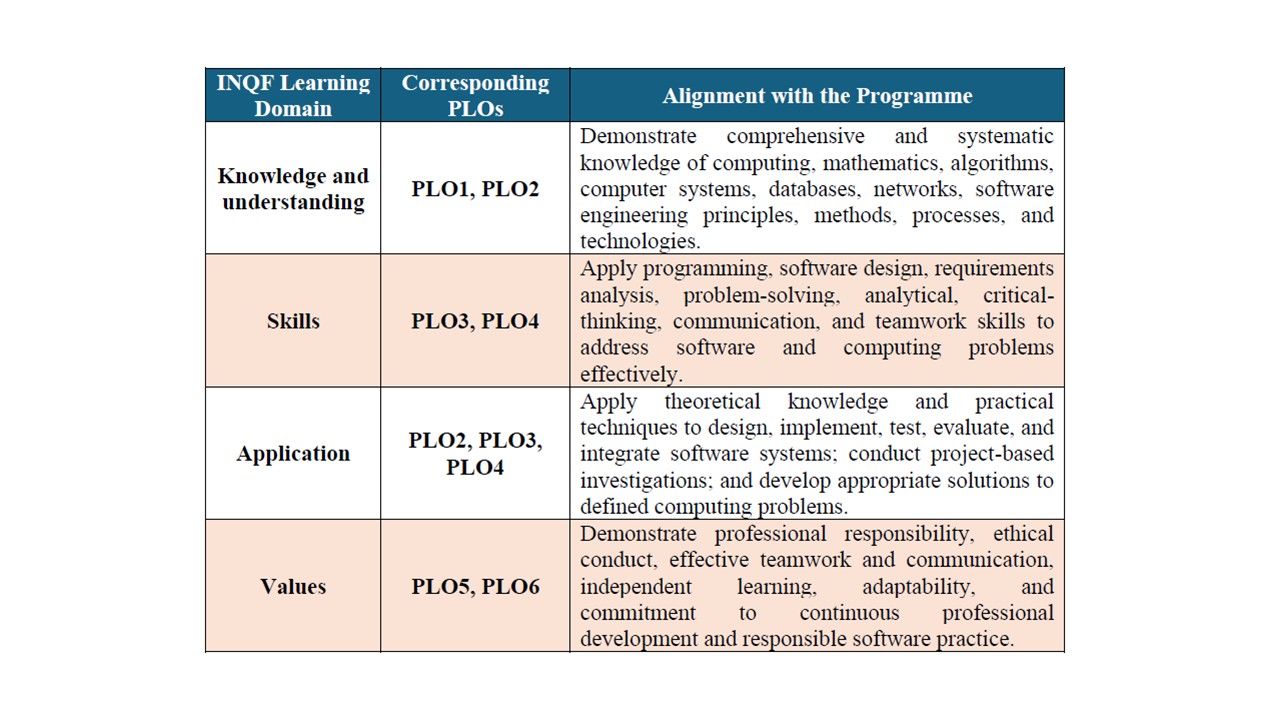
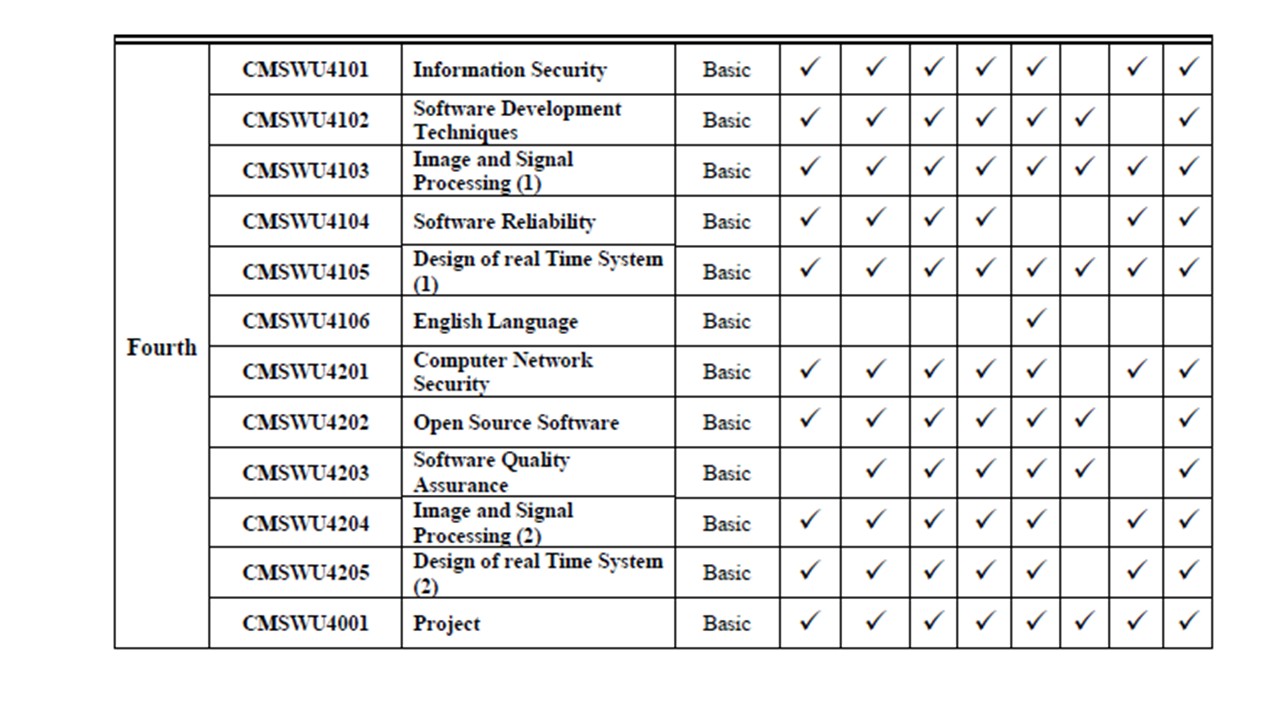
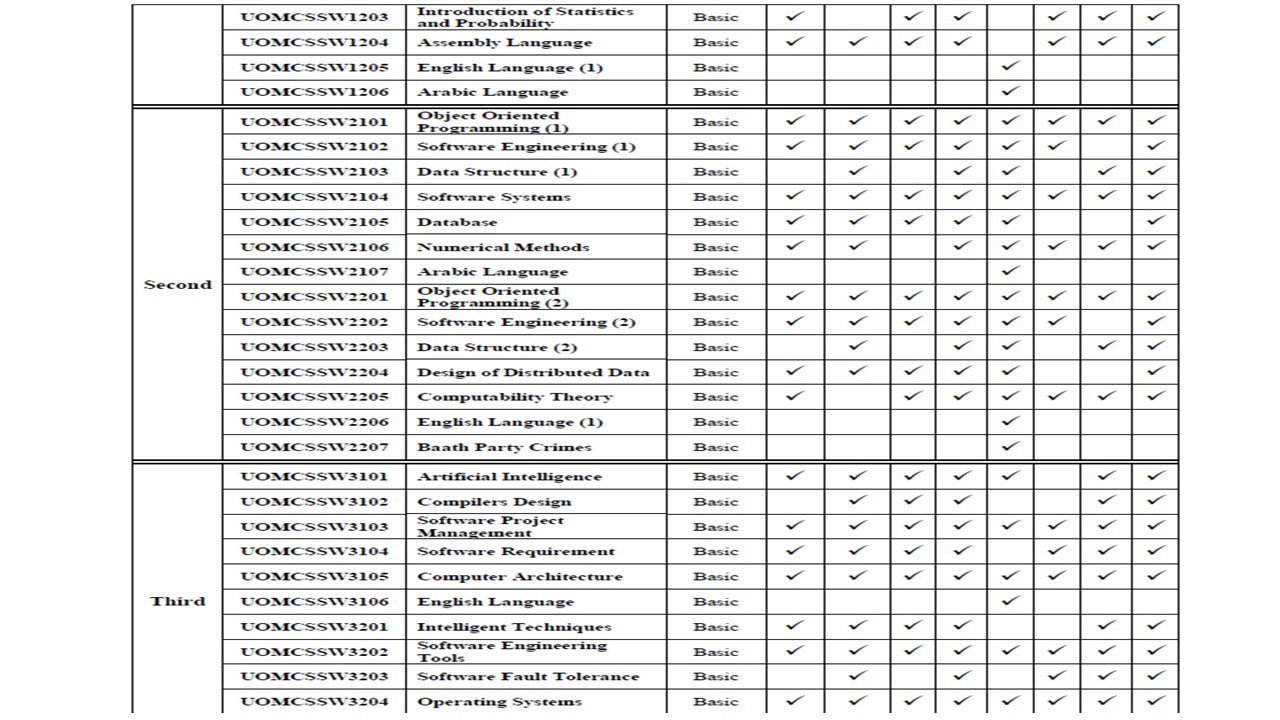
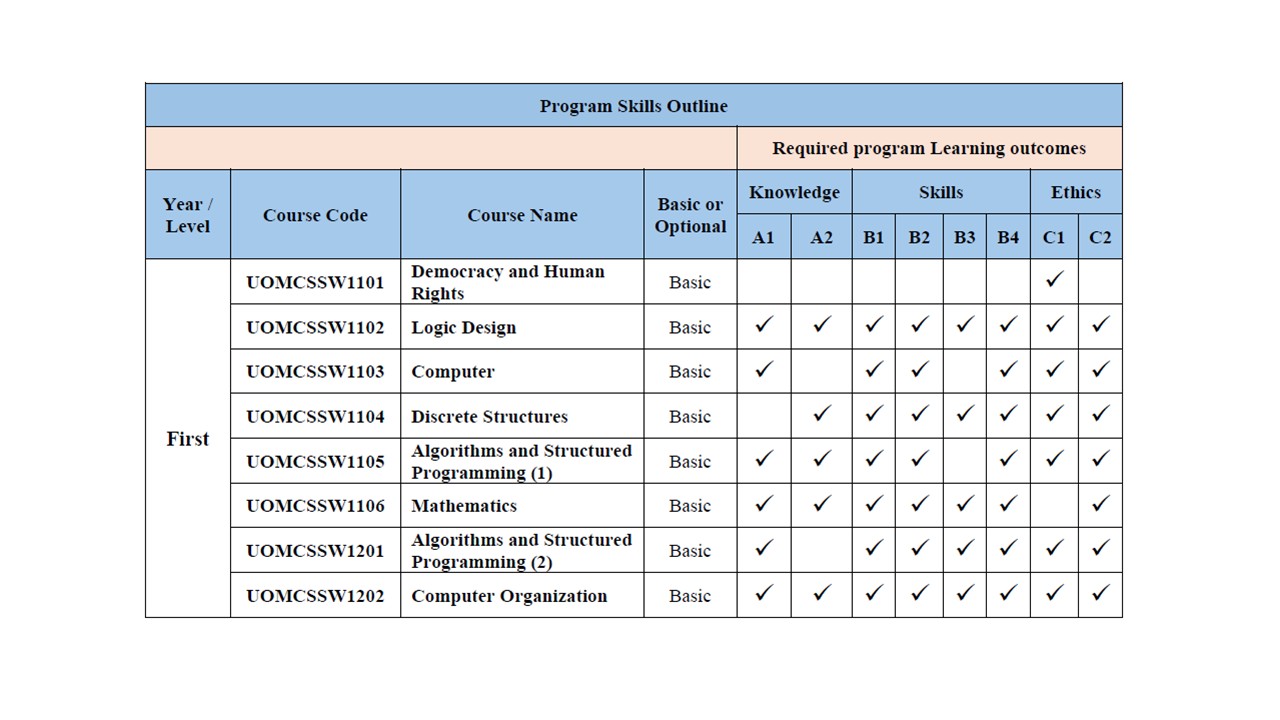
Graduates of the Bachelor of Science in Software are prepared to contribute to the analysis, design, development, testing, implementation, maintenance, and management of software systems in public institutions, private sector organizations, technology companies, and other computing related environments. Graduates are expected to be able to:
apply computing and software engineering knowledge to practical problems;
analyse user and system requirements and develop appropriate software solutions;
use modern programming, software development, database, web, and computing technologies;
evaluate software quality, reliability, security, and performance;
communicate technical information effectively and work within multidisciplinary teams;
demonstrate professional and ethical responsibility in software development and use;
engage in independent learning and adapt to developments in software technologies; and
contribute effectively to public and private sector organizations and to the development of technology based solutions for society.
Graduates meeting academic standing requirements are eligible to apply for:
Higher diploma programmes in software or related computing fields.
Master’s degree programmes in software and related specializations.
Doctoral studies, following successful completion of the relevant postgraduate qualification and satisfaction of applicable admission requirements.
Under the Bologna Process ECTS system:
Continuous Assessment (Mid semester / Formative): 40% or 50% and assessment methods may vary according to the nature and learning outcomes of each module, particularly for laboratory, practical, project based, and software development modules.
Final Examination (Summative): 60% (comprehensive theoretical and practical final exams).
Passing Threshold: A student must obtain a minimum overall mark of 50% to successfully pass a module and earn its associated ECTS credits. Students must also satisfy the applicable attendance, continuous assessment, examination registration, and academic integrity requirements established by the University and the Bologna Process regulations.
ECTS Grading Scale: Grade mapping from A (Excellent) to F (Fail
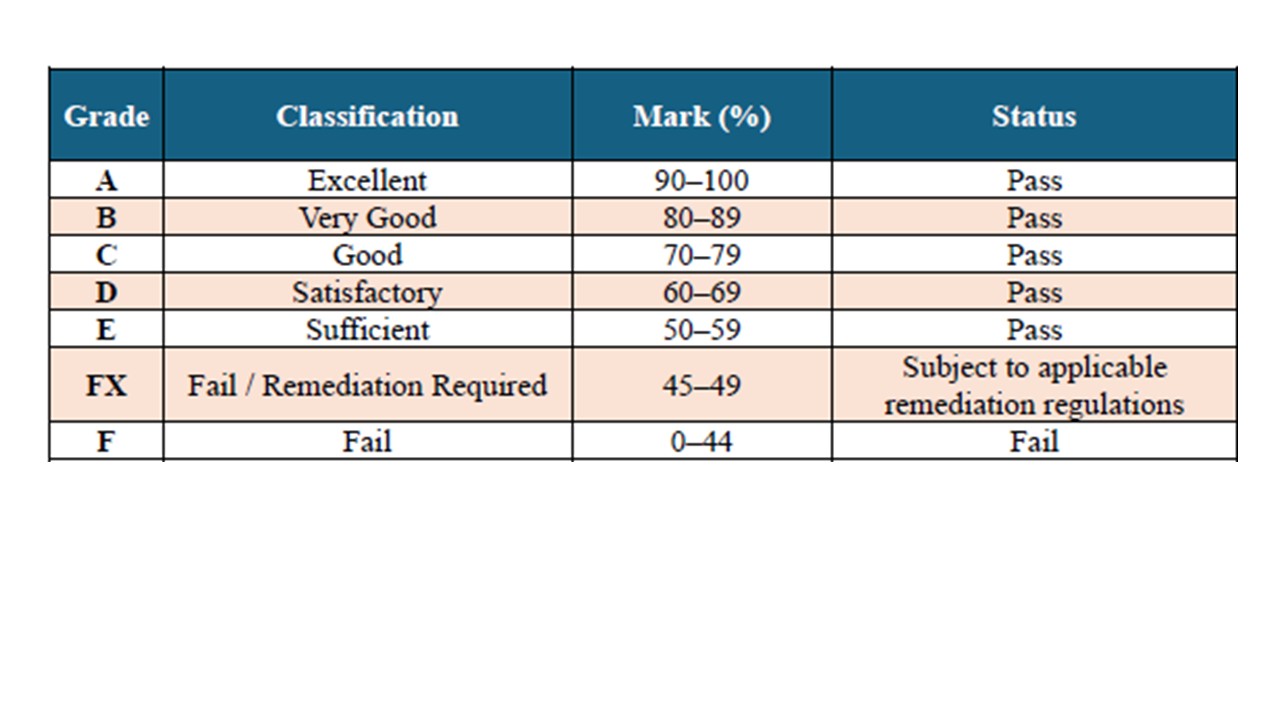
For a final module mark between 45% and 49%, the applicable Bologna Process regulations permit the module instructor to assign additional academic work, such as a project or report, for possible remediation. Any such treatment is subject to the limits and procedures established by the University and Ministry regulations.
Students who do not successfully complete a module may be eligible for subsequent examination attempts or may be required to repeat the module, as applicable under the Bologna Process progression and assessment regulations.
All examination, reassessment, attendance, and progression procedures are governed by the regulations in force at the University of Mosul and the Iraqi Ministry of Higher Education and Scientific Research
To be awarded the Bachelor of Science (B.Sc.) in Software Sciences, students must successfully fulfil all requirements of the approved academic programme, including:
Credit Completion: Successfully complete the full 240 ECTS credits required by the programme over four academic years (eight semesters).
Module Completion: Successfully pass all compulsory and required elective modules included in the approved curriculum.
Summer Training: Successfully complete the required four week summer training/internship in accordance with the Department and University regulations.
Graduation Project: Successfully complete and pass the final year graduation project, including its required academic, practical, documentation, presentation, and evaluation components.
Academic Requirements: Satisfy all applicable assessment, attendance, progression, and academic integrity requirements.
Regulatory Compliance: Fulfil all graduation requirements prescribed by the University of Mosul and the Iraqi Ministry of Higher Education and Scientific Research.
Upon successful completion of these requirements, the student is eligible for the award of the Bachelor of Science in Software Science
Mode of Attendance: Full time, On campus.
Medium of Instruction: English (core software engineering & technical modules) and Arabic (general university requirements).
Study System: Credit Hour System under the Bologna Process and European Credit Transfer and Accumulation System (ECTS).
Programme Structure: Four academic years comprising eight semesters.
Credit Structure: 240 ECTS credits in total, normally 30 ECTS per semester.
Learning Approach: The programme combines structured learning activities with independent student workload. Teaching and learning include theoretical instruction, practical and laboratory activities, assignments, projects, and other module specific learning activities.
Student Workload: One ECTS credit corresponds to approximately 25 hours of total student workload, including both structured and unstructured learning activities
The Programme Coordinator is responsible for supporting the academic organization, implementation, monitoring, and continuous development of the Bachelor of Science in Software Sciences programme in accordance with the Bologna Process, University regulations, and approved academic requirements. The Programme Coordinator supports the programme through:
Coordinating the implementation of the approved curriculum and module structure;
Monitoring ECTS distribution and student workload;
Supporting alignment between Module Learning Outcomes, Programme Learning Outcomes, and the Iraqi National Qualifications Framework;
Coordinating programme documentation required under the Bologna Process;
Supporting monitoring of student progression and academic performance;
Coordinating with module leaders and academic staff regarding programme delivery and assessment;
Contributing to programme review, quality assurance, and continuous improvement; and
Maintaining and updating relevant programme documentation in coordination with the Department and College.