9 July، 2025
Master’s thesis by Student Ammar Muhammad Younis Muhammad Saleh
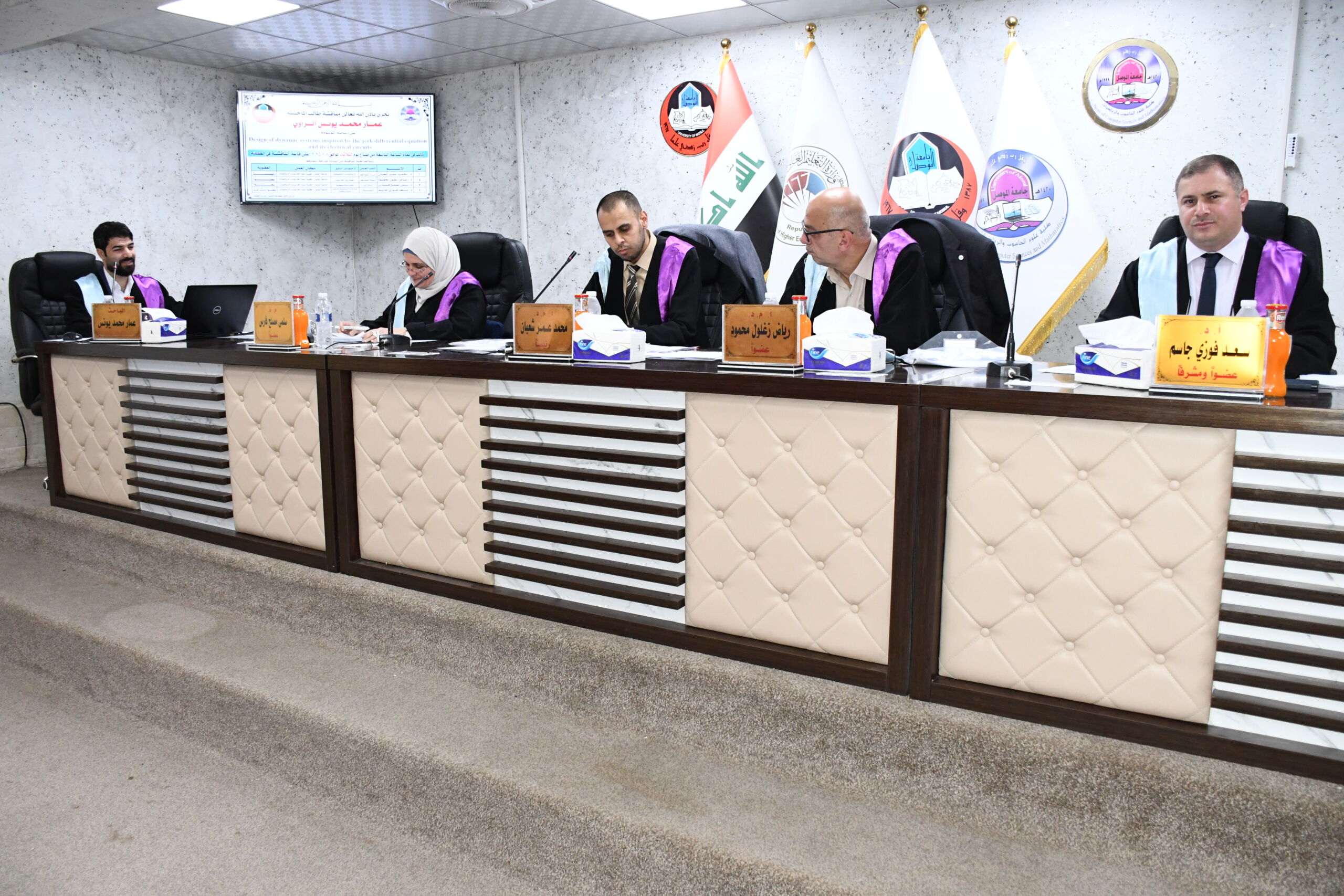
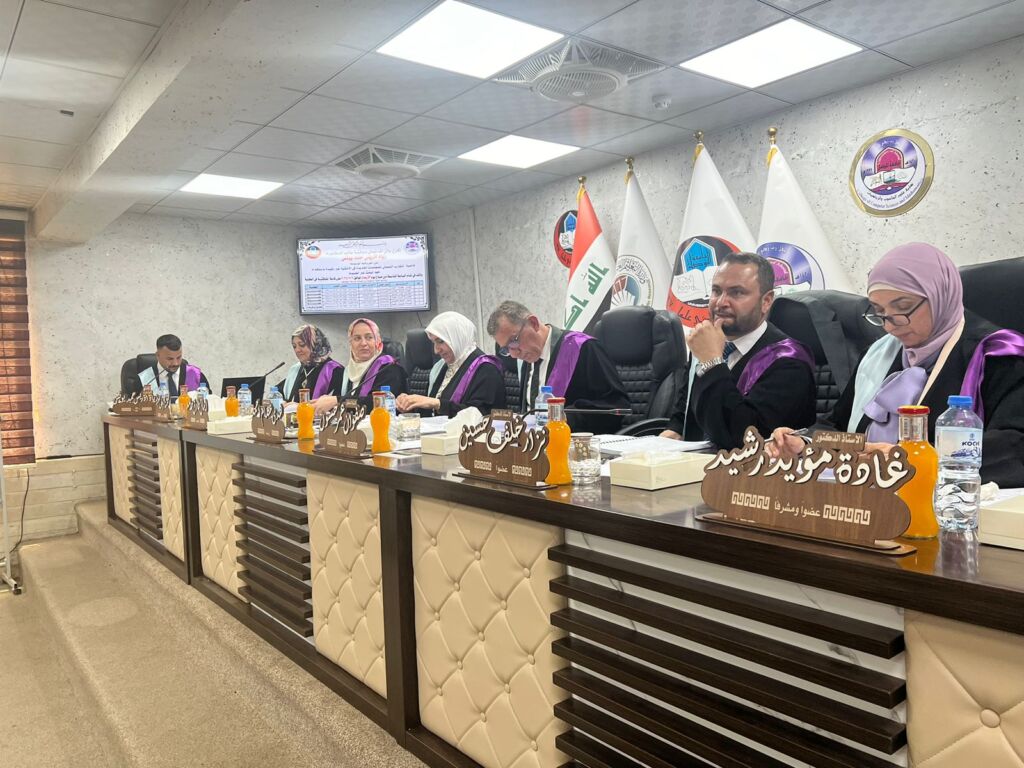
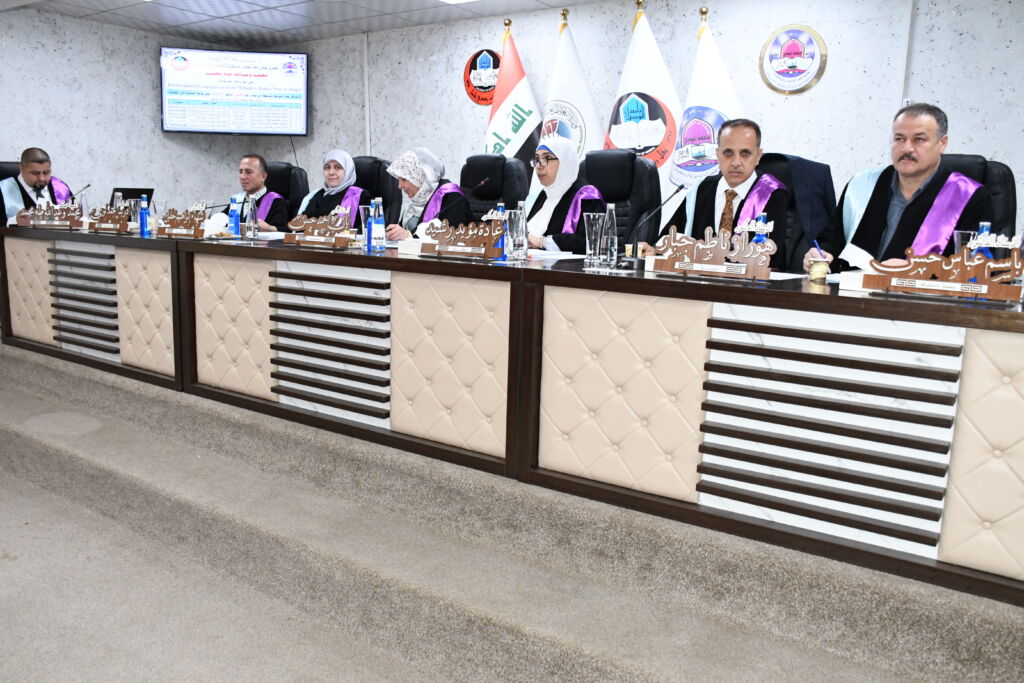
Discussion of Master’s thesis in the College of Computer Science and Mathematics – Department of Mathematics Sciences entitled:
“ Design of dynamic systems inspired by the jerk differential equation and its electrical circuits “
It was discussed in the discussion room at the Faculty of Computer Science and Mathematics at the University of Mosul on Tuesday, 8 -7-2025.
Master’s thesis by Student Ammar Muhammad Younis Muhammad Saleh
under the supervision of Prof. Dr. Saad Fawzi Jasim Al-Azzawi
Higher-order differential equations play an important role in modeling many complex dynamic systems, such as vibrations of three-dimensional structures, stability analysis in advanced control systems, and the study of physical phenomena such as fluid motion and nonlinear vibrations. Due to their complexity, these equations require sophisticated solution techniques, along with additional initial conditions to accurately determine solutions. In this study, dynamic systems derived from third- and fourth-order special differential equations with a single independent variable are proposed using the jerk and hyperjerk functions, respectively, and with the fewest possible terms to generate chaotic behavior. Both systems are studied in different cases and compared, discussing their most important dynamical properties, including equilibrium points, stability, exponentials, and the Lyapunov dimension. The nature of these systems is also classified as dissipative or conservative, depending on some of their parameters. The study also included the application aspect of the proposed systems in the field of electronic circuits using the NI Multisim 14.3 program. These proposed systems were converted into electronic systems containing resistors, capacitors, an amplifier, and a power supply, and the paths were obtained using an oscilloscope. The study demonstrated good agreement with the numerical simulation results using MATLAB R2021b, confirming the efficiency and effectiveness of the proposed systems.
The scientific committee included the following members:
- Prof. Dr. Mohammed Omer Shaaban.
- Prof. Dr. Riyadh Zaghlool Mahmood.
- Salma Muslih Faris.
- Dr. Saad Fawzi Jasim.