BP – Department of Horticulture and Landscape Gardening
[fusion_te
Bologna Process

Department of Horticulture and Landscape Gardening
- Qualifying specialized scientific cadres who are trained and have scientific competencies in the field of horticulture and landscape engineering, able to face the challenges of the profession and contribute to achieving sustainable development.
- Developing a modern, stimulating educational environment equipped with the latest technologies and advanced equipment that enables the student to compete, innovate and excel.
- Qualifying cadres familiar with agricultural legislation and legal and social issues and commitment to work ethics and quality management related to agricultural fields.
- Possess skills in the fields of language and computer use and develop their abilities to use the scientific and practical method in research in the field of gardening and landscape engineering.
- Able to analyze the ways in which humans, plants and soil interact with the general environment in order to enhance the conservation of natural resources and protect the environment.
- Evaluates the properties of soil and water and determines appropriate agricultural use patterns in the field of gardening and landscape engineering under different environmental conditions.
- Possesses advertising and marketing skills as well as labeling, presenting and selling food garden products.
- Able to analyze plant and soil processes at the landscape scale and focus on landscape engineering and training in sustainable garden designs.
- Understands horticultural plant production systems and how to integrate their components and manage them in an environmentally friendly and sustainable manner.
- Able to evaluate sustainable practices related to environmental conservation and build skills in dealing with chemicals, fertilizers and agricultural horticultural machinery.
- Familiar with the concepts of organic agriculture, horticultural crop protection and applied biotechnology in horticultural fields.
- Able to complete designs based on the environment and urban issues and invest in geographic information systems in the specialization.
- Acquires productive skills related to preparing and preparing the land for cultivation and crop service operations using modern agricultural machinery and techniques.
- Uses skills in harvesting practices and post-harvest in managing horticultural crop raw materials and conducting the necessary tests. 5
- Able to evaluate and analyze agricultural projects in the field of gardening and landscape engineering and invest in agricultural natural resources.
- Uses modern methods and the analytical approach in planning and implementing fertilization programs and utilizing land and water units with a sustainable concept.
- Learn the mechanisms of building and managing golf courses, football fields and tennis courts.
- Links the joints of horticultural sciences in horticultural industries and focuses on horticultural crops with medical and biopharmaceutical dimensions.
- Uses modern scientific methods for organic and organic agriculture to reach a safe horticultural agricultural product.
- Proposes different programs for mineral, organic and biological fertilization within the conditions of preserving the soil and environment and regulating water.
For more information, please visit the department’s website at the following link.
https://uomosul.edu.iq/en/agriculture/department-of-horticulture-and-landscape-architecture/
Upon successful completion of the program requirements, graduates receive a Bachelor of Science (B.Sc.) degree in Horticulture and Landscape Architecture from the College of Agriculture and Forestry at the University of Mosul.
Upon successful completion of the program requirements, graduates receive a Bachelor of Science (B.Sc.) degree in Horticulture and Landscape Architecture from the College of Agriculture and Forestry at the University of Mosul.
The program is classified within the sixth level of the Iraqi National Qualifications Framework, or its equivalent, in accordance with the regulations, controls and instructions approved by the Ministry of Higher Education and Scientific Research.
Admission to the Bachelor of Science in Horticulture and Landscape Architecture program is subject to the regulations, instructions, and policies approved by the Ministry of Higher Education and Scientific Research and the University of Mosul. Applicants must meet all the admission criteria and standards for academic programs at the College of Agriculture and Forestry.
To obtain a Bachelor of Science degree in Horticulture and Landscape Architecture, students must successfully complete all approved graduation requirements, which include:
1-Fulfilling all basic graduation requirements in accordance with the regulations and instructions approved by the Ministry of Higher Education and Scientific Research and the University of Mosul.
2-Completing the total program credit hours of 240 ECTS credits, including all required and elective courses as outlined in the study plan.
3-Successfully completing all practical program requirements, including laboratory work and applications, field training, and any other practical components stipulated in the study plan, if applicable.
4-Adhering to all approved academic regulations and instructions governing assessment procedures, academic progress, and graduation requirements, in accordance with the regulations in force at the Ministry of Higher Education and Scientific Research and the University of Mosul.
5-Completing the graduation project and fulfilling its scientific and practical requirements according to approved academic standards, demonstrating the student’s ability to apply the knowledge and skills acquired during their studies to address a specialized problem or topic in the field of horticulture and landscape engineering.
For more information, please visit the department’s website at the following link.
https://uomosul.edu.iq/en/agriculture/horticulture-and-landscape-architecture-2/
Prior learning (RPL) recognition and credit transfer are permitted in cases of student transfer or course equivalence, in accordance with the approved regulations, standards and instructions in force at the Ministry of Higher Education and Scientific Research and the University of Mosul.
Programme Learning Outcomes (PLOs)
Upon successful completion of the requirements of the Bachelor of Science (B.Sc.) program in Horticulture and Landscape Architecture, graduates are expected to have acquired a set of professional knowledge, skills, and competencies that enable them to achieve the program’s approved learning outcomes (PLOs), also known as graduate outcomes (GOs), qualifying them to practice the tasks and specializations associated with the field of horticultural sciences efficiently and competently.
GO1 / Scientific Knowledge : The ability to use theoretical and applied knowledge in areas related to solving complex agricultural problems. The ability to select and apply appropriate analytical and modeling methods for this purpose.
GO2 / Identifying Complex Relationships: The ability to apply modern design methods for this purpose.
GO3 / Laboratory and Field Studies: The ability to use information technologies effectively.
GO4 / Data Analysis: Studying complex problems or research issues specific to the field of horticulture and landscape architecture.
GO5 / Critical Thinking and Ethical Commitment: The ability to work in individual and multidisciplinary teams.
GO6 / Oral and Written Communication: Preparing and designing production reports, delivering effective presentations, and providing clear and understandable instructions in the field of horticulture.
The ability to access information in the field of horticulture, keep up with developments in science and technology, and continuously develop oneself.
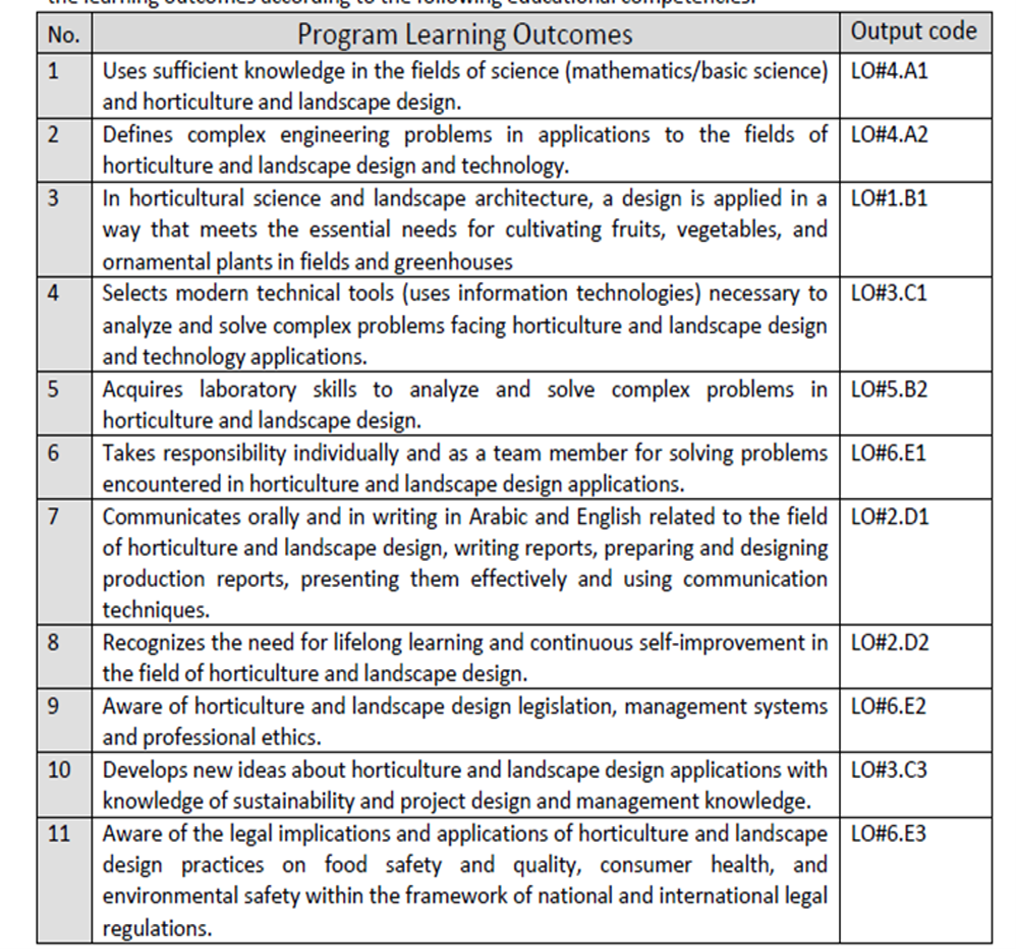
The Bachelor of Science in Horticulture program aligns with the requirements of the Iraqi National Qualifications Framework (INQF) at Level 6. The table below illustrates the alignment of the program’s learning outcomes with the key learning domains identified in the INQF, ensuring that graduates possess the knowledge, skills, competencies, and professional values necessary to practice horticulture effectively and efficiently, and enhancing their capacity for lifelong learning and professional development.
The program’s learning outcomes are achieved through a comprehensive curriculum in horticulture and landscape architecture, integrating theoretical and applied aspects with practical training. The table below illustrates the alignment of the core courses with the program’s learning outcomes, demonstrating each course’s contribution to developing the knowledge, skills, and professional competencies that graduates are expected to acquire, enabling them to work effectively and competently in the fields of horticulture and landscape architecture.
| Core Course | GO1 | GO2 | GO3 | GO4 | GO5 | GO6 |
| Computer Science | √ | √ | √ | |||
| Democracy and Human Rights | √ | |||||
| English Language | √ | √ | ||||
| Mathematics | √ | √ | ||||
| Agricultural Ethics | √ | √ | ||||
| Engineering Drawing | √ | |||||
| Transfer of Agricultural Engineering Technologies | √ | |||||
| Arabic Language | √ | √ | ||||
| Biosafety and Security | √ | √ | √ | √ | ||
| Agricultural Statistics | √ | √ | ||||
| Biodiversity | √ | √ | ||||
| Agricultural Informatics | √ | |||||
| Sustainable Development | √ | √ | √ | √ | √ | √ |
| Agricultural Marketing Technologies | √ | √ | √ | √ | √ | √ |
Graduates of the Bachelor of Science in Horticulture program are qualified to work in a variety of professional fields within the public and private sectors, most notably:
1-Working in nurseries and producing seedlings and horticultural plants.
2-Managing and producing fruit orchards, vegetables, and horticultural crops.
3-Working in landscaping and designing and managing green spaces.
4-Managing agricultural and horticultural projects and supervising production processes.
5-Working in companies and institutions that produce, package, and market horticultural products.
6-Working in government departments and institutions related to agriculture, horticulture, and the environment.
7-Providing agricultural extension services and transferring modern technologies and practices to producers.
8-Working in laboratories and research centers specializing in horticultural science and plant production.
9-Participating in sustainable agriculture projects and protecting natural and environmental resources.
10-Working in plant protection and managing pests and diseases affecting horticultural crops.
11-Pursuing postgraduate studies and specializing in horticultural science and related agricultural sciences.
The Bachelor of Science in Horticulture program enables its graduates to pursue postgraduate studies and enhance their career development and specialization in a number of related fields, most notably:
Postgraduate Studies
- Higher Diploma in Horticulture and Landscape architecture
- Master’s Degree in Horticulture and Landscape architecture
- PhD in Fruit Production
- PhD in Vegetable Crop Production
- PhD in Ornamental Plants
- PhD in Plant Tissue Culture
The Horticulture program adheres to the approved regulations and guidelines for examinations, assessment, and grading issued by the Ministry of Higher Education and Scientific Research and the University of Mosul. Student performance is measured through a comprehensive and diverse set of continuous and summative assessment methods, ensuring the achievement of targeted learning outcomes, including:
(Daily quizzes, assignments, and in-class and extracurricular activities(
Midterm exams for the first semester.
Final exams for the spring and fall semesters.
Field and laboratory reports and practical assessments.
Graduation projects and coursework.
Summer internships.
Adherence to approved regulations and instructions regarding academic integrity, and institutional policies governing cases of academic misconduct, including cheating and plagiarism, and taking the necessary actions in accordance with applicable regulations.
In order for students to be eligible for a Bachelor of Science degree in Horticulture, they must successfully complete all approved graduation requirements, in accordance with the regulations and instructions in force at the Ministry of Higher Education and Scientific Research and the University of Mosul, which include the following:
√Completion of all credit hours and units for the program, totaling (240) ECTS credits, including all required and elective courses specified in the study plan.
√Achievement of the minimum graduation requirements, including the required cumulative GPA, in accordance with the approved academic regulations and instructions.
√Successful completion of the graduation project and its requirements, along with completion of all required practical, laboratory, and summer training components of the program.
√Fulfillment of all academic and administrative requirements necessary for the award of the Bachelor’s degree.
The Bachelor of Science in Horticulture is a four-year, full-time undergraduate program offered on a Credit Transfer and Accumulation System (ECTS) basis, totaling 240 credit hours. The program adopts a student-centered approach, combining theoretical lectures with practical applications, laboratory experiments, field training, and project-based learning. This integration fosters a strong foundation of scientific knowledge and practical skills in horticulture and landscape engineering.
Students receive training in the use of modern technologies and tools related to the production and propagation of horticultural plants, orchard and nursery management, garden and landscape design and landscaping, irrigation and fertilization system management, and the diagnosis and control of plant pests and diseases. They also learn to utilize modern agricultural techniques and sustainability principles in the management of plant and environmental resources. The program includes practical applications in garden design and green space planning, as well as the use of appropriate software and digital technologies for drawing, design, and the management of horticultural projects. The educational process is enhanced through scientific visits, demonstration fields, nurseries and orchards, discussion panels, workshops, practical and summer training, which contributes to developing the scientific competence, technical and practical skills of students, developing their ability to solve problems and make decisions, and preparing them for the requirements of professional work in the fields of horticulture, garden engineering and related agricultural and environmental sectors.
Ayad tariq mahmood | Ph.D. in Horticulture and Landscape Design | Assistant Professor
Email: [email protected]
Mobile no.: +964 7701868688