BP – Department of Soil Sciences and Water Resources
Bologna Process

Department of Soil Sciences and Water Resources
Program Curriculum (2024 – 2025)
Mission & Vision Statement
Vision Statement
Soil Sciences and Water Resources Department preparing and qualifying trained technical cadres capable of supplying the private sector and relevant government institutions (faculties of agriculture—the Ministry of Agriculture and its affiliated departments—relevant research institutions and centers) with scientific competencies and distinguished technical expertise in soil and water sciences that improve and increase the local product of the food basket to achieve economic returns and events. A qualitative leap in performance that is compatible with the population increase, labor market requirements, and keeping pace with global development and progress Excellence and sophistication in academic education, leadership in community service, and quality in scientific research in the fields of Soil and Water Sciences in pursuit of international
Mission Statement
The Soil Sciences and Water Resources academic staff pursues a multifaceted charge at the College of Agriculture and University of Mosul. The program seeks to encourage young people who graduate from preparatory schools and agricultural institutes to engage in agricultural academic training for Iraqi agricultural colleges to ensure that they obtain future job opportunities that serve the labor market and develop the foundations of sustainable development in Iraq to enhance food security. committed to professional ethics, highly competent in terms of science and applied skills, and capable of meeting the needs of the local, regional, and global labor market and serving the community at a competitive level through developing scientific research and self-learning skills. Continuous.
- Qualifying specialized scientific cadres who are trained and have scientific competencies in the field of soil sciences and water resources, capable of facing the challenges of the profession and competing with their peers in serving the community and meeting the needs of the labor market.
- Developing a modern, stimulating educational environment equipped with the latest technologies and advanced equipment that enables the student to compete, innovate and excel and creates in him the desire to continue continuous learning and develop himself, skills and the ability to develop performance and work within a team and make decisions in the field of soil sciences and water resources.
- Qualifying cadres familiar with agricultural legislation and legal and social issues and commitment to work ethics and quality management related to agricultural fields, especially those related to soil sciences and water resources.
- Managing and employing resources and addressing problems in agricultural facilities and projects efficiently and with good performance in the field of soil sciences and water resources within the framework of preserving natural resources, biodiversity and sustainable development.
- Can analyze the ways in which humans, plants and soil interact with the general environment in order to enhance the conservation of natural resources and protect the environment.
- Uses scientific foundations and appropriate technology in inventorying and dividing lands and determining their use patterns and evaluates the characteristics of soil and water; and determines appropriate agricultural use patterns under different environmental conditions and with conditions for preserving soil from deterioration and water From pollution for a clean and sustainable environment.
- Gain knowledge and skills related to the origin, classification and maintenance of lands and solve related problems with the aim of increasing productivity
- Able to use modern methods and the analytical approach in planning and implementing fertilization programs and benefiting from the land and water units in a sustainable concept and controlling waste and reducing pollution to obtain an environmentally safe agricultural product.
- Capable to evaluate and manage regulated water resources and their suitability for irrigation in a way that achieves agricultural economic development and preserves biodiversity and resource sustainability.
- Capable of reclaim and cultivating desert lands or lands affected by salts, sodicity and calcareous and contributing effectively to increasing production capacity under different environmental conditions and maintaining high soil fertility and preventing it from deterioration.
- He uses modern scientific methods for organic and biological agriculture to reach a safe agricultural product and proposes Various programs for mineral, organic and biological fertilization within the conditions of soil and environment conservation and water regulation.
- Familiar with the effects of human activity on the environment and techniques for rehabilitating damaged soil and water systems and improve the use of methods for treating soil and water contaminated with minerals and pesticides.
- Able to manage nutrients in agricultural production projects and familiar with the fertilizer industry.
- Able to explore, manage and maximize groundwater storage and methods for treating contaminated groundwater.
- Addresses the problems of drought, erosion, floods, water shortages and land degradation that endanger food production.
- Able to manage and preserve local and international lands and waters in a more sustainable manner within the framework of ecosystem management and adaptation to climate change.
Upon successful completion of the program requirements, graduates receive a Bachelor of Science (B.Sc.) Soil science and water resources from the College of Agriculture and Forestry at the University of Mosul.
The program is classified within the sixth level of the Iraqi National Qualifications Framework, or its equivalent, in accordance with the regulations, controls and instructions approved by the Ministry of Higher Education and Scientific Research.
Admission to the Bachelor Soil science and water resources program is subject to the regulations, instructions, and policies approved by the Ministry of Higher Education and Scientific Research and the University of Mosul. Applicants must meet all the admission criteria and standards for academic programs at the College of Agriculture and Forestry.
To obtain a Bachelor of Science degree in Horticulture and Landscape Architecture, students must successfully complete all approved graduation requirements, which include:
- Fulfilling all basic graduation requirements in accordance with the regulations and instructions approved by the Ministry of Higher Education and Scientific Research and the University of Mosul.
- Completing the total program credit hours of 240 ECTS credits, including all required and elective courses as outlined in the study plan.
- Successfully completing all practical program requirements, including laboratory work and applications, field training, and any other practical components stipulated in the study plan, if applicable.
- Adhering to all approved academic regulations and instructions governing assessment procedures, academic progress, and graduation requirements, in accordance with the regulations in force at the Ministry of Higher Education and Scientific Research and the University of Mosul.
- Completing the graduation project and fulfilling its scientific and practical requirements according to approved academic standards, demonstrating the student’s ability to apply the knowledge and skills acquired during their studies to address a specialized problem or topic in the field of horticulture and landscape engineering.
Prior learning (RPL) recognition and credit transfer are permitted in cases of student transfer or course equivalence, in accordance with the approved regulations, standards and instructions in force at the Ministry of Higher Education and Scientific Research and the University of Mosul.
Upon successful completion of the Soil science and water resources requirements of the , graduates are expected to have acquired a set of professional knowledge, skills, and competencies that enable them to achieve the program’s approved learning outcomes (PLOs), also known as graduate outcomes (GOs), qualifying them to practice the tasks and specializations associated with the field of Soil science and water resources sciences efficiently and competently.
GO1 / Scientific Knowledge: The ability to use theoretical and applied knowledge in areas related to solving complex agricultural problems. The ability to select and apply appropriate analytical and modeling methods for this purpose.
GO2 / Identifying Complex Relationships: The ability to apply modern design methods for this purpose.
GO3 / Laboratory and Field Studies: The ability to use information technologies effectively.
GO4 / Data Analysis: Studying complex problems or research issues specific to the field of Soil science and water resources.
GO5 / Critical Thinking and Ethical Commitment: The ability to work in individual and multidisciplinary teams.
GO6 / Oral and Written Communication: Preparing and designing production reports, delivering effective presentations, and providing clear and understandable instructions in the field of Soil science and water resources.
The ability to access information in the field of Soil science and water resources, keep up with developments in science and technology, and continuously develop oneself.
| NO | Learning outcome code | Learning outcome |
| 1 | LO#4,A1
LO#4,A2 |
To understand the basic information about (the principles of soil science with its five basic specializations, biodiversity, and sustainable development) and contribute to the use of theoretical and applied knowledge in the fields of agricultural engineering. |
| 2 | LO#4,B1 | Apply the knowledge that gained in the field of soil, water and plant analysis in the applied field of maintain the development and sustainability of natural resources. |
| 3 | LO#1,B2 | Employs acquired skills in the field of reclamation of degraded lands and increasing their productivity to meet market requirements using modern technologies. |
| 4 | LO#1,D1
LO#2,D2 |
Identify suitable modern irrigation systems for meeting the challenges arising from climate change. |
| 5 | LO#5,B3 | Gain skills in the field of soil science and water resources that enable him to enter the labor market |
| 6 | LO#2,B3 | Adopts soil and water resources management and maintenance plans to achieve agricultural land sustainability |
| 7 | LO#3,C3 | Analyzes the causes of low land productivity that negatively impact the crop and suggests solutions regarding appropriate fertilizer recommendations. |
| 8 | LO#5.D2 | Understands modern scientific methods in organic and biological agriculture to achieve safe agricultural products and proposes the development of various engineering programs for fertilization to sustain agricultural lands. |
| 9 | LO#1,D3
LO#6,E2 |
He is aware of the impacts of human activity on the environment and participates in the rehabilitation of soil and water systems. |
| 10 | LO#3,C3 | Develops new ideas about natural resource engineering applications with knowledge of sustainability and project design and management knowledge. |
| 11 | LO#6,E3 | Aware of the problems caused by negative human activity in the use of soil, water and plants, while taking into account the conditions of environmental conservation according to local and global determinants. |
The Bachelor of Soil science and water resources program aligns with the requirements of the Iraqi National Qualifications Framework (INQF) at Level 6. The table below illustrates the alignment of the program’s learning outcomes with the key learning domains identified in the INQF, ensuring that graduates possess the knowledge, skills, competencies, and professional values necessary to practice Soil science and water resources effectively and efficiently, and enhancing their capacity for lifelong learning and professional development.
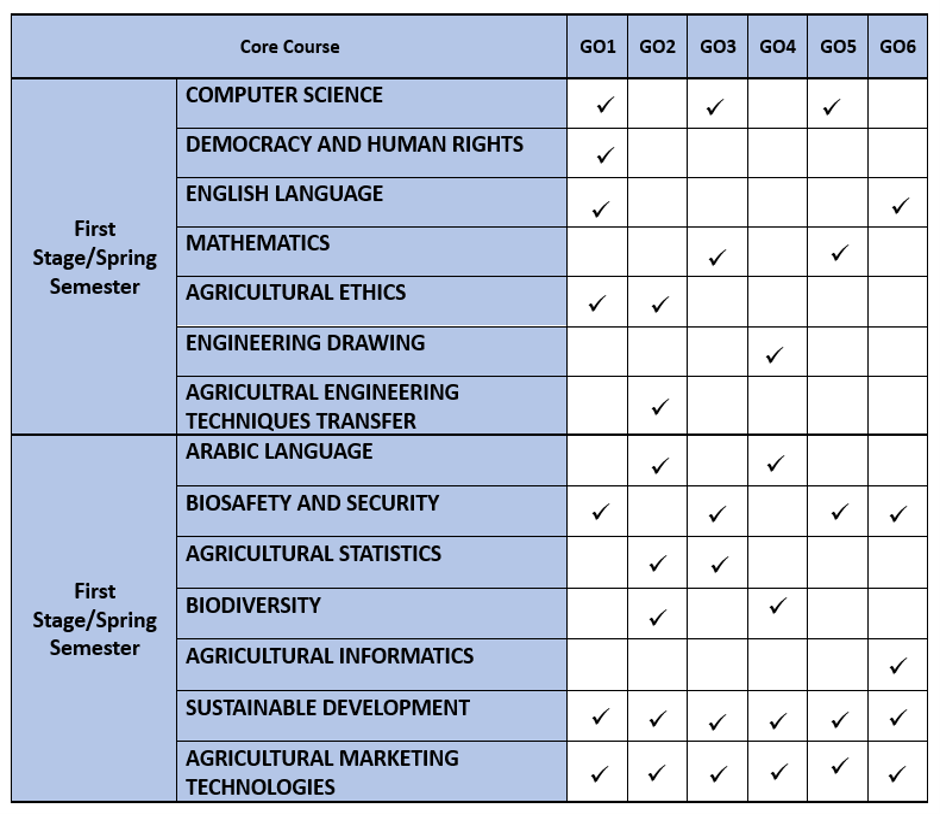
The program’s learning outcomes are achieved through a comprehensive curriculum in Soil science and water resources, integrating theoretical and applied aspects with practical training. The table below illustrates the alignment of the core courses with the program’s learning outcomes, demonstrating each course’s contribution to developing the knowledge, skills, and professional competencies that graduates are expected to acquire, enabling them to work effectively and competently in the fields of Soil science and water resources.
Graduates with a Bachelor of Science degree in Soil Science and Water Resources possess a comprehensive set of academic knowledge, field skills, and technical expertise that equips them to address the challenges of food and water security. The most prominent of these qualifications specialize in the following areas:
- Scientific and Specialized Qualifications
Land Management and Reclamation: Addressing physical and chemical soil problems such as salinity, alkalinity, and waterlogging, and developing fertilization and plant nutrition programs.
Water Resources Management: Planning and designing modern irrigation networks (drip and sprinkler irrigation), and designing agricultural drainage networks to improve water use efficiency and minimize waste.
Quality Testing and Evaluation: Conducting chemical, physical, and biological analyses of soil and water to determine their suitability for agriculture or other uses.
- Technical and Analytical Qualifications
GIS and Remote Sensing Technologies: Digital soil mapping, monitoring changes in vegetation cover and available water resources, and identifying areas of erosion and salinization using Geographic Information System (GIS) software. Laboratory Analysis: Proficiency in operating laboratory equipment to measure pollution levels, micro- and macro-elements, and chemical and heavy metal contaminants in soil and water.
Environmental Modeling and Data: Use of statistical and predictive simulation software to study groundwater movement and fluid flow within the soil profile.
- Environmental and Sustainable Qualifications
Environmental Impact Assessment (EIA): Preparation of environmental impact assessment studies for agricultural, engineering, and industrial projects on soil and water resources.
Combating Desertification and Erosion: Application of soil conservation strategies against water and wind erosion, and management of arid and semi-arid lands.
Water Treatment and Reuse: Overseeing agricultural and sanitary wastewater treatment and recycling technologies for sustainable irrigation.
- Field and Management Skills
Field Surveying and On-Site Service: Conducting geomorphological surveys and collecting representative samples according to standard protocols.
Providing Technical Consulting: Providing scientific solutions to farmers, institutions, and companies regarding the optimal use of land and water and the application of sustainable agricultural practices.
The Bachelor of Science in Horticulture program enables its graduates to pursue postgraduate studies and enhance their career development and specialization in a number of related fields, most notably:
Postgraduate Studies
Higher Diploma in Soil science and water resources
Master’s Degree in Soil science and water resources
PhD in Soil science and water resources.
Under the Bologna Process framework adopted in academic departments, the evaluation system in the Department of Soil Science and Water Resources relies on a balanced, student-centered continuous learning model. The final grade (100%) is distributed as follows:
Semester Work (50%):
Formative Assessment (40%): (continuous evaluation throughout the semester).
Mid-Term Exam (10%): (mid-semester summative evaluation).
Final Summative Exam (50%): (held at the end of the semester).
Operating effectively under this distribution requires specific specialized, technical, and organizational qualifications from both students and faculty members:
- Key Student Qualifications and Skills
- Formative Assessment Qualifications (40% Continuous Weight)
Since continuous assessment carries the largest share of the semester work, students must demonstrate:
Technical and Laboratory Documentation: The ability to prepare and format comprehensive lab and field reports (e.g., soil physical and chemical analysis, irrigation water quality assessments, and field sample evaluations).
Practical and Field Application: Hands-on execution in department laboratories and field trips (e.g., soil profile description, soil and water sampling, and operating GIS and GPS devices).
Assignment and Task Execution: Punctual submission of quantitative problem sets involving fertilization program design, crop water requirement calculations, and groundwater hydrology.
Academic Presentations and Projects: Proficiency in designing and delivering presentations and mini-projects addressing environmental issues like soil salinity, desertification, and erosion severity.
- Summative Assessment Qualifications (10% Mid-Term + 50% Final Exam)
Conceptual and Analytical Understanding: The ability to connect theoretical knowledge with practical applications and respond effectively to exam questions aligned with targeted Learning Outcomes (LOs).
Time Management and Precision: Solving mathematical problems related to irrigation and drainage system design and soil-water movement equations accurately under time constraints.
- Workload Management and Academic Commitment (ECTS Workload)
Student Workload Management: Organizing independent study hours outside the classroom (reading, report writing, and research) to satisfy the ECTS workload requirements of each module.
Attendance Compliance: High commitment to attending theoretical lectures and practical sessions, as Bologna Process regulations mandate exam debarment if unexcused absences exceed the permitted threshold (typically 15%).
- Key Faculty and Examination Committee Qualifications
Formulating Learning Outcomes (LOs) and Assessment Design: The ability to design continuous evaluation tools (quizzes, reports, assignments) and structure the 40% formative weight to measure all targeted course Learning Outcomes accurately.
Providing Continuous Feedback: Constructively grading and returning lab reports and field assignments with actionable feedback, enabling students to enhance their performance prior to the 50% final exam.
Digital Documentation and Grade Management: Proficiency in using Learning Management Systems (e.g., Moodle) or digital Bologna platforms to transparently record and publish formative (40%) and mid-term (10%) grades before final exams begin.
The Soil Science and Water Resources program adheres to the approved guidelines for examinations, assessment, and grading issued by the Ministry of Higher Education and Scientific Research and the University of Mosul. Student performance is measured through a comprehensive and diverse range of continuous and summative assessment methods to ensure the achievement of targeted learning outcomes. These methods include:
(Daily quizzes, assignments, and classroom and extracurricular activities)
- Midterm exams for the first semester
- Final exams for the spring and fall semesters
- Field and laboratory reports and practical assessments
- Graduation projects and coursework
Summer training.
Under the Bologna Process framework, the graduation requirements for obtaining a Bachelor of Science in Soil Science and Water Resources involve fulfilling a standardized set of academic, practical, and organizational criteria distributed over 4 academic years (8 semesters):
- Fulfillment of Academic Workload Units (240 ECTS)
Total Credits: Students must successfully complete 240 ECTS credits, equivalent to 30 ECTS per semester.
Student Workload Hours: Each ECTS credit corresponds to 25 to 30 actual learning hours, which include scheduled hours (theoretical lectures and laboratory sessions) and unscheduled hours (independent study, soil/water report preparation, and coursework assignments).
- Coursework and Module Completion
Core Modules: Passing all specialized courses within the discipline, including:
Soil Science: Soil Chemistry, Soil Physics, Soil Fertility & Fertilization, Soil Survey & Classification, and Reclamation of Salt-Affected and Waterlogged Soils.
Water Resources & Irrigation: Surface & Groundwater Hydrology, Agricultural Irrigation & Drainage Engineering, Water Quality Management, and GIS & Remote Sensing Applications.
General & Supporting Modules: Satisfying college and university requirements (e.g., Biostatistics, Computer Science, and Technical English).
Prerequisites: Adhering to course sequence requirements; passing foundational prerequisite courses (e.g., General Soil Chemistry) is required before enrolling in advanced modules (e.g., Soil Fertility and Fertilization).
- Completion of the Graduation Research Project
Timeline: Executed during the final academic year (Semesters 7 and 8).
Research Scope: Conducting applied field or laboratory research focused on addressing a real-world environmental or agricultural issue (e.g., assessing irrigation water contamination, evaluating drip system efficiency, or managing calcareous/saline soils).
Assessment: The project carries a designated ECTS weight and is evaluated through a written practical thesis and a public defense before a departmental scientific committee.
- Summer / Field Practical Training
Timing: Typically conducted during the summer break following the third academic year.
Training Environment: Practical training in agricultural research centers, water resource directorates, or public/private soil and water testing laboratories.
Assessment: Students must submit a field logbook and a comprehensive technical report detailing acquired skills to earn the designated ECTS credits.
- Passing Criteria and Academic Regulations
Minimum Passing Grade: Achieving a score of at least 50% in each module (distributed between formative assessments and summative exams).
Cumulative Grade Point Average (CGPA): The final CGPA is calculated based on the weighted ECTS credits of each module across all semesters.
Attendance Requirements: Maintaining a minimum attendance rate of 85% in theoretical lectures, field exercises, and laboratory sessions. Exceeding the maximum allowed absence threshold (15%) leads to exam debarment and loss of module credits.
- Issuance of the Diploma Supplement
Upon fulfilling all the above requirements, the graduate receives the official Diploma Supplement in both Arabic and English alongside the degree certificate. This document details:
A comprehensive record of all completed modules and earned ECTS credits.
The specific field and laboratory competencies acquired by the graduate.
An explanation of the educational framework, facilitating international degree recognition, postgraduate admissions, and global employment opportunities.
Under the Bologna Process framework and modern international academic standards, the study mode for the Bachelor of Science in Soil Science and Water Resources is designed to shift the learning process from traditional passive instruction to an interactive, skill-based, and field-oriented educational environment.
Here is a comprehensive breakdown of the components of this study mode:
- Full-Time Study Mode and Duration
Academic Commitment: The program requires full-time dedication over 4 academic years (8 semesters), with a structured weekly workload covering lectures, practical sessions, laboratory work, and field activities.
Curricular Progression: The curriculum progresses systematically. The first and second years focus on foundational and supporting sciences (Chemistry, Geology, Biology, Statistics, and Computer Skills), while the third and fourth years concentrate on advanced specialized disciplines (Soil Physics, Soil Chemistry, Soil Survey, Water Hydrology, Remote Sensing, and Irrigation & Drainage Engineering).
- Credit Accumulation and Transfer System (240 ECTS)
Credit Allocation: The program comprises 240 ECTS credits, evenly distributed at 30 ECTS per semester (60 ECTS per academic year).
Measuring Student Workload: This system measures the total human effort required for learning, rather than just classroom contact hours.
Each 1 ECTS credit corresponds to 25 to 30 actual workload hours.
The total effort required for the entire degree ranges between 6,000 and 7,200 hours, combining scheduled lectures, practical sessions, laboratory work, and independent self-study.
International Recognition: This framework ensures international qualification recognition and enables seamless credit transfer if students transfer to another institution or pursue global postgraduate studies.
- Student-Centered Learning Approach
Redefined Instructor Role: Faculty members transition from traditional “sole lecturers” to “academic facilitators and mentors.”
Self-Directed Responsibility: Students take primary ownership of their learning journey by conducting research, analyzing datasets, engaging in independent study, and preparing technical reports beyond classroom hours.
Critical Thinking: The methodology emphasizes fostering problem-solving skills and critical thinking to tackle real-world soil and water challenges rather than relying on rote memorization.
- Integration of Educational Methodologies and Applications
The educational framework integrates four core pedagogical pillars:
- Theoretical Lectures
Provide the conceptual foundation required to understand soil genesis, fluid dynamics within the soil matrix, environmental chemistry, and the hydraulics of surface and groundwater systems.
- Laboratory Experiments
Hands-on practical sessions conducted in specialized departmental laboratories, including:
Physical Analyses: Soil texture, bulk density, and water retention capacity.
Chemical Analyses: Soil pH, Electrical Conductivity (EC), nutrient availability, and contaminants.
Water Quality Assessment: Testing irrigation and drainage water parameters.
- Fieldwork and Practical Training
Because soil and water resources are inherently field-based sciences, the study mode incorporates:
Excavating, describing, and classifying soil profiles in situ.
Standardized field sampling of soil and water for laboratory testing.
Operating field survey instruments and spatial mapping tools (GPS & GIS).
Technical site visits to hydraulic structures (dams, irrigation networks, and water treatment plants).
- Project-Based Learning (PBL)
Students execute individual and collaborative mini-projects throughout their studies, culminating in their Final Graduation Research Project. Examples include:
Evaluating land degradation status and formulating reclamation strategies.
Designing drip irrigation systems based on crop evapotranspiration and water requirement calculations.
Managing soil salinization issues or assessing water pollution in specific geographical basins.
- Learning Outcomes and Added Value
This integrated study mode ensures that graduates leave the university not merely with theoretical knowledge, but as field-ready specialists and executive practitioners. They are equipped to enter the job market directly—whether in water resources directorates, agricultural research centers, land reclamation companies, or commercial agricultural enterprises—with high readiness to tackle water scarcity and soil degradation challenges.
Mohammed Ayad Harbawi | PhD in Soil Science and Water Resources | Lecturer
Email: [email protected]
Phone Number: +9647704115346