BP – Department of Agricultural Machinery and Equipment
Bologna Process

Department of Agricultural Machinery and Equipment
The Department of Agricultural Machines and Equipment is an academic specialization that focuses on the study of agricultural machinery, including its design, management, and maintenance. This field aims to develop scientific knowledge and technical skills related to agricultural machinery and its diverse applications—environmental, economic, and social.
It typically covers a wide range of topics, such as:
- Design of Agricultural Machinery: Understanding design principles to ensure machine effectiveness and efficiency.
- Maintenance and Repair: Learning techniques to maintain equipment and ensure optimal operation.
- Sustainable Development: Utilizing agricultural machinery in ways that contribute to environmental protection.
- Production Technologies: Implementing modern technologies, such as automation, to enhance productivity.
- Resource Management: Ensuring the efficient use of natural resources in agriculture.
In Level 1, students are introduced to the fundamentals of agricultural sciences in general, and to Agricultural Machines and Equipment sciences in particular. The curriculum is designed to support progression within the global agricultural and forestry program group. Core topics specific to the program are introduced in Level 2, laying the foundation for research-led modules in Levels 3 and 4. As a result, graduates are trained to understand how research informs education, aligning with the mission statements of both the university and the college.
In Levels 2, 3, and 4, students have the flexibility to choose more than half of their module credits. They are encouraged to select a diverse range of modules that reflect their specialization and include complementary scientific disciplines. This ensures that graduates acquire a broad knowledge base and can pursue a variety of interests within the field of Agricultural Machines and Equipment. Module selection is done in consultation with personal academic tutors.
The concept of research is introduced early and reinforced throughout the program via practical training. This is integrated into lecture modules or delivered through dedicated practical sessions, research seminars, and specialized tutorials. In Level 4, all students complete an independent research project. This may be a library-based or data analysis project, or a field or laboratory-based project, each carrying a specific number of academic credits.
Academic tutorials in Levels 1 and 2 are conducted with the same academic tutor, who also serves as the students’ personal tutor, providing continuity and consistent guidance. These tutorials include workshops on essential academic skills—such as library use and presentation skills—followed by assessed activities like essays and presentations, allowing students to apply these skills in a subject-specific context. Opportunities for international study years and industrial placements are also available. Individual needs are discussed with the relevant tutor and accommodated whenever possible.
| Programmer code: | BSc-AME. SC. | ECTS | 240 |
| Duration: | 4 levels, 8 Semesters | Method of Attendance: | Full Time |
For more details, please visit the following link: Department of Agricultural Machines and Equipment
- Technical Development:
Provide the students with skills in designing, operating, and maintaining agricultural machinery using state-of-the-art smart agricultural technologies. - Sustainability Enhancement:
Integrate concepts of sustainable agriculture and energy efficiency into the academic curriculum. - Labor Market Adaptability:
Prepare graduates to effectively function in interdisciplinary environments that encompass agricultural engineering and technology. - Innovation and Research:
Promote applied research in areas such as agricultural process automation and renewable energy. - International Collaboration:
Support student and academic exchange programs with European and global universities through joint agreements aimed at enhancing academic and cognitive skills.
For more details, please visit the following link: Course Description Guid 2025-2026 , Academic Program Description 2025-2026 and Vision, Mission, and Goals – Department of of Agricultural Machines and Equipment
Upon successful completion of the program requirements, graduates are awarded the Bachelor of Science (B.Sc.) degree in Agricultural Machines and Equipment by the University of Mosul.
The program is classified at Level 4 in accordance with the regulations and guidelines of the Ministry of Higher Education and Scientific Research (MOHESR).
Admission to the Bachelor of Science (B.Sc.) in Agricultural Machines and Equipment program is governed by the regulations and admission policies of the Ministry of Higher Education and Scientific Research (MOHESR) and the University of Mosul. Applicants must meet the approved admission criteria for College of Agriculture and Forestry programs.
To be awarded the Bachelor of Science (B.Sc.) in Agricultural Machines and Equipment, students must successfully satisfy all graduation requirements, including:
- Successful completion of all 240 ECTS credits, including all compulsory and elective courses specified in the curriculum.
- Achievement of the minimum graduation requirements in accordance with the regulations of the Ministry of Higher Education and Scientific Research (MOHESR) and the University of Mosul.
- Successful completion of all required laboratory work, field training, and other practical components of the program, where applicable.
- Compliance with all academic regulations governing assessment, progression, and graduation as approved by the Ministry of Higher Education and Scientific Research (MOHESR) and the University of Mosul.
For more details, please visit the following link: Program-Catalogue-2025-2026-1.pdf
Recognition of Prior Learning (RPL) and transfer of academic credits are considered only in cases of student transfer or course equivalency, in accordance with the regulations and instructions of the Ministry of Higher Education and Scientific Research (MOHESR) and the University of Mosul.
Upon successful completion of the Bachelor of Science (B.Sc.) in Agricultural Machines and Equipment program, graduates are expected to achieve the following Program Learning Outcomes (PLOs) or Graduate Outcomes (GOs), which describe the knowledge, skills, and professional competencies required upon graduation:
Outcome 1: Graduates will be able to apply engineering principles, modern tools, and techniques to design systems, components, devices, or products that meet specific needs in the field of agricultural engineering. This includes considering realistic constraints and conditions, effectively analyzing and solving complex engineering problems, and applying modern technological information in line with advancements in agricultural machinery engineering.
Outcome 2: Graduates will be able to communicate effectively within multidisciplinary teams, work independently when needed, and interact using a foreign language at a beginner level. They will also be able to prepare clear and effective reports and presentations, explain written and oral instructions, and apply them accurately in professional contexts.
Outcome 3: Laboratory and Field Studies– Graduates will be able to carry out the steps of experimental design and execution, conduct field studies, and collect, analyze, and interpret data in order to investigate complex problems or research issues specific to agricultural machinery engineering and technology.
Outcome 4: Scientific Knowledge– Graduates will be able to use mathematics, science, agricultural machinery engineering, and engineering technologies to solve complex engineering problems and apply both theoretical and practical knowledge effectively. They will also be familiar with business practices such as project, risk, and change management, and develop awareness of entrepreneurship, innovation, and sustainable development. Additionally, they will understand the impact of engineering practices on health, environment, and safety within global and social contexts, and be aware of the legal consequences of engineering solutions.
Outcome 5: Data Analysis– Graduates will master the skills required to work independently in mathematics-related areas within their agricultural field and to serve as consultants, auditors, or experts.
Outcome 6: Critical Thinking– Graduates will recognize the importance of continuous learning and adopt lifelong learning practices. They will stay up to date with scientific, technological, and societal developments both locally and globally, contribute to project development, and provide innovative and effective solutions. Additionally, they will act responsibly and in accordance with ethical principles and professional standards in agricultural engineering practices.
The academic program in the Department of Agricultural Machinery and Equipment is dedicated to developing qualified human resources and strengthening scientific competencies toward earning a bachelor’s degree in this field. The department emphasizes the integration of theoretical instruction and practical application whenever possible, aiming to bridge the gap between academic knowledge and real-world practices. To this end, the department offers well-equipped laboratories and training fields that enable students to refine their technical skills and gain hands-on experience. Special focus is given to fieldwork and mandatory summer training programs to ensure that graduates are well-prepared for the demands of the agricultural machinery sector. By the end of the program, the student is expected to be able to:
| No. | Learning Outcome Code | Learning Outcomes |
| 1 | LO#1, B1 | Applies engineering principles to design a system using modern methods, or to develop a component, device, or product that meets specific requirements in agricultural engineering, while considering practical limitations and real-world conditions — in other words, by evaluating all available options and the current state of the field. |
| 2 | LO#1, B2 | Applies modern tools and techniques necessary for analyzing complex engineering problems in agricultural machinery applications and related engineering technologies, while effectively utilizing technological information. |
| 3 | LO#2, D1 | Communicates effectively within multidisciplinary teams; demonstrates the ability to work independently and as part of a team with colleagues in a foreign language at a basic level. |
| 4 | LO#2, D2 | Demonstrates how to write effective reports in the field, write comprehensible documents, prepare effective presentations, and deliver clear written and oral instructions. |
| 5 | LO#3, C1 | Implements the steps of designing and conducting experiments, carrying out field studies, collecting and analyzing data to examine complex problems or research issues related to the specialization in agricultural machinery engineering. |
| 6 | LO#4, A1 | Uses mathematics, science, agricultural machinery engineering, and engineering technologies to solve complex engineering problems; acquires the ability to apply theoretical and practical knowledge in these fields to engineering challenges. |
| 7 | LO#4, A2 | Identifies business practices related to the field, such as project management, risk management, and change management; is aware of entrepreneurship and innovation; and gains knowledge about sustainable development. |
| 8 | LO#4, A3 | Recognizes the impacts of engineering practices on health, environment, and safety in global and social dimensions, and is aware of the legal consequences of engineering solutions. |
| 9 | LO#5, B3 | Masters the skills necessary for working independently in areas related to mathematics in the field, and for acting as a consultant, auditor, or expert. |
| 10 | LO#6, E1 | Understands the importance of following events and developments on the social and global agenda, monitors these developments, prepares and produces projects, and proposes solutions. |
| 11 | LO#6, E2 | Takes responsibility for acting in accordance with ethical principles and professional standards applicable to engineering practices. |
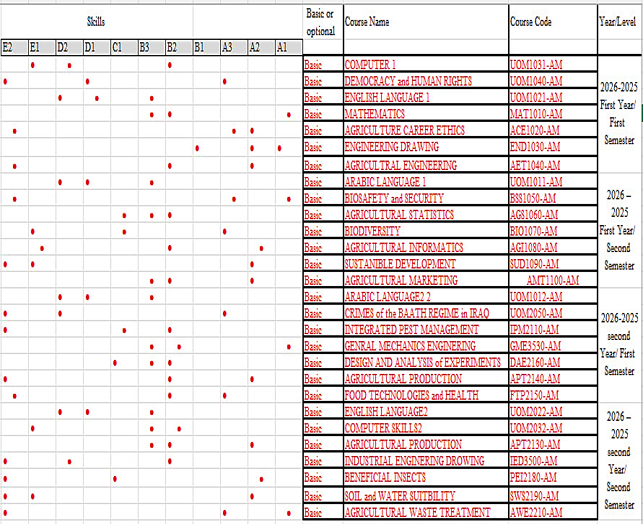
The Program Learning Outcomes (PLOs) are achieved through the integrated delivery of the Agricultural Machines and Equipment curriculum. The following matrix presents the alignment between the core courses and the Program Learning Outcomes (PLOs), demonstrating how each course contributes to the development of the knowledge, skills, and professional competencies expected of graduates.
Graduates of the Bachelor of Science (B.Sc.) in Agricultural Machines and Equipment are qualified to pursue professional careers in a wide range of public and private sectors, including:
- Agricultural machinery manufacturing and design companies.
- Agricultural contracting and service companies.
- Government agencies, including ministries of agriculture, irrigation, and public works.
- Farming and agribusiness enterprises.
- Food processing and post-harvest handling industries.
- Renewable energy and sustainable agriculture sectors.
- Project management, construction supervision, and quality assurance organizations.
- Governmental and private institutions that require agricultural engineering expertise.
- Universities, research centers, and higher education institutions following the completion of postgraduate studies.
Graduates of the Bachelor of Science (B.Sc.) in Agricultural Machines and Equipment may pursue postgraduate studies and professional development opportunities in the following areas:
Postgraduate Studies
- Master’s degree in Agricultural Mechanization.
- Master’s degree in Agricultural Machinery Engineering.
- Master’s degree in Renewable Energy and Sustainable Agriculture.
- Doctor of Philosophy (Ph.D.) in Agricultural Machines and Equipment or any of its specializations.
Professional Development
- Professional certification programs in agricultural machinery management.
- Professional training in engineering software, including AutoCAD and other specialized agricultural engineering applications.
- Training in project planning and management.
The Agricultural Machines and Equipment Program adopts the examination, assessment, and grading regulations approved by the Ministry of Higher Education and Scientific Research (MOHESR) and the University of Mosul. Student performance is assessed through a variety of continuous and summative assessment methods, including:
- Continuous assessment (quizzes, assignments, and classroom activities).
- Midterm examinations.
- Final examinations.
- Laboratory reports and practical assessments.
- Engineering design projects and coursework.
- Summer training.
- Oral presentations and seminars.
- Graduation project assessment.
- Compliance with academic integrity regulations and institutional policies regarding academic misconduct, cheating, and plagiarism.
To be eligible for the award of the Bachelor of Science (B.Sc.) in Agricultural Machines and Equipment, students must successfully fulfill all graduation requirements in accordance with the regulations of the Ministry of Higher Education and Scientific Research (MOHESR) and the University of Mosul, including:
- Successful completion of all 240 ECTS credits and all compulsory and elective courses specified in the curriculum.
- Achievement of the minimum graduation requirements, including the required cumulative Grade Point Average (GPA), in accordance with the applicable regulations.
- Successful completion of the graduation project and all required laboratory, practical, and summer training components.
- Fulfillment of all academic and administrative requirements for the award of the bachelor’s degree.
The Bachelor of Science (B.Sc.) in Agricultural Machines and Equipment is a four-year, full-time undergraduate program delivered in accordance with the Bologna Process and comprising 240 ECTS credits. The program adopts a student-centered learning approach that integrates theoretical lectures, laboratory experiments, practical applications, engineering design, field training, and project-based learning. Students are trained to utilize industry-standard software for computer-aided design and other specialized engineering applications. These learning activities are further supported by seminars, technical workshops, and practical training to enhance students’ technical competence, digital skills, and readiness for professional engineering practice.
Program Coordinator of the Bachelor of Science (B.Sc.) in Agricultural Machines and Equipment
The Program Coordinator is responsible for the overall coordination, implementation, and continuous improvement of the Bachelor of Science (B.Sc.) in Agricultural Machines and Equipment program. The role includes overseeing the implementation of the curriculum, monitoring the achievement of the Graduate Outcomes, coordinating academic activities among faculty members and students, supervising laboratory and field training activities, and ensuring alignment with the University of Mosul’s quality assurance policies, the Ministry of Higher Education and Scientific Research (MOHESR) regulations, and program accreditation requirements. The Program Coordinator also supports curriculum review and enhancement to ensure that the program remains responsive to advances in agricultural engineering, industry needs, and emerging technologies.
Programmer Coordinator
Ghazwan Ahmed Dahham | MSc in Agricultural Machinery and Equipment | Assistant Professor
Mobile no.: +964 7710251949